
Is Europass Actually Good?
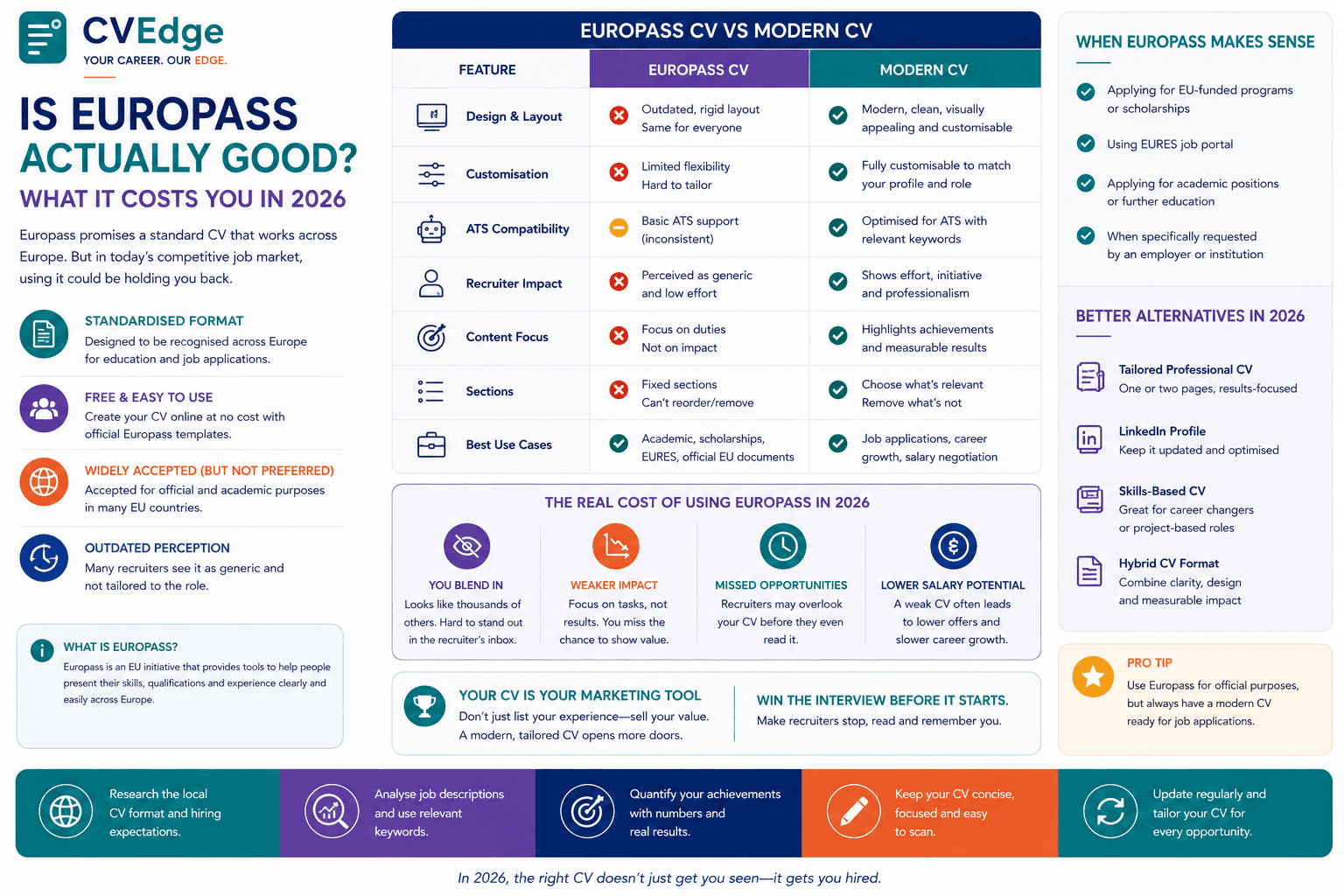
Europass is the European Union's official CV format, available free through the Europass platform. It is standardised, multilingual, recognised across member states, and genuinely useful in some situations.
It is also, for most private-sector applications, the wrong choice. Here is the honest breakdown.
Whatever format you land on, check what a parser extracts from it with our free ATS Resume Checker.
Where Europass Genuinely Helps
EU institutions and public bodies. Applications to the European Commission, EU agencies, and many national public-sector bodies either request Europass or are read by people who work with it daily. Use it where it is asked for.
Academic mobility and funded programmes. Erasmus+, research mobility schemes and many grant applications specify it.
Cross-border credential clarity. Europass pairs with the European Qualifications Framework, which lets you express a qualification in terms another member state can interpret. If you hold a qualification from one country and are applying in another, that mapping is real value.
Language self-assessment. The CEFR-based language grid is the European standard and is clearer than free-text claims. This part of Europass is worth using even if you abandon the rest of the template.
Where Europass Costs You
It looks like everyone else's. The format is fixed, which is the point, and the consequence is that every Europass CV in a stack looks identical. A recruiter reviewing forty applications is skimming for differentiation, and a standard template makes that harder rather than easier. Some private-sector recruiters have developed an active aversion to it, associating it with unfocused mass applications.
The layout is two-column. The classic Europass renders a narrow left column of labels against a right column of content. That is exactly the structure that applicant tracking systems handle worst. Reading order can invert, labels can attach to the wrong content, and contact details can end up detached from the name. The current Europass editor produces cleaner output than earlier versions did, but the layout risk is real and you should verify the parse rather than assume it.
It rewards completeness over emphasis. Europass has a field for everything, and the structure encourages filling them. Good CVs are built on selection: what you leave out shapes the reader's attention as much as what you include. A format that nudges you toward comprehensiveness works against that.
It buries achievement. The template's experience section is structured for job description, not outcome. Candidates fill it with duties because the field seems to ask for duties. The result is a document that says what you were responsible for and not what changed.
It is verbose. Europass CVs commonly run three or four pages for a candidate whose experience would fit comfortably on two.
The Practical Rule
Use Europass when an application explicitly asks for it, when you are applying to EU institutions or public bodies, or when qualification equivalence across borders is the central problem you need to solve.
Use a conventional, well-structured single-column CV for essentially every private-sector application in Europe, including in countries where Europass is well known. Match the local convention instead: the German Lebenslauf for Germany, a concise one-to-two page CV for the Netherlands, the local norm in Ireland or Switzerland.
If You Do Use Europass
Make it work harder:
- Rewrite every experience entry as achievement rather than duty. The field will accept it.
- Cut ruthlessly. Leave optional sections empty rather than padding them.
- Keep the language grid; it is the best part of the format.
- Export and then run the file through an ATS check before submitting, so you know what a parser sees.
- Do not submit the same Europass document to twenty employers unchanged. Tailoring matters more than format, and Europass makes tailoring feel unnecessary. It is not.
What to Take From It Even If You Do Not Use It
Two Europass ideas are worth keeping in any European CV:
CEFR language levels. Write "French C1", not "fluent French". Every European recruiter reads that instantly.
Qualification equivalence. If your degree is from outside the country you are applying in, state the EQF level or the local equivalent. It saves the recruiter a judgement call they may get wrong.
Templates That Parse Cleanly
Every layout below is single-column and free to use. Preview and edit any of them in the CVEdge resume builder, or browse all 32 in the template library.
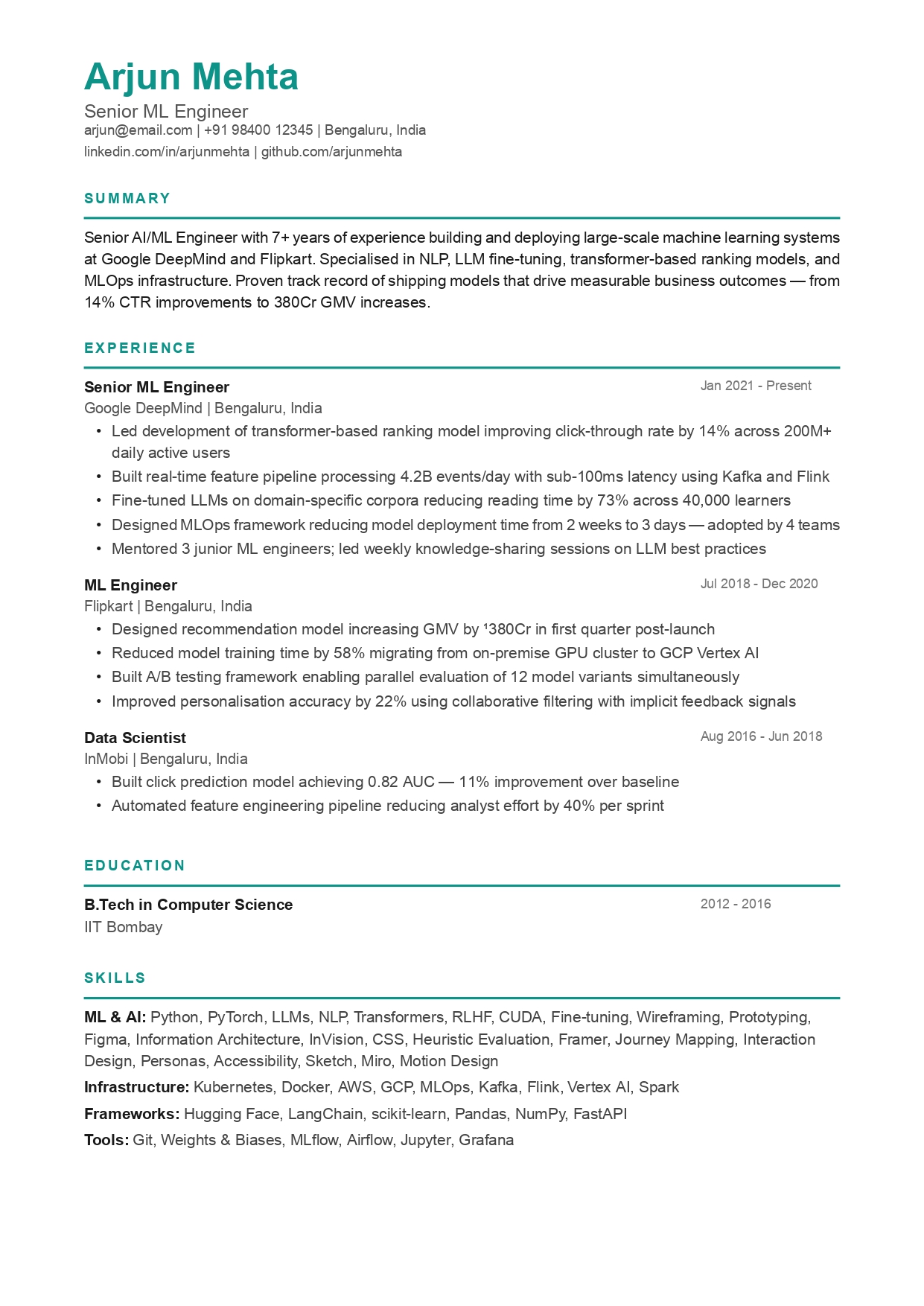
Classic ATS Resume Template: Standard headings, no graphics, parses cleanly through Greenhouse, Workday, Lever and iCIMS. The default if you are unsure.
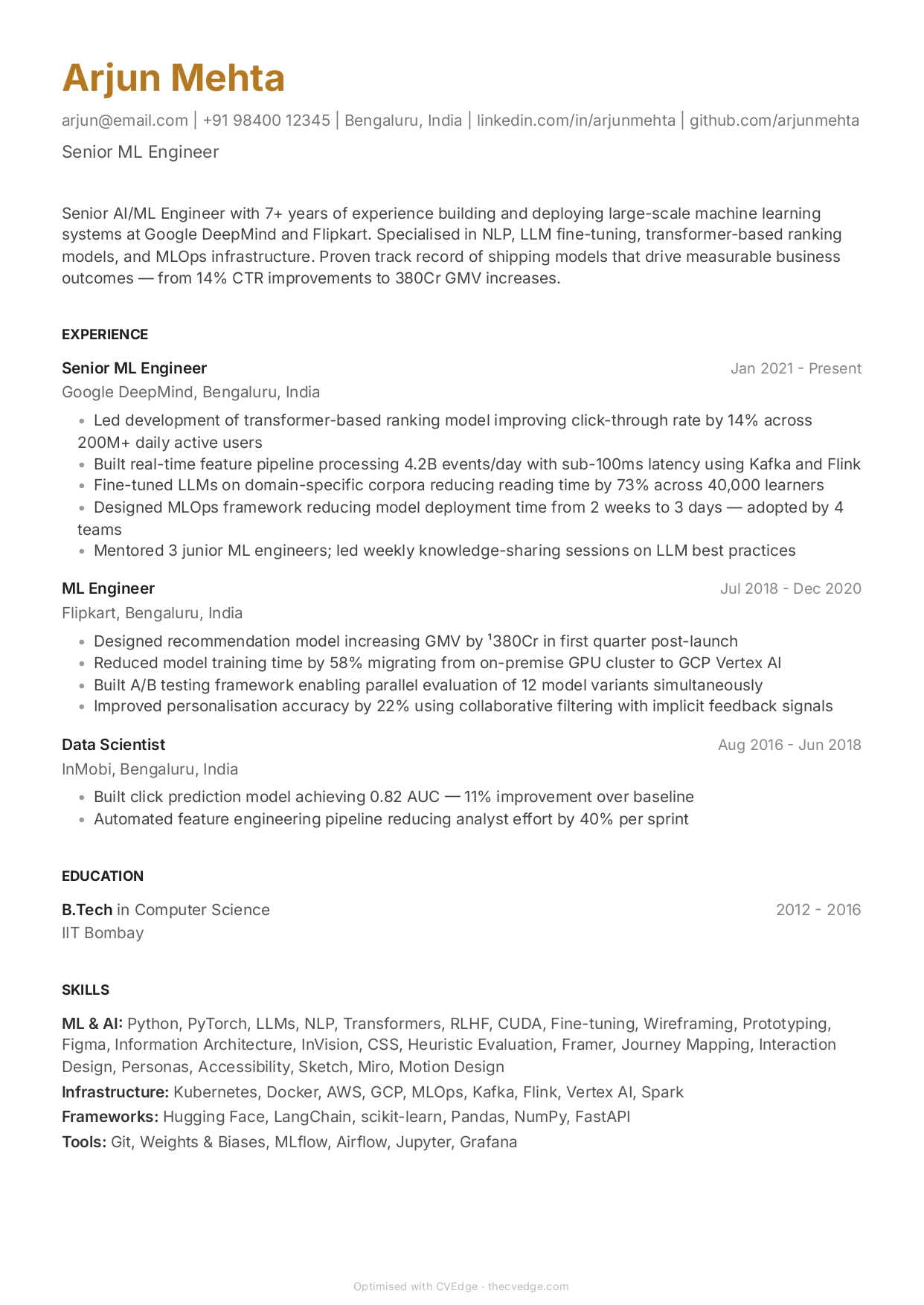
Minimal ATS Resume Template: Maximum content in minimum space, useful when you need to hold a two-page limit without cutting substance.
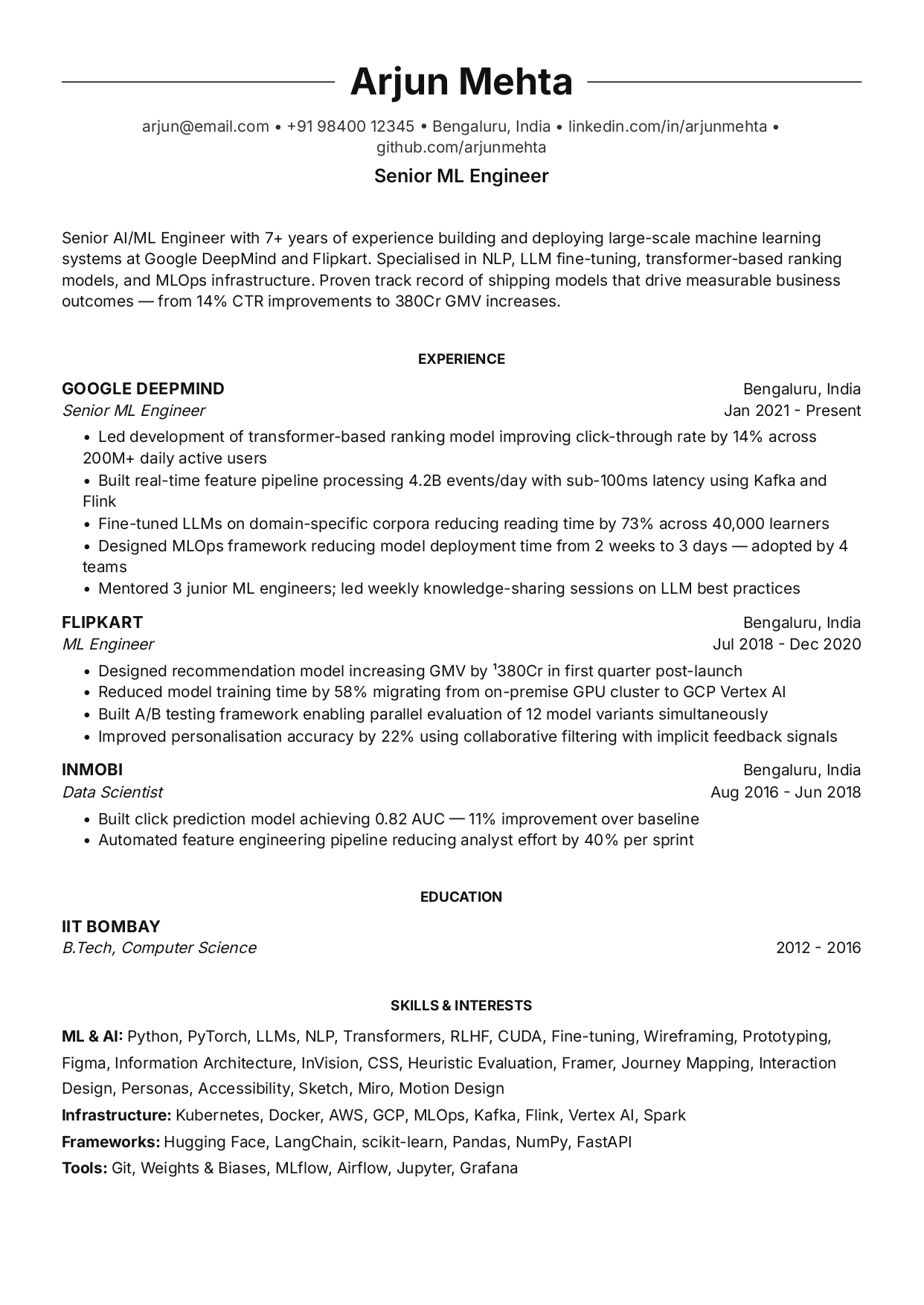
Harvard ATS Resume Template: Single-column, academic-standard layout. The most-viewed template on CVEdge and the safest choice when you do not know which ATS you are up against.
Related Guides
Next Step
Whichever format you choose, check how a parser reads it with our free ATS Resume Checker.