

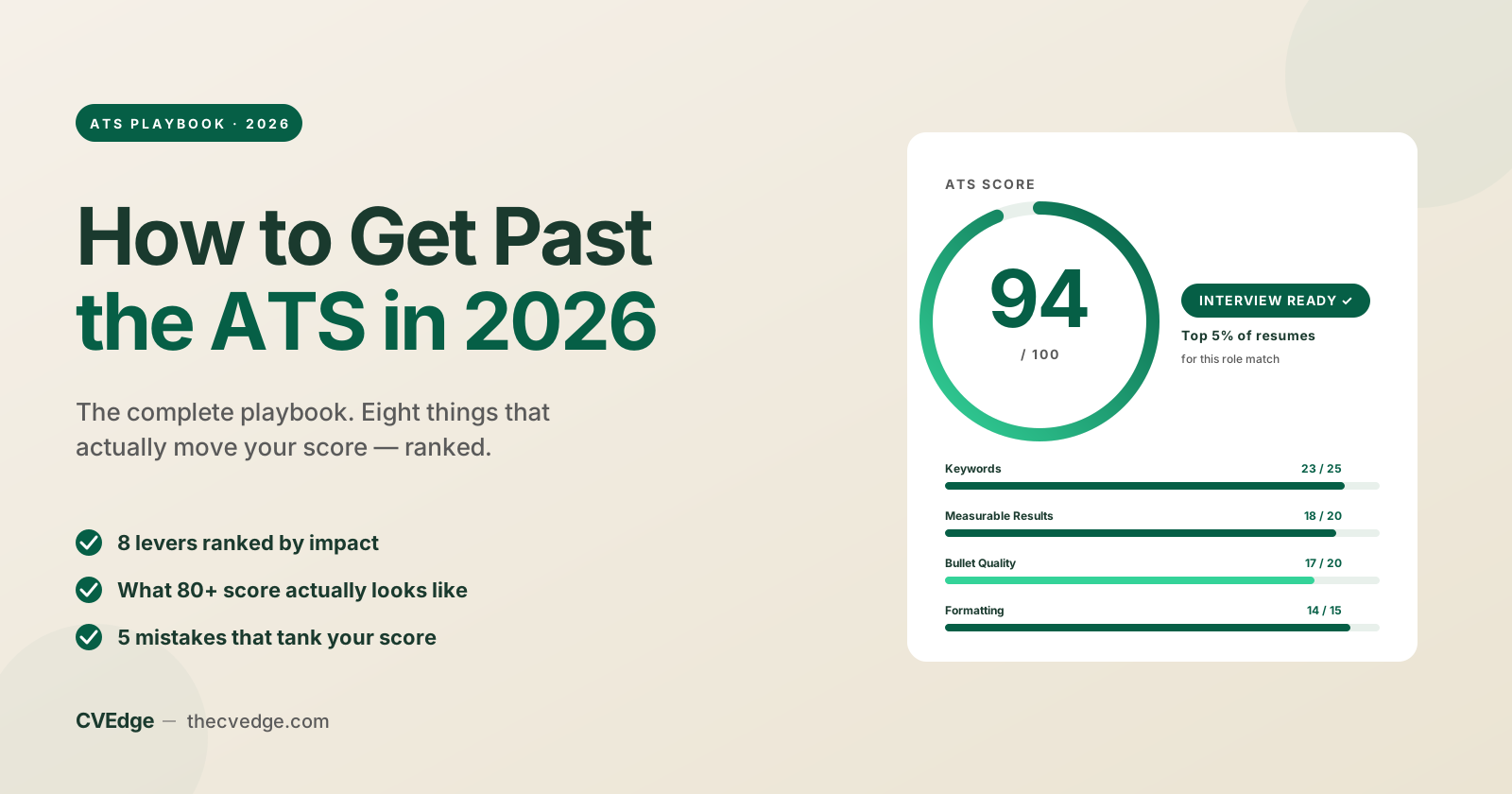
If you've sent 30+ applications and heard back from fewer than 3, the ATS is filtering you out.
Not your experience. Not your education. Not the market.
Applicant Tracking Systems (ATS) score every resume submitted to a major company before any human reads it. Score too low, and your resume is functionally invisible — even if you're objectively qualified for the role.
This is the complete playbook for getting past the ATS in 2026. No fluff. Just the eight things that actually move the score.
How ATS Scoring Actually Works
Most articles get this wrong. Here's how it really works in 2026.
When you submit your resume through a portal (Workday, Greenhouse, Lever, iCIMS, Taleo), the system:
- Parses your resume — extracts text, identifies sections, pulls out structured data (job titles, dates, skills, education)
- Compares against the job description — looks for keyword matches, skill alignment, experience scope
- Scores you across categories — keywords, formatting, sections, measurable outcomes
- Ranks you against other candidates — only the top 10-20% are surfaced to recruiters
If you fail at step 1 (parsing), nothing else matters. Your resume is a blob of unrecognised text.
If you score below ~70 at step 3, you're filtered out before any human sees you.
The 8 Things That Move ATS Score
Ranked by impact, based on scoring thousands of resumes through CVEdge.
1. Keyword Alignment with the Job Description (~25% of score)
This is the single biggest lever.
ATS systems search for specific terms from the job description — exact role titles, hard skills, tools, certifications. If your resume doesn't contain them, you don't match.
The fix: Read the job description. Identify the 15-20 most-mentioned hard skills, tools, and exact role titles. Add the ones that match your real experience to your skills section and weave them into bullets naturally.
Important: Don't keyword-stuff. ATS systems penalise resumes where keywords appear without context. The keyword "Python" needs to be near "built", "scripted", "automated" — not just listed in isolation.
2. Measurable Outcomes (~20% of score)
ATS systems detect numbers. Bullets with metrics — percentages, dollar amounts, user counts, time saved — score significantly higher than vague descriptions.
Weak: Improved sales process and trained the team.
Strong: Redesigned sales process for 12-rep team — increased quota attainment from 62% to 84%, generating $1.8M incremental ARR.
The fix: Every bullet should contain at least one number. If you don't have exact figures, use ranges or estimates ("approximately 30% reduction").
3. Bullet Quality (~20% of score)
Not just any bullet counts. ATS systems specifically look for:
- Strong action verbs at the start (led, drove, scaled, shipped — not "responsible for", "helped with")
- Specificity — named systems, named teams, named outcomes
- Recent and relevant — outcomes from 2024-2025 score higher than 2018
The fix: Read every bullet aloud. If it could describe ten different people in your role, rewrite it.
4. Formatting (~15% of score)
ATS systems are dumb. They can read clean single-column resumes. They cannot read:
- Tables (they get parsed as garbage text)
- Multi-column layouts with sidebars (often read left-to-right across the page, mangling content)
- Text boxes (often skipped entirely)
- Graphics, charts, infographics (invisible to ATS)
- Headers and footers (often ignored or misread)
- Non-standard fonts (replaced with defaults that may break spacing)
The fix: Use a single-column, ATS-tested template. Standard section headings ("Experience", "Education", "Skills" — not "My Journey", "Where I've Made Impact"). Save as PDF.
5. Section Headers (~10% of score)
ATS systems use section headers to identify what's where. Creative section headings break this.
ATS-safe headers:
- Experience / Work Experience / Professional Experience
- Education
- Skills / Technical Skills
- Certifications
- Projects (for early career or career-changers)
ATS-breaking headers:
- "Where I've Made an Impact" (instead of Experience)
- "What I Bring to the Table" (instead of Skills)
- "My Story" (instead of Summary)
The fix: Use boring, standard section headings. The recruiter doesn't care if your headers are creative — and if the ATS misreads your sections, your content is lost.
6. Contact Information Completeness (~5% of score)
ATS systems specifically score whether your resume has:
- Name
- Phone
- Location (city, state/country)
- LinkedIn URL
Missing any of these drops your score. Putting them in a header/footer that ATS can't read also drops it.
The fix: Put contact info as plain text at the top of the resume body — not in a graphic header.
7. Section Completeness (~3% of score)
ATS systems expect five core sections: Contact, Summary, Experience, Education, Skills. Missing any of these (especially Summary) drops your score.
The fix: Include all five. Even if your summary is just three lines, include it.
8. File Format (~2% of score)
PDF parses cleanly across nearly every ATS. .docx parses well but can break with unusual formatting. .pages, .txt, .rtf often fail.
The fix: Always export PDF. Always.
How to Test Your ATS Score Before Applying
The fastest way: paste your resume + the actual job description into CVEdge's ATS scanner.
You'll get:
- A score from 0-100 calibrated against real ATS behaviour
- Category breakdown (keywords, formatting, bullets, etc.)
- Specific missing keywords from the JD
- Specific bullets that need rewriting
Aim for 80+ before applying. Below 70 means you're being filtered out.
What 80+ Looks Like
A resume scoring 80+ has all of the following:
- ✅ 70%+ keyword match with the JD
- ✅ Every bullet has a number, action verb, and outcome
- ✅ Single-column layout, standard section headers
- ✅ All five core sections present
- ✅ Contact info as plain text at the top
- ✅ PDF export with no embedded images
- ✅ Job titles match the role you're applying to (or include both: Senior Software Engineer / Lead Developer)
- ✅ Recent work in last 2 years gets the most detail
If your resume has all of these, you'll consistently score 80+ across most ATS platforms.
The 5 Worst Mistakes That Tank ATS Score
- Pretty Canva templates with sidebars — usually score under 60 even with great content
- Missing the JD's exact role title — applying for "Senior Product Manager" but your resume only says "Lead PM"
- Skills listed only as a tag cloud — ATS wants skills in context (in bullets), not just listed
- All bullets start with "Responsible for" — kills bullet quality score
- Using .docx instead of PDF — small risk, but catches you out at the worst time
The 80+ ATS Guarantee
CVEdge is the only resume tool that guarantees an 80+ ATS score on Pro — or we work with you until you get there.
How it works: if you're a Pro user, ran a Fix All ATS scan, and your score is still below 80 within 14 days of signing up, we manually review your resume and work with you to fix it.
No other resume tool offers this. Most can't, because their scoring isn't calibrated to real ATS behaviour.
The Bottom Line
Getting past the ATS isn't magic. It's eight specific things, ranked by impact:
- Keyword alignment with the JD
- Measurable outcomes in every bullet
- Strong bullet quality
- ATS-safe formatting
- Standard section headers
- Complete contact info
- All five core sections present
- PDF export
Get those right and you'll consistently score 80+. Score 80+ and you'll consistently get interviews — for the first time in months, possibly.
Stop getting rejected by robots.