
Switzerland CV Format
Switzerland has four national languages, a dense concentration of multinational employers, and one of the most document-thorough application cultures in Europe. Getting the CV right matters less than getting the whole package right, and the first decision is not about the CV at all.
Check what a parser reads from your current document with our free ATS Resume Checker.
Decide the Language First
Switzerland is not a single hiring market. It is at least four, and applying in the wrong language is a fast rejection.
- German-speaking cantons: Zurich, Basel, Bern, Zug, St. Gallen and most of the country by population. Apply in German unless the posting is in English.
- French-speaking cantons: Geneva, Vaud, Neuchâtel, Jura and parts of Valais and Fribourg. Apply in French unless the posting is in English.
- Italian-speaking Ticino: apply in Italian.
- International employers: pharma in Basel, banking and commodities in Geneva and Zug, technology and the international organisations. Many operate in English and post in English.
The rule is simple: apply in the language of the job posting. If the posting is in German, a French or English application signals that you did not read it.
Note that Swiss German is spoken but not written. Written applications in the German-speaking cantons use standard High German.
The Application Package
Like Germany, Switzerland expects a complete dossier rather than a CV alone:
- Cover letter (Motivationsschreiben / lettre de motivation)
- CV (Lebenslauf / curriculum vitae)
- Employer references (Arbeitszeugnisse / certificats de travail)
- Diplomas and certificates
- Work permit documentation where applicable
The employer references are the part overseas applicants most often miss. Swiss employers issue formal written references on departure, and Swiss recruiters expect to see them appended. If you come from a country with no equivalent, note that in your cover letter and offer named referees instead, but do not simply omit the section without comment.
Assemble the whole dossier as a single, well-ordered PDF unless the application portal asks for separate files.
The CV Itself
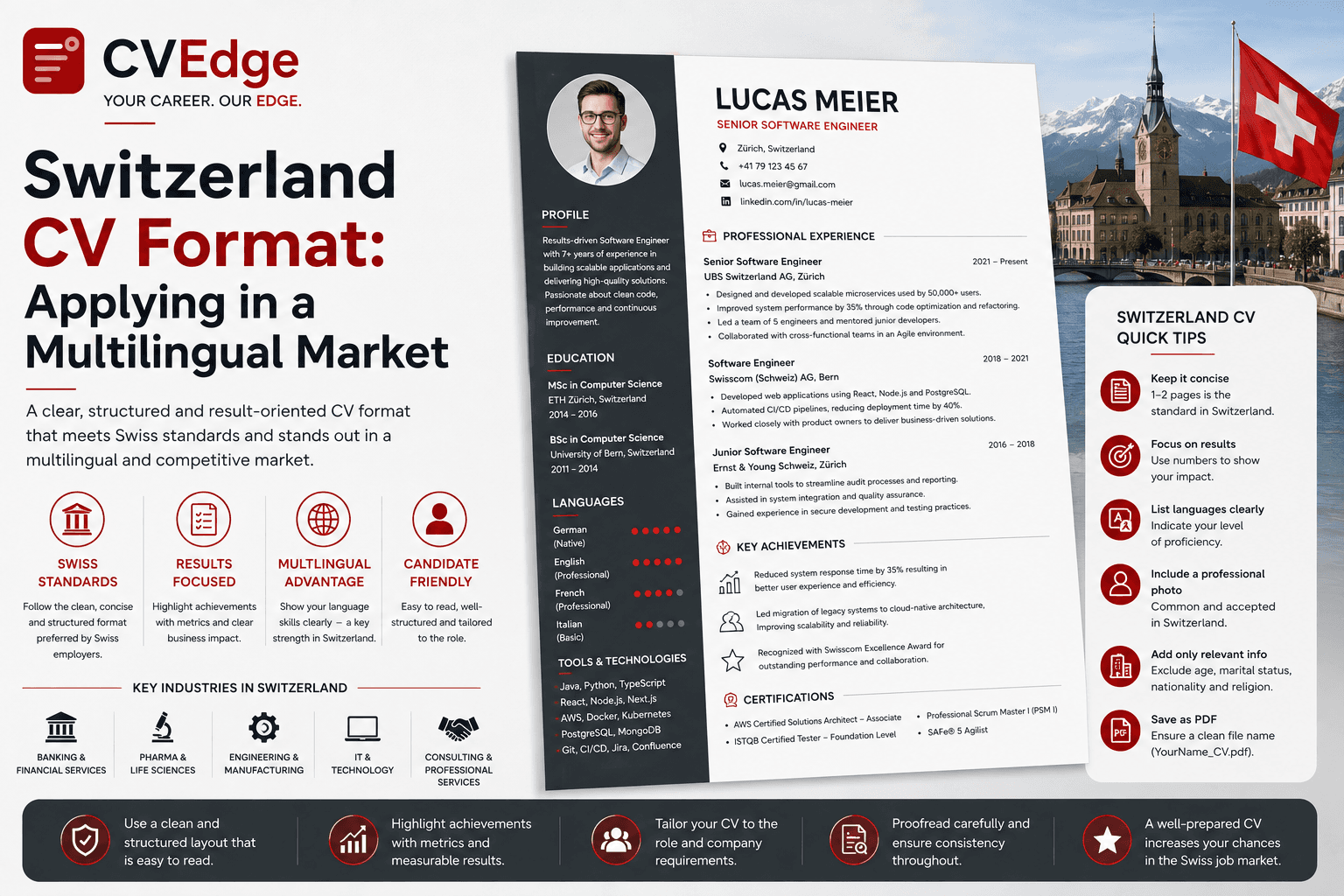
Length. Two to three pages. Switzerland tolerates more detail than the Netherlands and less than an academic CV.
Photograph. Still common and broadly expected, more so than in Germany and considerably more than in the UK or Ireland. A professional headshot is the conventional choice. As always, place it so that it does not force a text-box layout that breaks parsing.
Personal details. Swiss CVs conventionally include more than Anglo ones. Name, address, phone, email, and commonly date of birth and nationality. Marital status appears on some CVs and is optional. Omit religion and any identity or social insurance numbers.
Work permit status. Essential for non-EU and non-EFTA candidates, and useful for everyone. State whether you hold a B, C or L permit, are an EU/EFTA citizen with free movement rights, are a cross-border commuter with a G permit, or would require sponsorship. Swiss employers face quota constraints for third-country nationals and will screen on this early.
Dates. Month and year, and account for gaps.
Structure
- Personal details, with photo if included
- Professional profile, three or four lines
- Professional experience, reverse chronological
- Education
- Continuing education and certifications
- Languages, with levels
- IT and technical skills
- Optional: memberships, publications, volunteering
- References, or a note that Arbeitszeugnisse are attached
Languages Are a Ranking Factor
More than in most markets, language ability is a screening criterion rather than a nice-to-have. State each language with a CEFR level and be exact.
For many Swiss roles, the practical requirement is a working level of the local language plus English. Overstating is quickly exposed, and in a market this credential-conscious that damages more than the single application.
Tone
Swiss professional register is precise, formal and understated. Long-run stability is viewed positively; frequent short tenures are scrutinised. Quantify results but avoid promotional framing.
Salary is normally discussed at interview rather than stated on the CV, unless the posting requests an expectation, in which case give a figure in CHF and answer the question.
The ATS Layer
Widely used by large Swiss employers, the pharmaceutical groups and the banks in particular. Single column, standard headings, no tables or text boxes, PDF. See ATS resume format.
Common Mistakes
- Applying in English to a German- or French-language posting
- Sending only a CV with no cover letter or certificates
- Arbeitszeugnisse not mentioned at all
- Work permit status omitted
- Language levels claimed vaguely
- Swiss German used in writing
- Promotional Anglo-American phrasing
Templates That Parse Cleanly
Every layout below is single-column and free to use. Preview and edit any of them in the CVEdge resume builder, or browse all 32 in the template library.
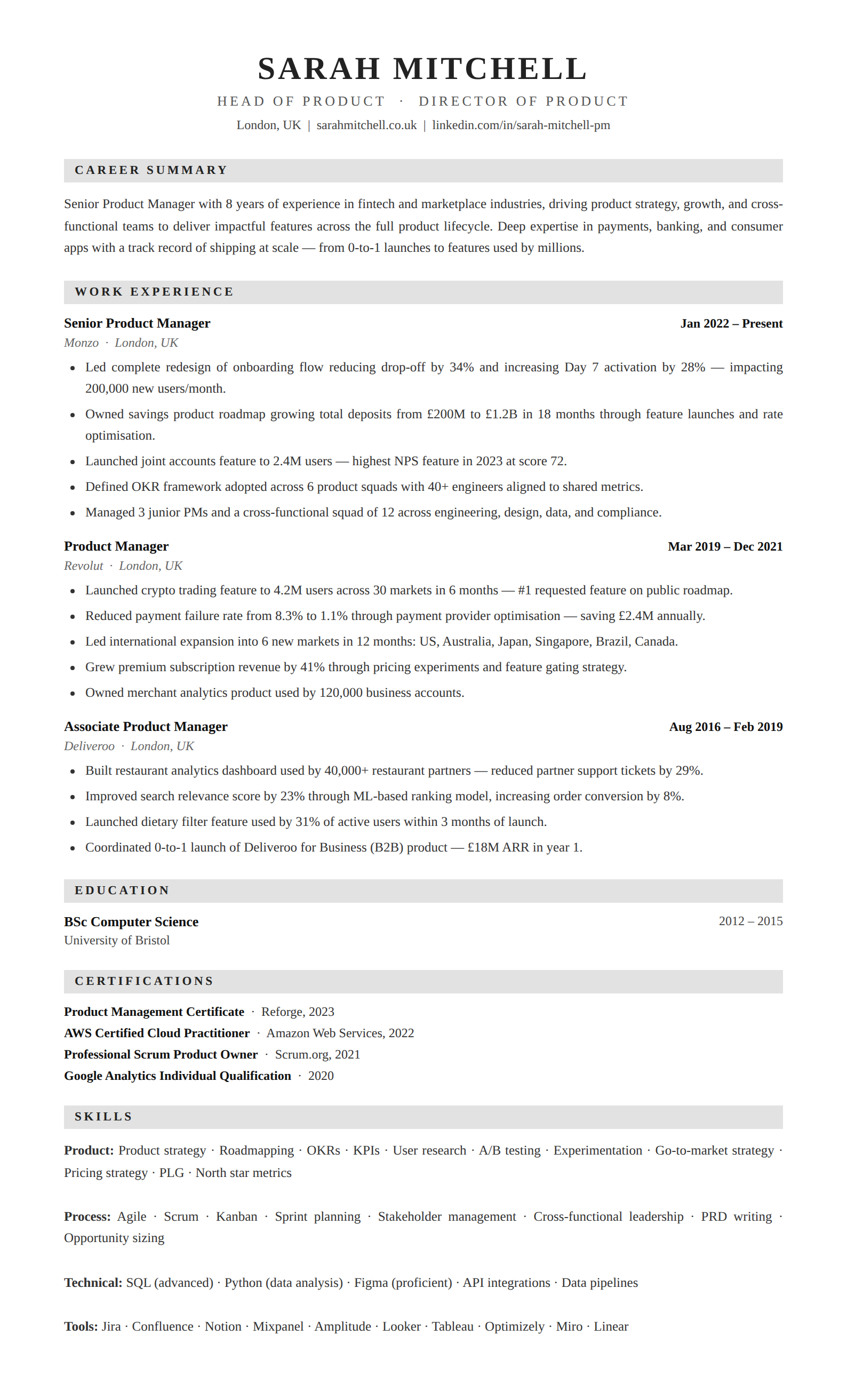
Classic Serif ATS Template: Serif typography that reads as formal and traditional, built on a single-column structure that still parses.

Executive Resume Template: Built for senior candidates, it gives the summary and leadership scope room to land before the role history.
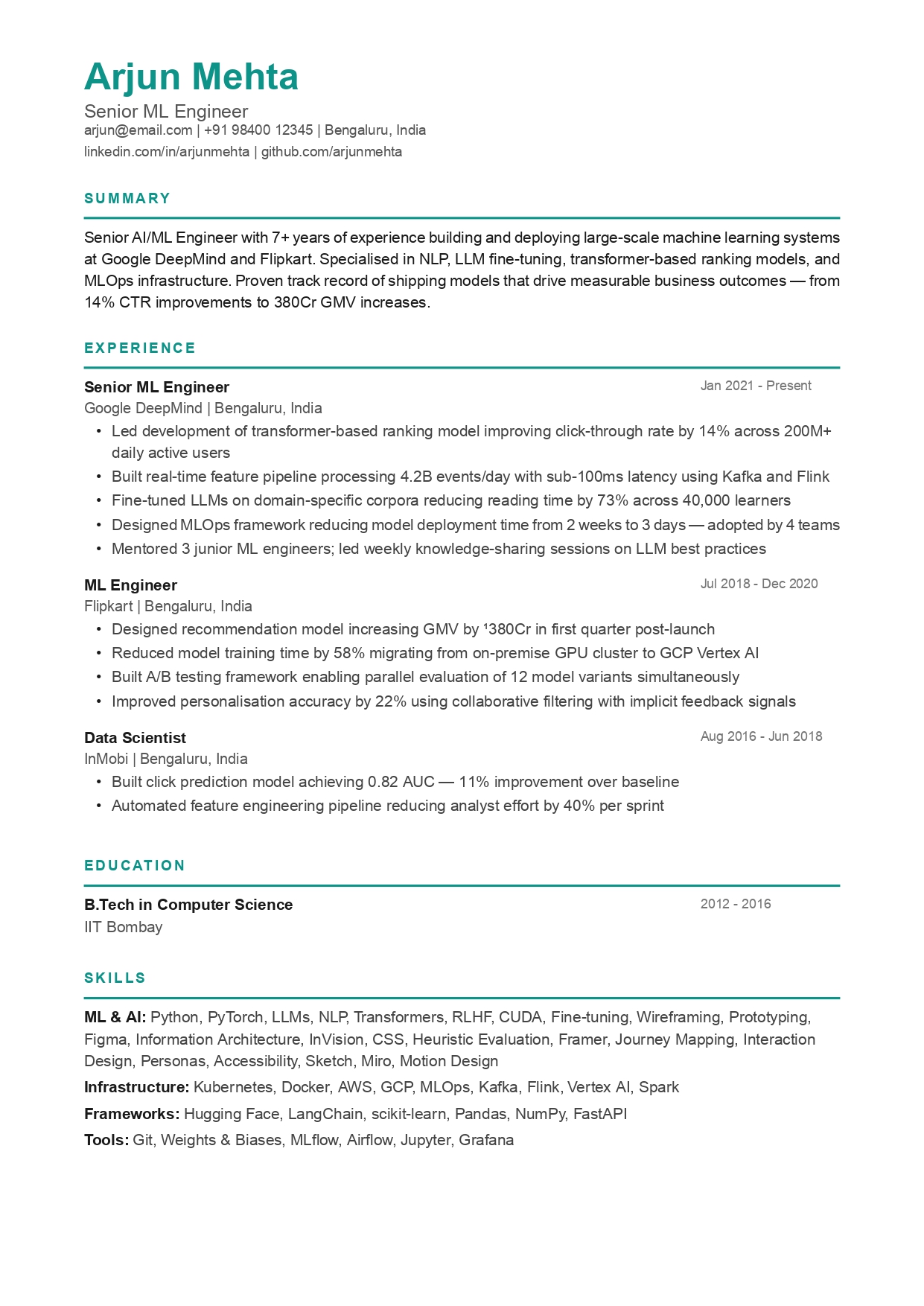
Classic ATS Resume Template: Standard headings, no graphics, parses cleanly through Greenhouse, Workday, Lever and iCIMS. The default if you are unsure.
Related Guides
Next Step
Assemble the full dossier, then check the CV parses cleanly with our free ATS Resume Checker.