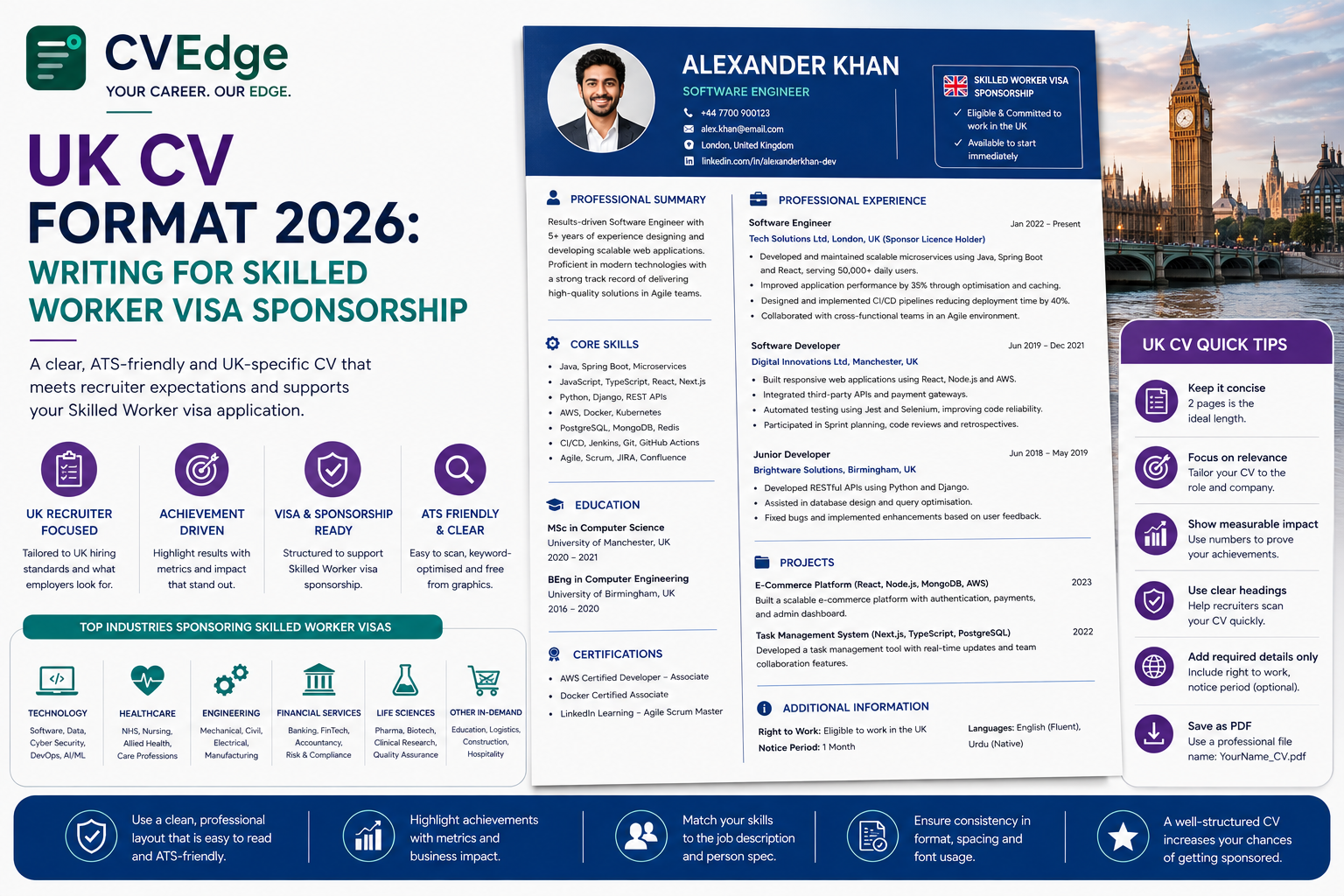
A UK CV is a two-page document on A4 that tells an employer what you do, how well you do it, and why you fit the role in front of them. It is not a life history, it does not carry a photo, and it does not need your date of birth. Most UK recruiters and hiring managers read the first page closely and skim the second, and many applications now pass through an applicant tracking system (ATS) before a person sees them.
This guide walks through every section in the order a UK employer expects, explains what to leave out, and ends with an outline you can copy. If you are moving to the UK from abroad, read the Skilled Worker visa CV guide as well, because sponsorship adds a few things to think about.
The Basic Rules
- Length: two sides of A4 for most people. One side is fine for school leavers and many graduates. The CV length guide covers the exceptions.
- Paper size: A4, not US Letter. Letter-sized files print with odd margins on UK printers and look imported.
- Order: reverse chronological. Your most recent role comes first.
- Font and layout: one column, a plain font at 10 to 12 points, clear headings, and enough white space to scan.
- File type: PDF unless the advert asks for Word. Some agency systems prefer .docx, so keep both.
- Spelling: UK English. "Organised", "programme", "analysed". Recruiters notice.
Section 1: Contact Details
Put these at the top, on one or two lines:
- Full name (as the heading, not the word "CV")
- Town or city and postcode area, for example "Leeds, LS6"
- Mobile number
- Professional email address
- LinkedIn URL, and a portfolio or GitHub link if relevant
Leave out your full street address, date of birth, nationality, marital status and photo. The what not to put on a UK CV guide explains why each one can work against you. If you need sponsorship or already have the right to work, that belongs in a short line covered in the right to work guide.
Section 2: Personal Statement
UK CVs usually open with a personal statement (sometimes called a profile): three to five lines that say who you are, what you are good at, and what you want next. It is the most-read part of the document and the part most people write worst.
A useful shape:
- Your current title or stage, years of experience and sector.
- The two or three strengths the target job asks for.
- One result with a number.
- Optionally, the role you are looking for.
Before: A hard-working and motivated professional with excellent communication skills, looking for a challenging new role.
After: Customer service team leader with six years in telecoms retail. Run a team of eight across two stores and lifted our customer satisfaction score from 78% to 91% in a year. Looking for a first area manager role in the North West.
There are 25 more in the personal statement examples guide.
Section 3: Work Experience
This is the core of the CV. For each role, list:
- Job title, employer, town, and dates (month and year)
- Three to six bullet points for recent roles, one or two for older ones
Write bullets as achievements, not duties. Start with a strong verb, say what you did, and finish with the result. The bullet point guide has dozens of examples, and the action verbs list helps when every line starts with "Responsible for".
Before: Responsible for processing invoices and dealing with supplier queries.
After: Processed around 400 supplier invoices a month and cut late payments by a third by setting up a weekly query log with purchasing.
If you have gaps, explain them briefly in the timeline rather than hiding them. The employment gap guide shows how.
Section 4: Education
What you include depends on your stage.
- Graduates and students: degree, university, classification (First, 2:1, 2:2) or predicted grade, and dates. Add a dissertation title or relevant modules only if they support the job. See the graduate CV guide.
- School leavers: GCSEs (number of passes, with English and maths grades named), A-levels or BTECs with grades or predicted grades. See the school leaver CV guide.
- Experienced candidates: degree and university on one line. GCSEs can go once you have a degree or several years of work, unless the advert asks for English and maths at grade 4 (C) or above.
Professional qualifications such as ACCA, CIPD, PRINCE2 or a teaching qualification often deserve their own heading above education. The certifications guide covers where to put them.
Section 5: Skills
Keep it short and specific: software, tools, languages, licences and technical methods you could be questioned on. Group them if the list is long ("Finance systems: Sage 200, Xero, SAP"). Leave out soft skills like "team player" here; prove those in your bullets instead. The skills guide lists what employers search for by sector.
A full UK driving licence is worth listing if the job involves travel. Language skills should state a level ("Spanish: fluent", "French: conversational").
Section 6: Extras (Optional)
Volunteering, a society role, a side project, or a relevant award can all earn space if they show something the job needs. Generic hobbies ("reading, socialising, travel") do not. A line like "Volunteer treasurer, local food bank, 2023 to present" says more than any adjective.
References are not usually listed. The references guide explains what UK employers do instead.
Tailor Every Application
A UK employer reads your CV against the job advert. Before you send it:
- Read the advert and highlight the skills, tools and duties it repeats.
- Make sure your personal statement names the role and the top two requirements.
- Reorder bullets so the most relevant achievement in each job comes first.
- Use the advert's wording where it honestly matches what you did ("stakeholder management", "safeguarding", "month-end close").
The tailoring guide goes through this step by step, and the keywords guide explains why exact terms matter.
How UK Application Systems Read Your CV
Large UK employers often use portals such as Workday, Oracle Taleo or SAP SuccessFactors, and recruitment agencies load CVs into their own databases. These systems pull your text into fields, then recruiters search it by keyword. Things that break that process:
- Two-column layouts, where the parser reads across columns and mixes lines up
- Text inside tables, text boxes, headers or footers
- Icons instead of words for phone and email
- Unusual headings ("My Journey" instead of "Work Experience")
- Scanned or image-only PDFs
The ATS explainer shows what happens after you click apply, and the UK CV template guide points to layouts that parse cleanly.
Some UK employers, including the Civil Service and the NHS, ask for a written statement as well as or instead of a CV. Those have their own rules: see the Civil Service personal statement guide and the NHS supporting information guide.
A Full Example Outline
SARAH OKAFOR Manchester, M20 · 07700 900123 · sarah.okafor@email.com · linkedin.com/in/sarahokafor
Personal Statement Marketing executive with four years in B2B software. Run paid search and email for a £400k annual budget and grew marketing-sourced pipeline by 35% last year. Looking for a marketing manager role in a scale-up.
Work Experience Marketing Executive, Northbridge Software, Manchester, March 2023 to present
- Rebuilt the email nurture programme, raising demo bookings from email by 40% in six months
- Managed paid search across Google and LinkedIn, cutting cost per lead from £95 to £62
- Wrote and ran a quarterly webinar series that brings in around 300 registrations per event
Marketing Assistant, Halden Recruitment, Stockport, September 2021 to February 2023
- Ran the company blog and social channels, growing LinkedIn followers from 2,000 to 9,500
- Coordinated six industry events a year, including budgets and supplier bookings
Education BA (Hons) Marketing, University of Leeds, 2:1, 2021
Skills HubSpot, Google Ads, LinkedIn Campaign Manager, GA4, Canva, basic SQL Full UK driving licence
That fits comfortably on one and a half pages with room for one more role. Notice what is missing: no photo, no date of birth, no "references available on request", and no list of soft skills.
Common UK CV Mistakes
- Using a US resume format with Letter paper and US spelling
- A personal statement full of adjectives and no facts
- Duties instead of results in every bullet
- Three or more pages for a mid-career role
- An email address you set up at school
- Sending the same CV to every advert
If you are changing sector, the career change guide shows how to lead with transferable results rather than job titles.
CV Templates That Parse Cleanly
Classic CV Template: standard headings, one column, no graphics. Set the paper size to A4 and it is the safest default for UK employers and recruitment agencies.
Sterling CV Template: a serif body with clear rules under each heading, built for large-employer portals and public-sector applications.
Classic Serif CV Template: a clean one-page layout for students, school leavers and graduates.
Related Guides
- UK Cover Letter: Format, Length and a Template
- Personal Statement for a CV: 25 UK Examples
- How Long Should a CV Be in the UK?
- Resume vs CV: What Recruiters Expect
Frequently asked questions
Should a UK CV have a photo?
No. UK employers do not expect one, and many recruiters remove CVs with photos to protect themselves against discrimination claims. Acting and some modelling roles are the exceptions. The CV photo rules guide compares countries.
Do I need to put my date of birth on my CV?
No. Age is a protected characteristic under the Equality Act 2010, and employers do not need it to shortlist you. Leaving it out is normal.
Is a CV the same as a resume in the UK?
In everyday UK use, "CV" means the two-page document you send with a job application, which Americans call a resume. The resume vs CV guide explains the differences in detail.
Should I write my CV in the first person?
Write without pronouns. "Managed a team of five" rather than "I managed a team of five". It is shorter and is the UK norm. The personal statement can use an implied first person in the same way.
How often should I update my CV?
Add achievements as they happen, while you still remember the numbers, and do a full review at least once a year. Tailor it again for every application.
Next Step
Upload your CV to the free ATS CV checker to see what an employer's system pulls out of it, then fix the gaps before you apply.