

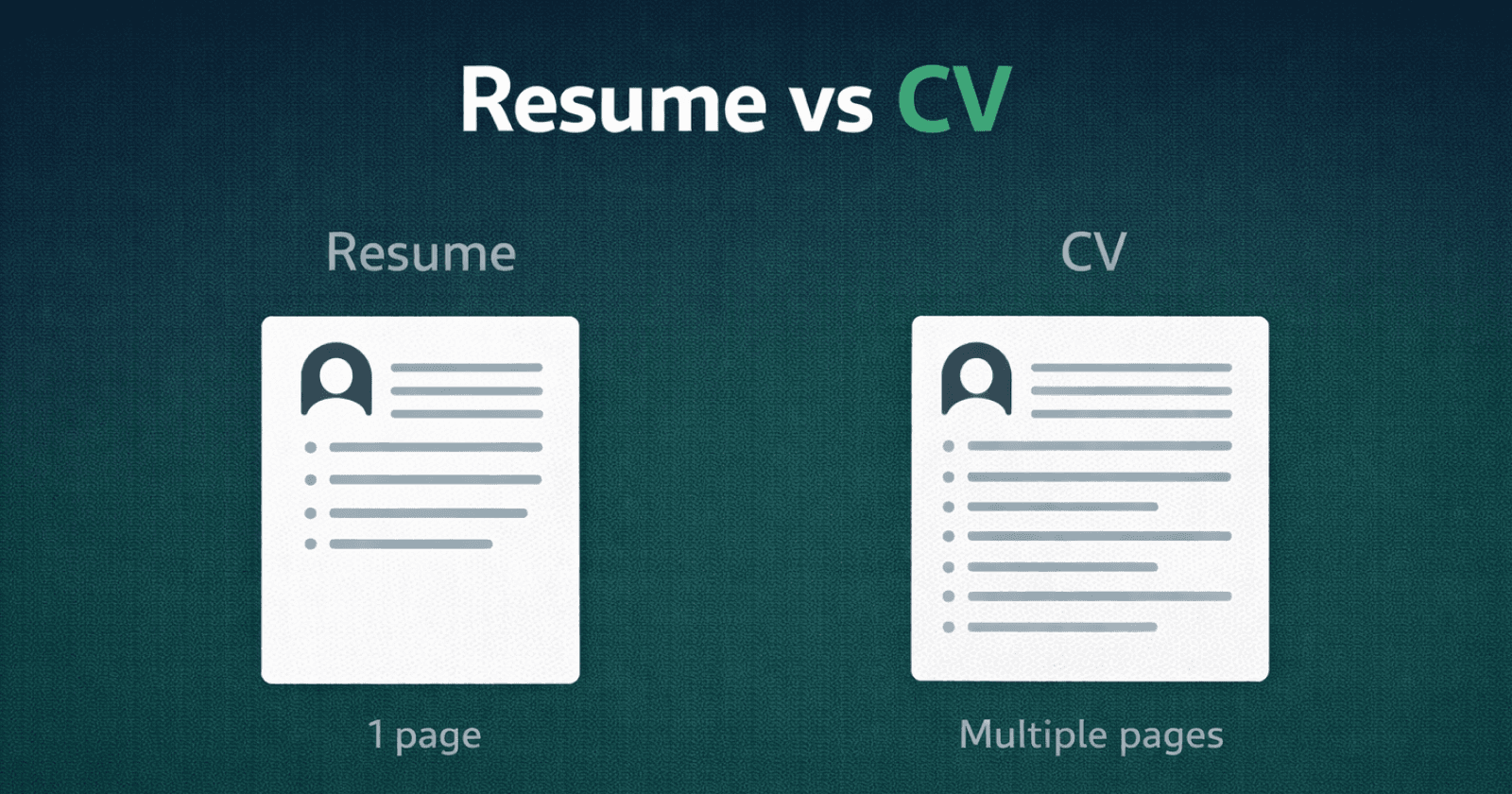
"Resume" and "CV" mean different things depending on who is asking, and applying with the wrong assumption is a genuine and avoidable source of rejection — particularly for international applications. Here is what each term means where.
United States and Canada
Resume is the default: one to two pages, tailored per application, covering relevant experience rather than everything you have done.
CV in North America means something specific and narrow — an exhaustive academic document listing publications, grants, conference presentations and teaching. It is used for academia, research and some medical roles, and it can run to many pages. If a US employer outside those fields asks for a CV, they almost certainly mean a resume.
Critically: no photo, no date of birth, no marital status, no nationality. US and Canadian employers frequently discard applications containing these, because their presence creates discrimination-liability exposure. This is the single most common mistake on applications sent from regions where photos are standard.
United Kingdom and Ireland
CV is the standard term for what Americans call a resume. Two pages is the norm; one page is acceptable early-career.
No photo, and date of birth is not expected. A brief personal statement at the top is conventional. Listing "References available on request" is unnecessary — it is assumed, and it consumes a line you could use better.
Continental Europe
Conventions vary meaningfully by country, and the differences are worth checking rather than assuming.
In Germany, applications are traditionally more formal and photos have been common, though the practice has been declining since anti-discrimination legislation. German applications may also include certificates and references as attachments.
In France, one to two pages, and photos are common though not required. In the Netherlands and Scandinavia, conventions run closer to the UK, and photos are less usual.
The Europass format exists and is accepted across the EU, though many private-sector recruiters find it rigid and it is rarely the strongest choice outside public-sector or cross-border applications.
Middle East (UAE, Saudi Arabia, Qatar)
CV is the term used. Expectations here differ most from Western norms, and applications that ignore them stand out.
Photos are common and often expected. Nationality is frequently included, and is genuinely relevant to employers navigating visa and quota requirements. Date of birth and marital status appear more often than in Western markets. Also worth stating explicitly: your visa status, notice period, and whether you hold a local driving licence — these are practical screening criteria in the region.
Three pages is more acceptable than in the UK or US.
India, Singapore and much of Asia
Resume and CV are used more or less interchangeably in India, with "resume" more common in the private sector. Two to three pages is normal, and more personal detail traditionally appears than would be usual in the West.
For multinational employers in Singapore and Hong Kong, conventions run closer to UK and US norms — brief, no photo. Match the company's origin rather than the country you are applying from.
The practical rule
Match the destination, not your origin. If you are applying from a region where photos are standard to a company in one where they are a liability, remove the photo. If you are applying from the UK to the Gulf, adding visa status and notice period will help you.
Where the employer is a multinational, follow the conventions of the country the role is based in — that is where the hiring manager sits.
What does not change
Regional formatting differs; the substance does not. Everywhere, the CV that wins states what you did, at what scale, and what changed as a result. Everywhere, bullets that describe duties rather than outcomes underperform. Everywhere, the top third of page one carries disproportionate weight.
Get the substance right once, then adjust the regional presentation per application. That is a ten-minute change, not a rewrite.
Build both versions
CVEdge lets you keep multiple versions of the same underlying content, so you can maintain a photo-free two-page version for UK and US applications and a fuller version for the Gulf without rewriting anything. Start free, or read our region-specific guides on UAE resume format and Saudi Arabia CV format.