
Saudi Arabia and the UAE are often treated as one market by people applying from outside the region. They are not. The Saudi labour market has its own dynamics: a national employment policy that directly shapes hiring, a large state-driven investment programme creating demand in specific sectors, and a different balance of Arabic and English in day-to-day business.
Those differences change what belongs on your CV. If you have already read our UAE guide, the shared Gulf conventions carry across; this covers what is particular to KSA.
Saudization shapes the screening
Saudi Arabia operates a national employment programme, commonly known as Saudization or Nitaqat, which sets targets for the proportion of Saudi nationals employed by companies, with the specifics varying by sector and company size. Certain roles and professions have been progressively restricted to Saudi nationals over recent years.
Two practical consequences for an applicant:
If you are a Saudi national, this is a substantial advantage and your CV should make your nationality immediately visible at the top. Employers have quota targets to meet and actively recruit against them.
If you are an expatriate, the useful response is to make the case for specialist scarcity. Companies hire expatriates where the skills are not readily available locally, so a CV that reads as generic and interchangeable competes badly, while one that demonstrates specific, hard-to-source technical depth competes well. Be concrete about the specialism, the certifications, and the scale of systems or projects you have handled.
Programme rules and restricted-profession lists change regularly. Verify the current position for your sector with the relevant Saudi authority rather than relying on any article, including this one.
Vision 2030 concentrates the demand
Saudi Arabia's economic diversification programme has concentrated hiring in identifiable areas: giga-projects and construction, tourism and hospitality, entertainment and events, renewable energy, mining, healthcare, financial services, logistics, and technology and digital infrastructure.
If your experience touches any of these, connect it explicitly rather than leaving the relevance implicit. A project manager who has delivered large-scale infrastructure, a hospitality operator who has opened new properties, an energy engineer with renewables experience: each of these is directly relevant to stated national priorities, and saying so in the summary line is more effective than any adjective.
This is also where the honest caution applies: sector relevance helps, but claiming alignment you do not have is transparent to anyone who works in it.
Arabic matters more here than in the UAE
Business in Saudi Arabia is conducted in both Arabic and English, with the balance depending heavily on sector and employer. Government-linked entities, public-facing roles and much of the domestic corporate sector use Arabic considerably more than the equivalent roles in Dubai.
If you have Arabic, state the level accurately and specifically: "Native", "Business fluent, written and spoken", "Conversational" are meaningfully different claims and each will be tested. If you do not, it is not a barrier for most technical and specialist roles, and there is no benefit to overstating it.
The status line for KSA
As in the UAE, put the practical availability facts near the top:
- Nationality. Prominent, particularly for Saudi and GCC nationals.
- Iqama status if you are already in the Kingdom: whether you hold a residence permit and whether it is transferable. A candidate already resident with a transferable iqama is faster and cheaper to hire than one requiring a new visa from abroad.
- Current location: Riyadh, Jeddah, Dammam, or applying from abroad.
- Notice period and availability.
- Languages with honest levels.
A professional photograph is conventional and expected, as elsewhere in the Gulf, and its absence is not disqualifying.
Professional licensing and certificate attestation
Several professions in Saudi Arabia require registration or accreditation with the relevant national body before you can practise: engineering, healthcare and accounting among them. If you hold the relevant registration, or have begun the process, put it on the CV. It removes a question the employer would otherwise have to raise.
Educational certificates generally require attestation through your home country's authorities and Saudi authorities, as in the UAE, and the process takes time. If it is done, say so. Verify current requirements with the relevant authority; they change.
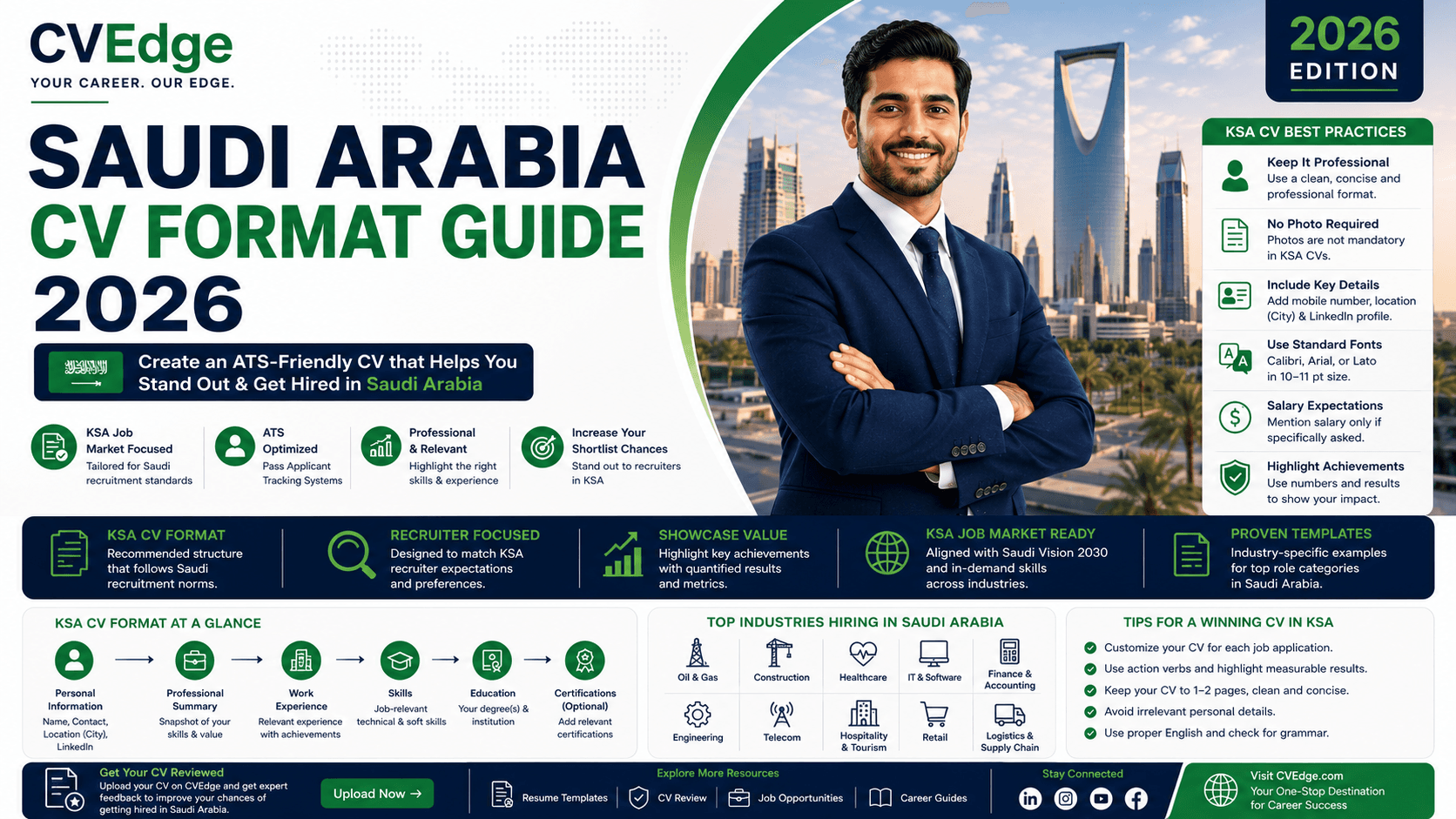
Structure
- Header: name, phone with country code, email, city, LinkedIn, in the body of the page rather than a document header.
- Status line: nationality, iqama status, location, notice period.
- Summary: two or three lines on specialism, years, and sector alignment where genuine. "Twelve years in large-scale infrastructure delivery, including four years on GCC giga-projects" does the work of a paragraph.
- Experience: reverse chronological, outcomes rather than duties, with scale stated. Project value, team size, and asset or system scale are the currency here.
- Education, licensing and certifications.
- Skills and languages.
Two pages. One if you are under about seven years in.
Scale is the metric that travels
Saudi employers, particularly on the large programmes, hire for demonstrated capacity to operate at size. Where you have it, quantify it: contract value managed, square metres delivered, headcount led, plant capacity, transaction volume, number of sites. A bullet that says "Led delivery of a SAR 400 million package across three sites, 140 staff" answers the scale question directly, and scale questions are what these screens are for.
Where you do not have that scale, do not manufacture it: state what you did have accurately and let the specialism carry the argument instead.
The parsing mechanics are the same
Large Saudi employers and the regional portals run applicant tracking systems. Single column, conventional English section headings even where the role is Arabic-speaking, real text rather than images, and consistent month-and-year dates. If you submit an Arabic version, submit it as a separate document rather than mixing scripts in one file, which parsers handle poorly.
Check yours by pasting the PDF into a plain text editor, or run it through the free ATS checker to see the extracted fields.
Frequently asked questions
Should a CV for Saudi Arabia include a photo?
It is still common and many Saudi employers expect one, but keep it out of the layout structure: a small headshot in the header, not a sidebar or two-column grid that breaks ATS parsing. For multinationals and government entities using an online portal, a plain no-photo version is the safer file.
How long should a Saudi Arabia CV be?
Two pages for most professionals, three for senior or highly technical roles with long project lists. Lead with a status line (nationality, iqama or visa status, location, notice period) so the recruiter's first practical questions are answered before they read your experience.
Do I need Arabic on my CV for KSA?
Write the CV in English unless the posting is in Arabic, but state your Arabic level honestly in the languages line. For government-linked employers and Saudization-sensitive roles, Arabic is a genuine differentiator; for multinational technical roles it is usually a plus rather than a requirement.
What is Saudization and why does it affect my CV?
Saudization (Nitaqat) sets targets for the share of Saudi nationals in a company's workforce. Employers screen expatriate candidates against those quotas, so make your nationality, current status and the specialist skills that justify an expatriate hire clear in the first few lines.