
Indian professionals are among the largest groups in the UAE workforce, and the path from an Indian job to a Dubai one is well worn. But the CV that got you your current role in Bengaluru or Mumbai is not quite the document a Dubai recruiter is expecting, and the gaps are specific rather than general.
This covers what actually changes. For the broader regional conventions (visa status, photographs, personal details), see our UAE resume format guide; this piece is about the differences that are particular to moving from an Indian CV.
1. Length: cut it roughly in half
Indian CVs commonly run three to five pages, and in some sectors that is entirely normal: a detailed project-by-project listing is a genuine convention in Indian IT services, where staffing decisions are made against specific technology stacks.
Dubai recruiters expect two pages, and one if you have under about seven years of experience. The instinct to include every project is the single most common thing Indian applicants need to unlearn. Consolidate: your last three roles get bullets, older roles get a title, employer and dates, and the project list becomes a skills section plus two or three representative examples.
2. Remove salary history — but be ready for the question
Many Indian CV templates include current CTC, expected CTC, or both. Take them off the document. Stating a number on the CV anchors the negotiation before you have had a chance to demonstrate value, and it is not a UAE convention.
You will still be asked, usually early and often by the recruiter rather than the employer. Prepare a researched AED figure rather than converting your rupee salary. Direct conversion is the classic mistake: it ignores that UAE income is not taxed, that housing and schooling are frequently the largest costs and are sometimes allowances rather than salary, and that the market rate for your role in Dubai has little relationship to the market rate in India.
Research the AED range for your role and level on the regional job portals, then think in terms of a total package (base, housing allowance, transport, annual flights, medical cover, schooling if you have children) rather than a single number.
3. Notice period is a real screening criterion
Indian notice periods of 60 or 90 days are standard at home and long by Gulf standards, where hiring often moves quickly. This genuinely costs candidates opportunities when an employer needs someone in four weeks.
Put your notice period on the CV rather than letting it surface late. If it is negotiable, say so: "90 days' notice, buy-out negotiable" is a materially different proposition from "90 days" alone, and it is worth confirming what your current employer will accept before you start applying.
4. Add the status line Indian CVs do not have
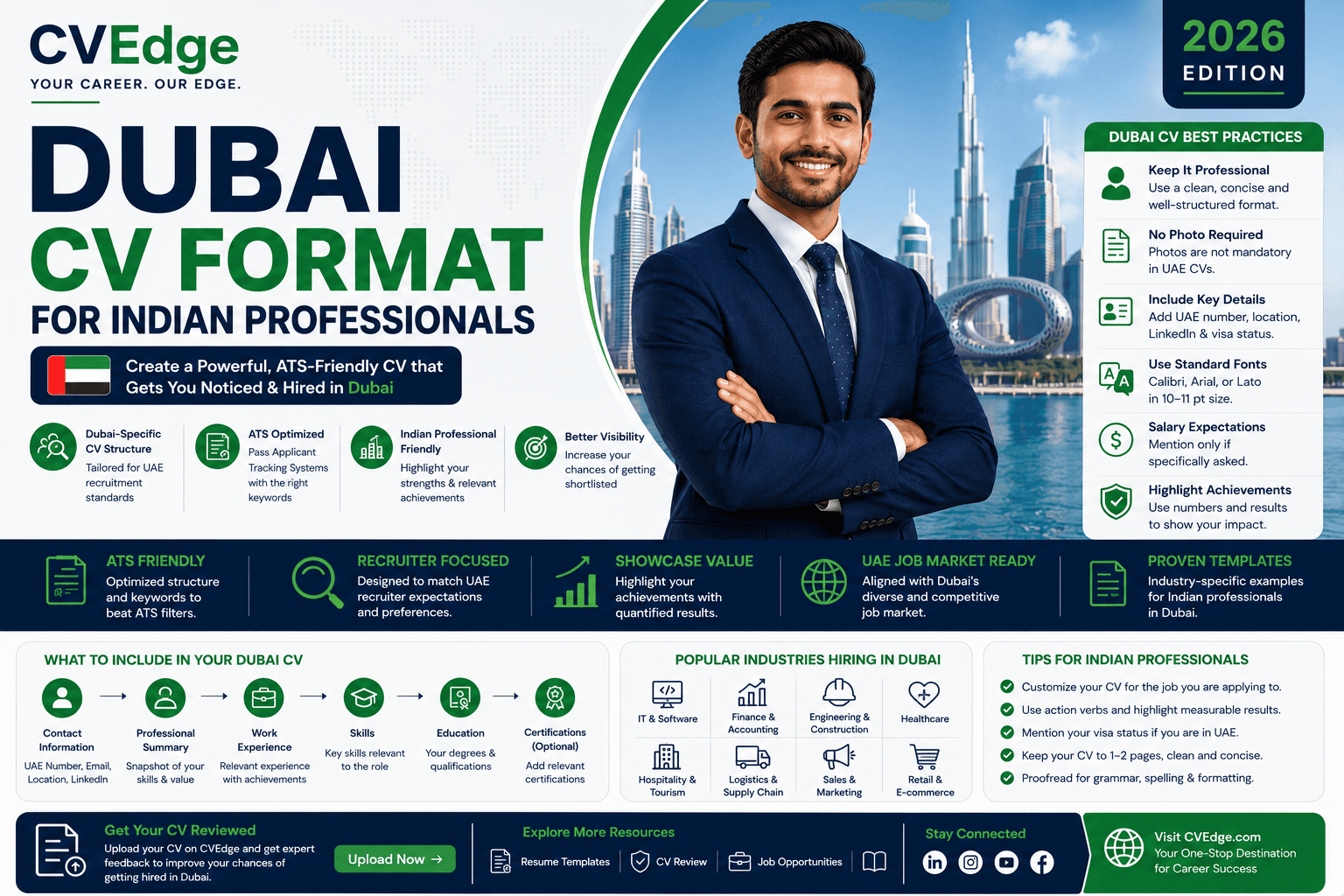
Include nationality, current visa status and current location near the top. A recruiter needs to know whether you are applying from India and will need sponsorship, or are already in the UAE on a transferable visa. These are not details to bury. They change the cost and timeline of hiring you, and one line answers them.
5. Reframe employer names that will not be recognised
Large Indian employers are well known in the Gulf. Mid-size ones and domestic-market brands often are not, and a recruiter cannot judge the scale of your experience from a name they have never seen.
Add a short parenthetical: "Regional FMCG distributor, ₹800 crore revenue, 1,200 staff" or "Series B fintech, 4 million users". One clause converts an unknown name into a known scale. Do the same for scale within your bullets: team size, budget owned, transaction volume, number of markets.
6. Start degree attestation early
UAE employment offers typically require your degree certificate to be attested. For Indian qualifications this generally runs through the issuing university, state-level authorities, the Ministry of External Affairs, and the UAE embassy, then through UAE authorities on arrival. It takes real time and is the most common cause of a delayed start date.
If yours is done, note it on the CV: "B.Tech, attested". If it is not, begin it before you have an offer rather than after. Requirements and routes change, so verify the current process with the relevant authorities rather than relying on any article.
7. Adjust the vocabulary
Some standard Indian professional English reads as unfamiliar to a Gulf recruiter working in international business English. A few conventions worth adjusting:
- "CTC": not used in the UAE. Talk about total package if it comes up.
- "Lakh" and "crore": convert to international notation on the CV. "₹800 crore" can stay if you also give a rough equivalent, but "8 billion rupees" or an approximate AED or USD figure travels better.
- "Do the needful", "revert back", "prepone": common and perfectly clear in India, unfamiliar or odd-sounding elsewhere. Worth editing out of a document being read internationally.
- Honorifics and formal salutations in a covering email. Keep it direct and brief.
8. Name any GCC or international exposure you have
Regional experience is a genuine differentiator. If you have worked on GCC accounts from India, handled Middle East clients, travelled to the region for delivery, or worked in a multinational with regional reporting lines, make it explicit. A recruiter will not infer it from an employer name.
If you have none, do not invent it. Emphasise scale, multicultural team experience and any multi-market work instead.
The mechanics still apply
UAE employers and the regional portals run applicant tracking systems. Single column, standard headings, real text rather than images, contact details in the body of the page rather than a document header, and consistent month-and-year dates. Check by pasting your PDF into a plain text editor: if it reads correctly in order, it will parse.
You can check the extracted fields and ATS score for your CV free at CVEdge, no account needed.
Frequently asked questions
What should I remove from my Indian CV for Dubai?
Salary history, the declaration and signature block, "Date and Place", father's name, passport number, and 10th and 12th board marks. Keep nationality, visa status and a photo, which Gulf recruiters still expect.
How long should my Dubai CV be if my Indian CV is four pages?
Two pages. Cut older roles to one line each, keep only projects with a stated result, and move the detailed project list to a separate document you can send on request.
Should I mention my notice period on a CV for the UAE?
Yes, in a status line under your name: nationality, current visa status, location and notice period. Availability is a real screening criterion in the UAE because visa processing already adds weeks.
How do I explain an Indian employer a Dubai recruiter may not know?
Add a short descriptor after the name: "Infosys (IT services, 300,000+ employees)" or "a Series B fintech in Bengaluru". Scale and sector are what the recruiter needs to place your experience.