

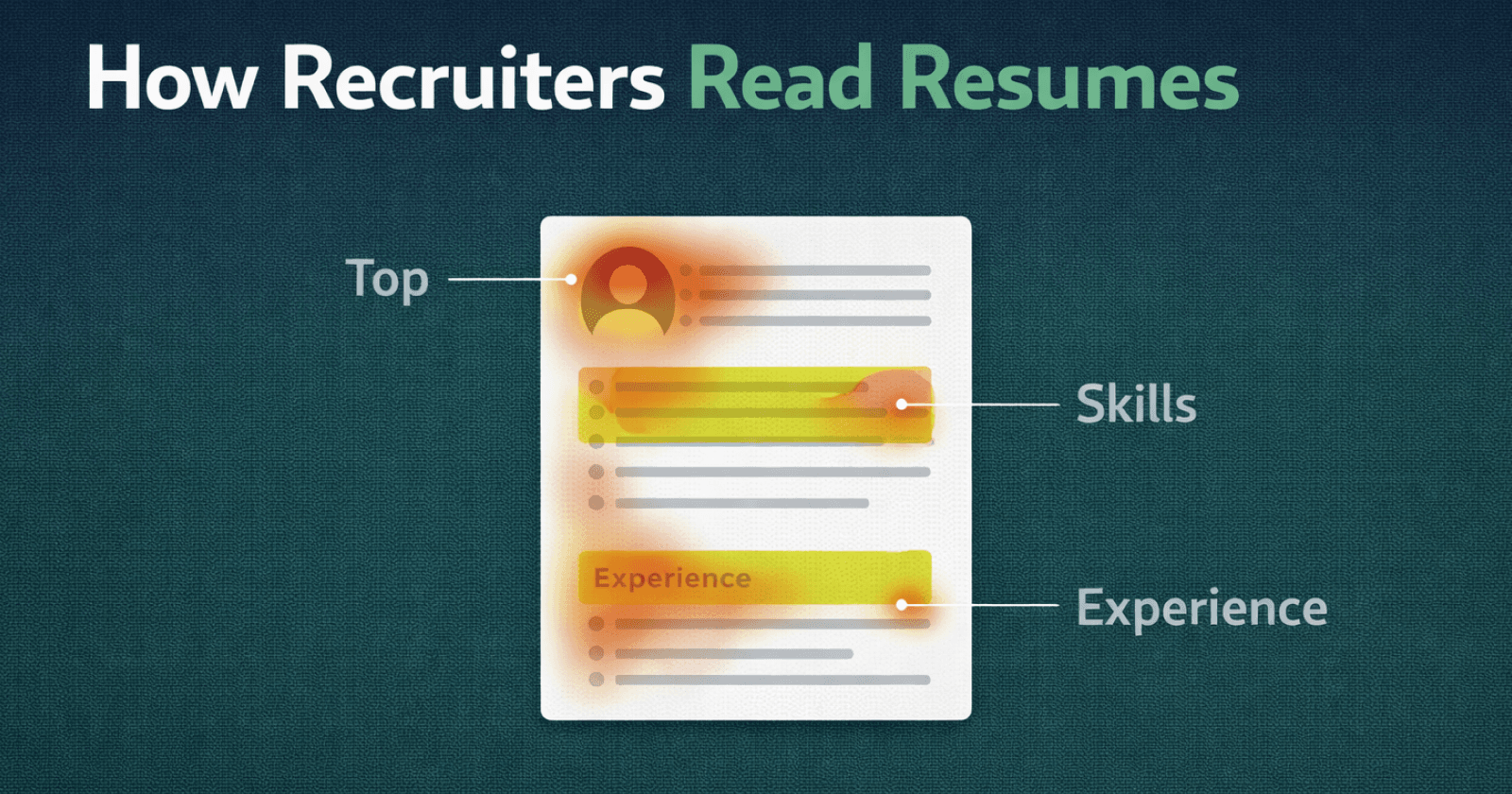
The claim that recruiters spend about six seconds on a CV gets repeated constantly, usually without context. It comes from real research, it is more nuanced than the headline suggests, and understanding what it does and does not establish changes how you should structure a page.
Where the number comes from
Two eye-tracking studies are the source. A 2012 study by TheLadders reported an average initial scan of roughly six seconds. A 2018 follow-up by the same organisation reported around 7.4 seconds. Both used eye-tracking equipment on professional recruiters reviewing real CVs.
Two caveats are worth stating, because they are usually omitted. These were vendor-run studies with modest sample sizes, not peer-reviewed research, so the precise figure should be held loosely. And the number describes the initial triage pass — the decision about whether a CV is worth reading — not the total time spent on candidates who survive it. A CV that clears the first pass gets minutes, not seconds.
What the research supports robustly is the shape of the behaviour rather than the exact duration: the first pass is fast, pattern-based, and concentrated on a small number of fields.
What the eye actually looks at
Across both studies, gaze concentrated on a consistent set of elements during the initial scan:
- Name
- Current title and company
- Current position start and end dates
- Previous title and company
- Previous position dates
- Education
Notice what is absent: your bullets. During the first pass, the detailed content you spent the most time writing is largely skimmed rather than read. It matters enormously — but only after the scan has decided you are worth a second look.
The F-pattern
Reading-behaviour research more broadly — including long-standing web usability work by the Nielsen Norman Group — describes an F-shaped scanning pattern: a horizontal sweep across the top, a shorter sweep lower down, then a vertical scan along the left edge.
Applied to a CV, this has three practical consequences:
- The top third of page one carries disproportionate weight. It receives the horizontal sweep and is where the relevance decision is made.
- The left edge is scanned more than the right. The first few words of each bullet are read; the ends of lines often are not.
- Content low on page two receives very little first-pass attention. Anything you need seen should not live there.
What this means for structure
Front-load the top third
Your name, a clear current title, and a three-to-four sentence summary stating your specialisation, level and strongest result. This is the highest-value real estate on the document. A summary that opens with generic ambition — "seeking a challenging role where I can grow" — wastes it entirely.
Start bullets with the strongest words
Because the left edge is scanned and line-ends often are not, the opening words of each bullet do most of the work. "Responsible for managing..." spends that position on nothing. "Cut p99 latency 78%..." spends it on the result.
Where possible, move the number toward the front rather than burying it at the end of a long clause.
Make titles and dates unambiguous
Since titles, companies and dates absorb most of the first-pass attention, they should be instantly parseable. Consistent formatting, no ambiguity about which line is the company and which is the role, and no gaps left unexplained. If your internal title was non-standard, write the functional equivalent alongside it.
Keep the most relevant material on page one
Reverse chronological order usually handles this automatically. Where it does not — for instance, if your most relevant experience is three roles back — a hybrid format with a skills summary near the top lets you establish relevance without disturbing the timeline.
What the research does not say
A few reasonable-sounding conclusions that the data does not support:
- That design tricks buy you attention. Attention concentrated on standard fields, not on visual flourishes. Unusual layouts more often slowed comprehension than helped it.
- That bullets do not matter. They matter decisively — in the second pass, and in the interview. The scan decides whether there is a second pass.
- That one page is required. Length was not the variable; clarity of the top third was.
- That six seconds is your total. It is the triage budget, not the review budget.
The practical summary
Write for two passes. The first is fast, pattern-based and concentrated on the top third, your titles and your dates — so make those instantly legible and put your strongest positioning statement where the sweep lands. The second is a genuine read, where your bullets and their results determine whether you get a call.
Most CVs are written entirely for the second pass and lose at the first. Fixing the top third is usually the highest-return edit available.
See how yours scans
Upload your CV to CVEdge free for a breakdown of how it parses, whether your summary and titles are doing their job, and which sections are costing you attention in that first pass.