

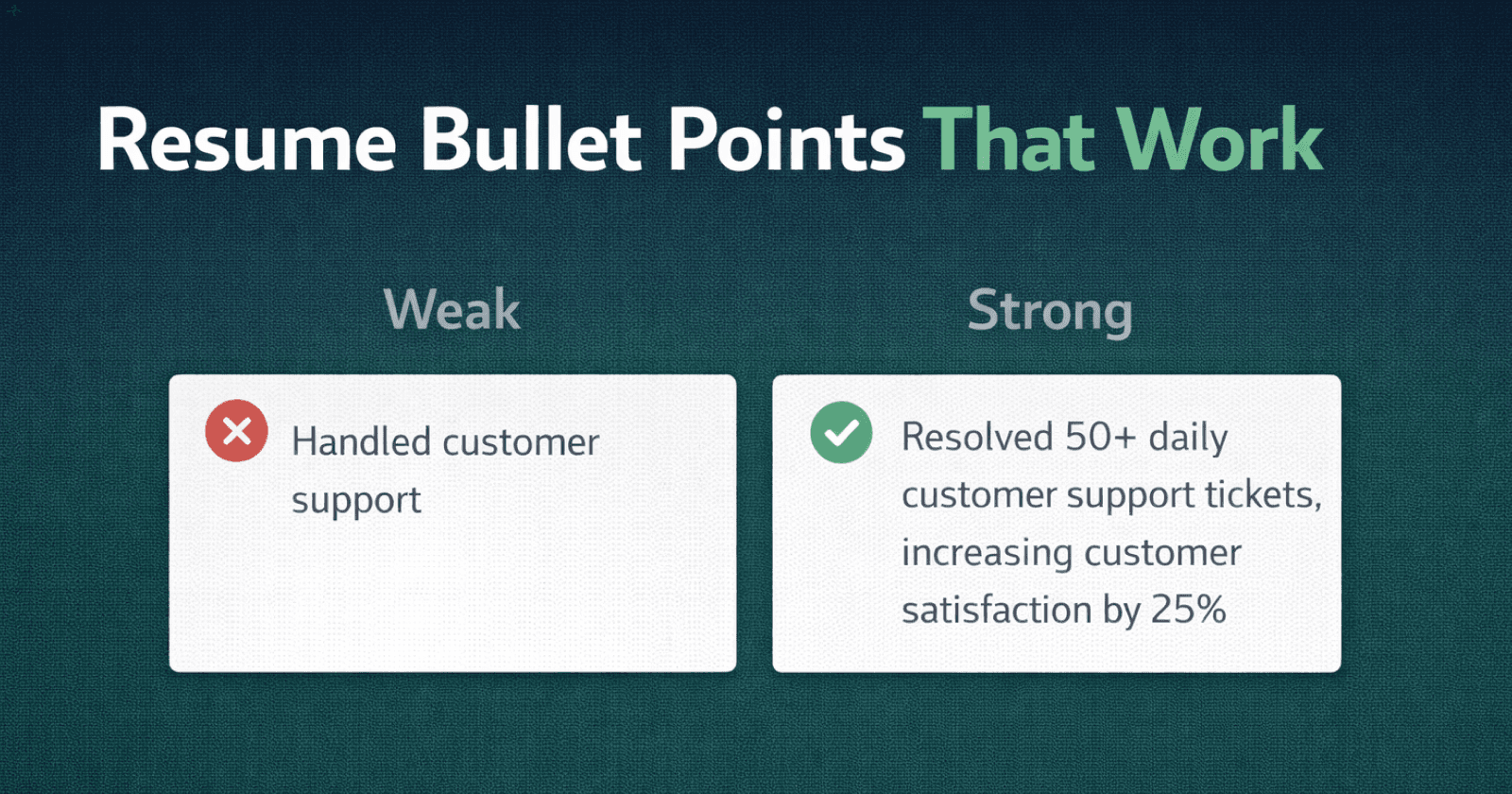
The difference between a CV that gets calls and one that does not is usually not the experience — it is whether the bullets describe duties or outcomes. "Responsible for managing the reporting process" and "Automated 30 recurring reports, removing 12 analyst-hours per week" can describe the same job. Only one gets read.
The structure
Strong bullets share a consistent shape: a strong action verb + the specific thing you did + a measurable result.
Each part is doing work. The verb establishes agency. The specific work makes it credible and gives the interviewer something to ask about. The result is what makes a reviewer stop scanning.
A useful ordering trick: because the left edge of each line gets scanned and line-ends often do not, move the result toward the front where it fits naturally. "Cut p99 latency 78% by batching ORM queries" lands harder than the same content with the number buried at the end.
Twelve rewrites
- Before: "Responsible for social media accounts." After: "Grew LinkedIn following from 4k to 27k in 11 months, driving 18% of inbound demo requests."
- Before: "Helped improve the onboarding process." After: "Redesigned onboarding around a single activation moment, lifting week-1 activation from 22% to 34%."
- Before: "Worked on the company website." After: "Rebuilt the marketing site in Next.js, cutting LCP from 4.1s to 1.6s and lifting mobile conversion 8%."
- Before: "Managed a team of engineers." After: "Grew and led a team of 7 engineers, cutting median PR review time from 3 days to 6 hours and reducing voluntary attrition to zero over two years."
- Before: "Handled customer support tickets." After: "Resolved ~60 tickets/week at 96% CSAT, and wrote the billing runbook that cut escalations to engineering 40%."
- Before: "Assisted with financial reporting." After: "Rebuilt the monthly close model, cutting close from 9 days to 4 and eliminating three recurring reconciliation errors."
- Before: "Performed data analysis for the marketing team." After: "Identified that 31% of signup drop-off came from one verification step; removing it lifted completed signups 22% with no increase in fraud."
- Before: "Used SQL to pull reports." After: "Automated 30 recurring reporting requests into self-serve Looker explores, removing ~12 analyst-hours per week."
- Before: "Involved in the migration project." After: "Led the zero-downtime migration of a 400M-row Postgres table across two sprints with no customer-visible errors."
- Before: "Created training materials for new hires." After: "Built a 12-module onboarding curriculum that cut new-hire time-to-first-deploy from 3 weeks to 6 days."
- Before: "Participated in the on-call rotation." After: "Cut MTTR from 47 to 12 minutes by replacing 140 threshold alerts with 18 SLO-based ones."
- Before: "Worked with stakeholders to gather requirements." After: "Ran 40 customer interviews that reframed a requested export feature as a reporting-trust problem; the resulting feature hit 60% adoption versus 8% for the original request."
What to do when you have no numbers
This is the most common objection, and it has three good answers.
Estimate a defensible range. "Reduced processing time by roughly 40%" is credible and can be discussed in an interview. An honest approximation beats both false precision and no number at all.
Use a different dimension. If you cannot measure the outcome, measure the scope: how many people, how many systems, how much data, how often, over what period. "Supported 14 internal teams across 3 time zones" carries real information without an outcome metric.
State the before and after qualitatively. "Replaced a manual spreadsheet process with an automated pipeline, ending weekly reconciliation errors" has no percentage and still shows a clear change of state.
What not to do is invent figures. Numbers you cannot defend become the worst possible interview topic, and interviewers probe them precisely because they are easy to check.
Verbs to use and to avoid
Use: built, led, cut, grew, shipped, designed, migrated, automated, negotiated, rebuilt, launched, reduced, unblocked.
Avoid: responsible for, helped with, worked on, involved in, assisted, participated in, tasked with. These consume the highest-value position on the line — its first words — while conveying nothing about what you actually did.
Also worth retiring: "successfully" (if it were unsuccessful you would not list it) and "various" (which hides scope rather than summarising it).
How many bullets, and how much detail
Three to five bullets for your current role, two to four for the previous one, and one to two for anything older than about eight years. Weight detail toward recency, because that is where reviewers concentrate.
Aim for a result on most bullets rather than all of them. Some genuinely have none, and forcing one produces obviously manufactured figures — which does more damage than the missing number would have.
Rewrite yours automatically
If you are staring at a bullet and cannot see the version with the result in it, upload your CV to CVEdge. The AI rewriter converts duty-shaped bullets into outcome-shaped ones and flags where a number is missing, using [X] placeholders rather than inventing figures.