Often, yes, but not in the way most people fear. Recruiters rarely run CVs through an AI detector, and the detectors that exist are unreliable. What they notice is the writing itself: phrases they have read hundreds of times this month, bullets that all have the same shape, and achievements that sound impressive but say nothing specific. An AI-written CV is not usually rejected because it was written by AI. It is rejected because it reads like everyone else's.
This guide covers what gives an AI-written CV or resume away, what employers' policies on AI actually mean, and how to use AI tools in a way that improves your application instead of flattening it.
Do Employers Use AI Detectors?
Some screening tools claim to flag AI-generated text, but detection remains unreliable. OpenAI withdrew its own AI text classifier in 2023, citing its low rate of accuracy. Detectors produce false positives on clear, formal writing, which is exactly what a good CV contains.
In practice, the bigger risk is human judgement. Recruiters and hiring managers read a large volume of applications, and AI tools have made a certain style of writing very common. Once a reader recognises that style, they tend to discount the content, whether or not AI was involved.
What Gives an AI-Written CV Away
1. The same vocabulary everyone else uses
Generative tools favour a recognisable set of words and phrases: "spearheaded", "leveraged", "results-driven", "dynamic", "fast-paced environment", "proven track record", "passionate about", "seamlessly". None of these is wrong in isolation. Together, in every bullet, they signal unedited output.
2. Bullets with identical rhythm
AI tools tend to produce bullets of the same length and structure: verb, task, "resulting in" a vague improvement. Real experience is uneven. Some bullets are short facts; others need a line of context.
3. Results with no substance
AI-style: Spearheaded cross-functional initiatives to drive operational efficiency, resulting in significant improvements in team productivity.
Human and specific: Rebuilt the weekly rota in a shared spreadsheet so managers stopped double-booking staff; overtime hours fell by about a third over the next quarter.
The first could belong to anyone. The second could only belong to one person, and that is what makes it credible.
4. Spelling and conventions that do not match the market
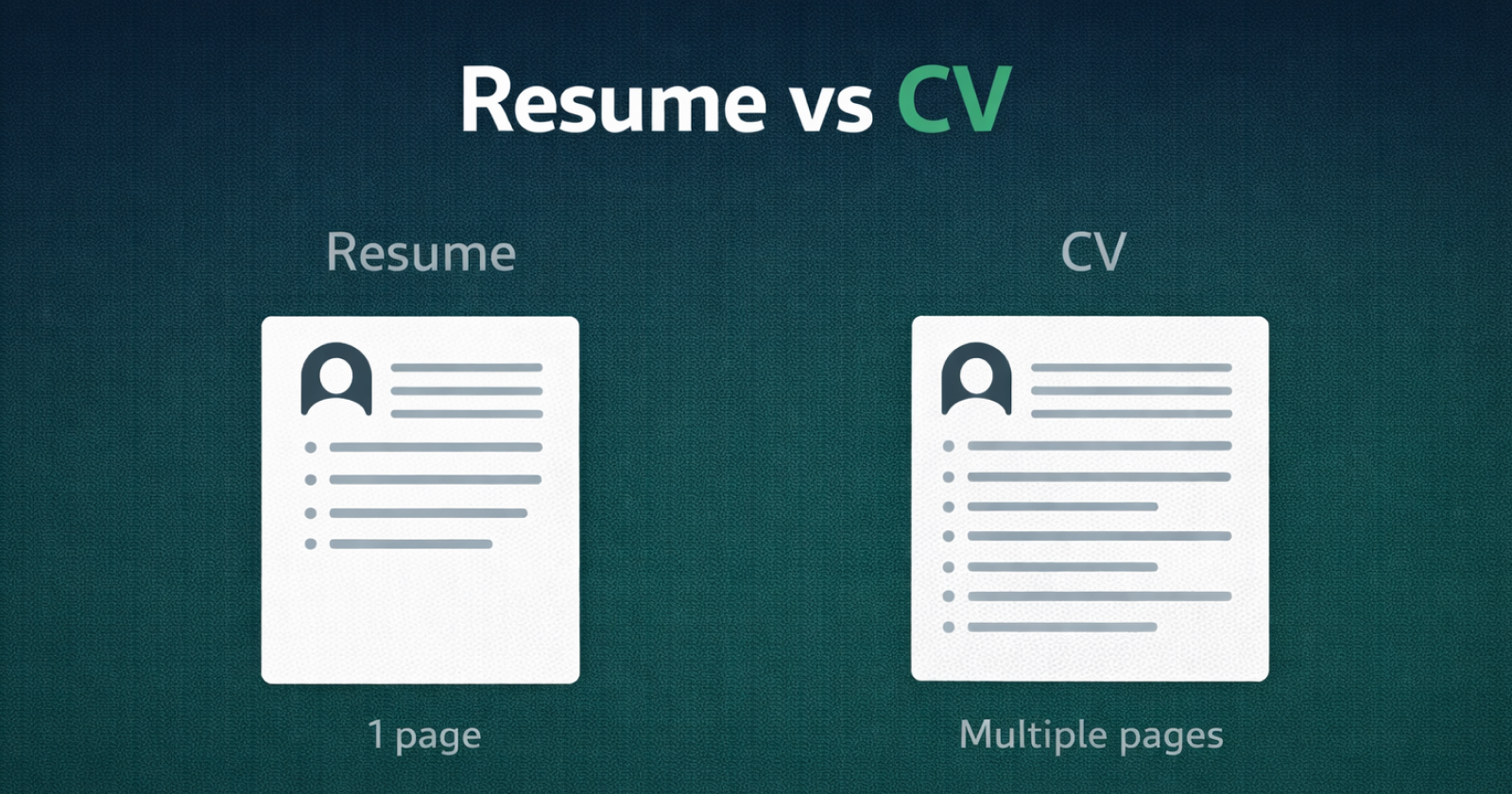
A UK CV that suddenly switches to "optimized", "organization" and "resume" mid-document, or a US resume with "colour" in one bullet, suggests pasted text. Check your spelling settings and keep one convention throughout. Our guide to the difference between a resume and a CV covers what each market expects.
5. Numbers that do not survive the interview
This is the serious one. Ask an AI tool to "add metrics" and it will often invent plausible-looking figures: "increased sales by 35%", "reduced costs by £200,000". If you cannot explain where a number came from, an interviewer will find out in one follow-up question. Invented figures turn a weak CV into a dishonest one, and dishonesty is a far bigger problem than generic writing.
What Employers' AI Policies Mean
Employers vary widely. Some explicitly welcome candidates using AI to improve their writing. Others, including some graduate recruiters, ask candidates not to use AI for written application answers, or require you to confirm the answers are your own. Online tests and interviews increasingly include rules about AI assistance.
Three practical rules:
- Read the application instructions. If an employer asks you not to use AI for a specific answer, follow it.
- Never use AI during a live or recorded assessment unless the employer says you can.
- Your CV must be accurate either way. Whoever drafted the words, you are responsible for every claim.
How to Use AI Honestly and Well
AI tools are genuinely useful for CV writing when you supply the facts and use the tool for structure and editing.
Give it facts, not adjectives
Instead of asking for "a strong bullet about my sales role", give the tool the raw material: what you did, the numbers you actually have, and who benefited. Ask it to make the sentence shorter or clearer, not more impressive.
Use it to cut, not to pad
AI is good at turning a three-line bullet into one line, removing repetition and finding a stronger verb. It is poor at adding substance it does not have.
Leave gaps visible
If a bullet would be stronger with a number you do not have to hand, leave a placeholder such as [X] and find the real figure, or remove the claim. CVEdge's Fix All rewrite works this way: where a figure is missing, it leaves an [X] placeholder rather than inventing one.
Tailor with the job description
AI can help you compare your CV with a job description and spot missing skills or keywords. Add them only where they are true. Our guide to tailoring your CV to a job description covers the process.
Edit the result line by line
Read every AI-suggested line aloud. If it sounds like something you would never say, rewrite it in your own words. Remove the stock phrases listed above. Check spelling against UK or US conventions.
A Quick Self-Check Before You Apply
- Could each bullet only belong to you?
- Can you explain every number in an interview?
- Have you removed stock phrases?
- Is the spelling consistent with the country you are applying in?
- Have you followed the employer's stated AI policy?
If the answer to all five is yes, how the first draft was produced matters very little. For a fuller comparison, see AI resume builder vs writing it yourself.
Related Guides
- AI Resume Builder vs Writing It Yourself
- How to Write Resume Bullet Points That Show Impact
- How to Tailor Your CV for a Job Description
- How to Write a CV in the UK
Frequently asked questions
Is it wrong to use ChatGPT to write a CV or resume?
Not in itself. Many employers accept it as a writing aid. The problems are generic language, invented numbers, and ignoring an employer's explicit instruction not to use AI for application answers.
Can AI detectors prove I used ChatGPT?
No. AI text detectors are unreliable and produce false positives on formal writing. Recruiters are more likely to notice generic phrasing than to run a detector.
What words make a CV sound AI-written?
Stock phrases repeated throughout, such as "spearheaded", "leveraged", "results-driven", "dynamic" and "proven track record". Replace them with specific actions and outcomes.
Should I let AI add numbers to my bullets?
No. Only use figures you can explain and, where possible, evidence. If you lack a number, leave a placeholder, find the real figure, or describe the outcome without one.
Will using AI hurt my ATS score?
Not directly. Applicant tracking systems parse text and match keywords; they do not penalise AI writing. A CV can still score poorly if AI has replaced specific skills and job titles with vague language.
Next Step
Upload your CV to the free ATS CV checker to see what an employer's system pulls out of it, then fix the gaps before you apply.