

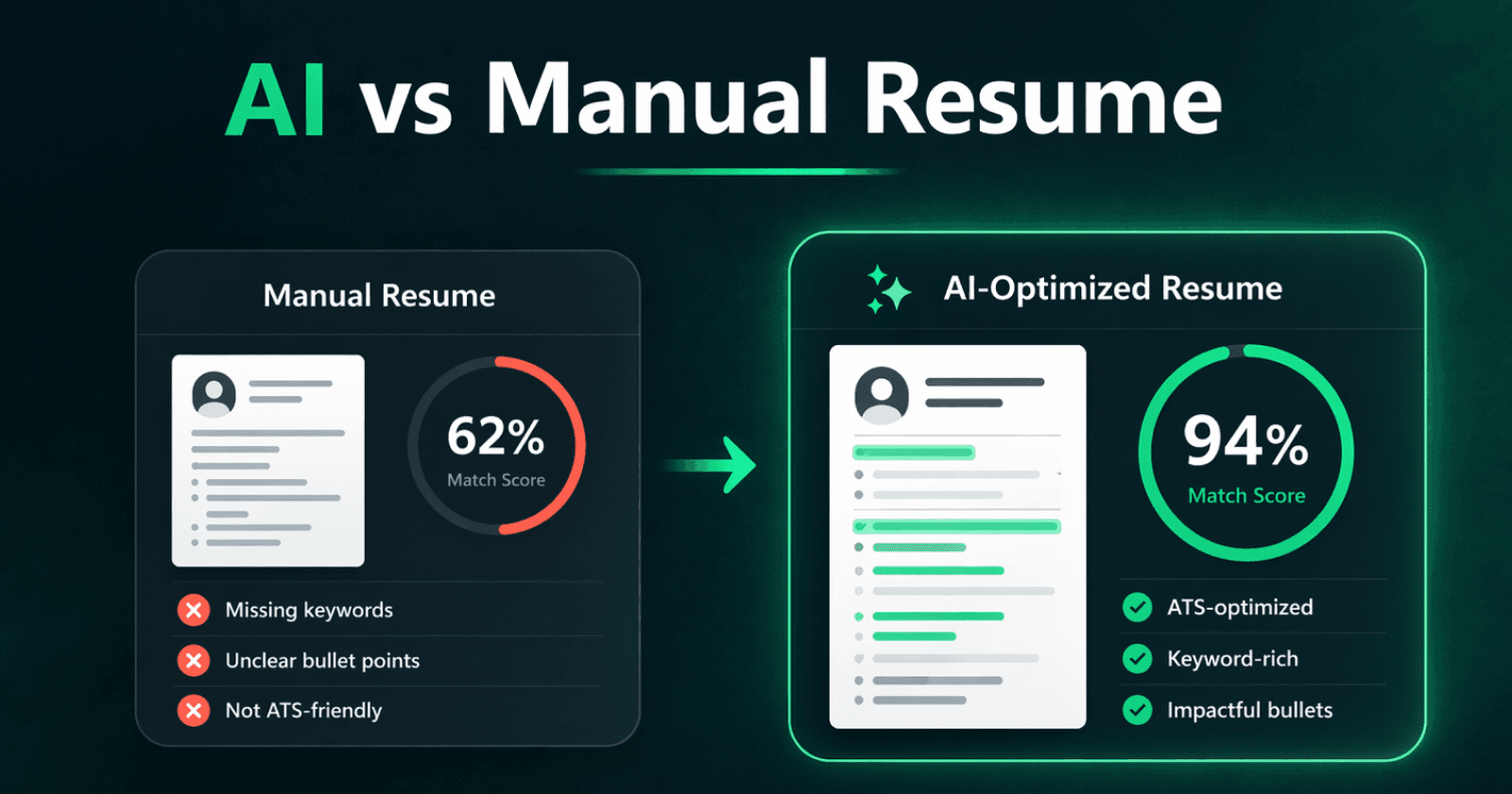
We build an AI resume tool, so treat what follows with appropriate scepticism — but the honest answer is that AI is genuinely good at some parts of this and genuinely bad at others, and knowing which is which will get you a better CV than committing fully to either approach.
Where AI genuinely helps
Restructuring bullets you have already written
This is the strongest use case by a distance. You know what you did; the difficulty is compressing it into a line that leads with the result. Give a model "I was in charge of the reporting process and made it faster by automating some of it" and it will reliably return something closer to "Automated recurring reporting, cutting turnaround from 2 days to same-day." The raw material is yours; the compression is mechanical.
Vocabulary alignment
Spotting that a posting says "stakeholder management" where your CV says "worked with business partners" is tedious and error-prone by hand. Comparing two documents for terminology gaps is exactly what these systems are good at.
Formatting and consistency
Tense consistency, parallel bullet structure, date formatting, and parser-safe layout are rule-following tasks. Doing them manually is a poor use of your time.
Beating the blank page
A mediocre first draft you can react to is more useful than an empty document. Editing is easier than generating.
Where AI fails
It does not know what you did
The fundamental limit. A model given a job title will produce plausible-sounding achievements for that title — which are fiction. Every number it invents is a trap you walk into during the interview, and interviewers probe numbers precisely because they are checkable.
Any tool that generates achievements from a title alone is producing liabilities, not a CV.
It flattens voice
Unconstrained models converge on the same register: "spearheaded", "leveraged", "cutting-edge solutions", "results-driven professional". Recruiters read hundreds of CVs a week and this pattern has become conspicuous. Uniform polish across every bullet reads as generated, and generated reads as unexamined.
It cannot judge relevance
Deciding that your two years in logistics matter more than your five in retail for this particular application requires understanding the target role's priorities. That judgement remains yours.
It over-claims
Models trained to be helpful tend to upgrade "helped with" to "led". Sometimes that is a fair reframing; sometimes it is a misrepresentation you will have to defend. Always check the seniority implied by a rewrite.
Can recruiters tell?
Often, yes — not through detection tools, which are unreliable, but through pattern recognition. The signals are consistent: every bullet the same length and rhythm, uniformly grandiose verbs, achievements with suspiciously round numbers, and a summary of generic superlatives with no specific claim.
Worth being clear about what is actually penalised. Using AI is not the problem; nobody objects to spell-check. What gets penalised is a CV that reads as though the candidate did not think about it — because that predicts how they will approach the job.
The hybrid approach
- You write the raw material. Brain-dump what you did, in whatever form. Include numbers wherever you can recall or reconstruct them.
- AI restructures it. Compress into result-first bullets, enforce parallel structure, fix tense.
- AI finds keyword gaps against the specific posting.
- You verify every claim. Check each number, each verb's seniority, each implied scope. Remove anything you would not want examined.
- You re-inject specificity. Restore the concrete detail that makes it yours — the odd system name, the unusual constraint, the thing only someone who was there would mention.
Step five is what most people skip, and it is where the difference shows. Specific detail is the strongest available signal of authenticity, and it also gives the interviewer something to ask about — which is the point of the document.
What good tooling should do
Judge a resume tool by whether it refuses to invent. Ours uses [X] placeholders where a metric is missing rather than filling in a plausible figure, because a blank you fill in honestly is worth more than a number you have to defend. That constraint is the difference between a tool that helps and one that hands you a problem.
Try the middle path
Upload your CV to CVEdge for a free ATS score and bullet-level rewrite suggestions — you keep the underlying claims, the tool handles structure and keyword alignment, and nothing gets fabricated on your behalf.