
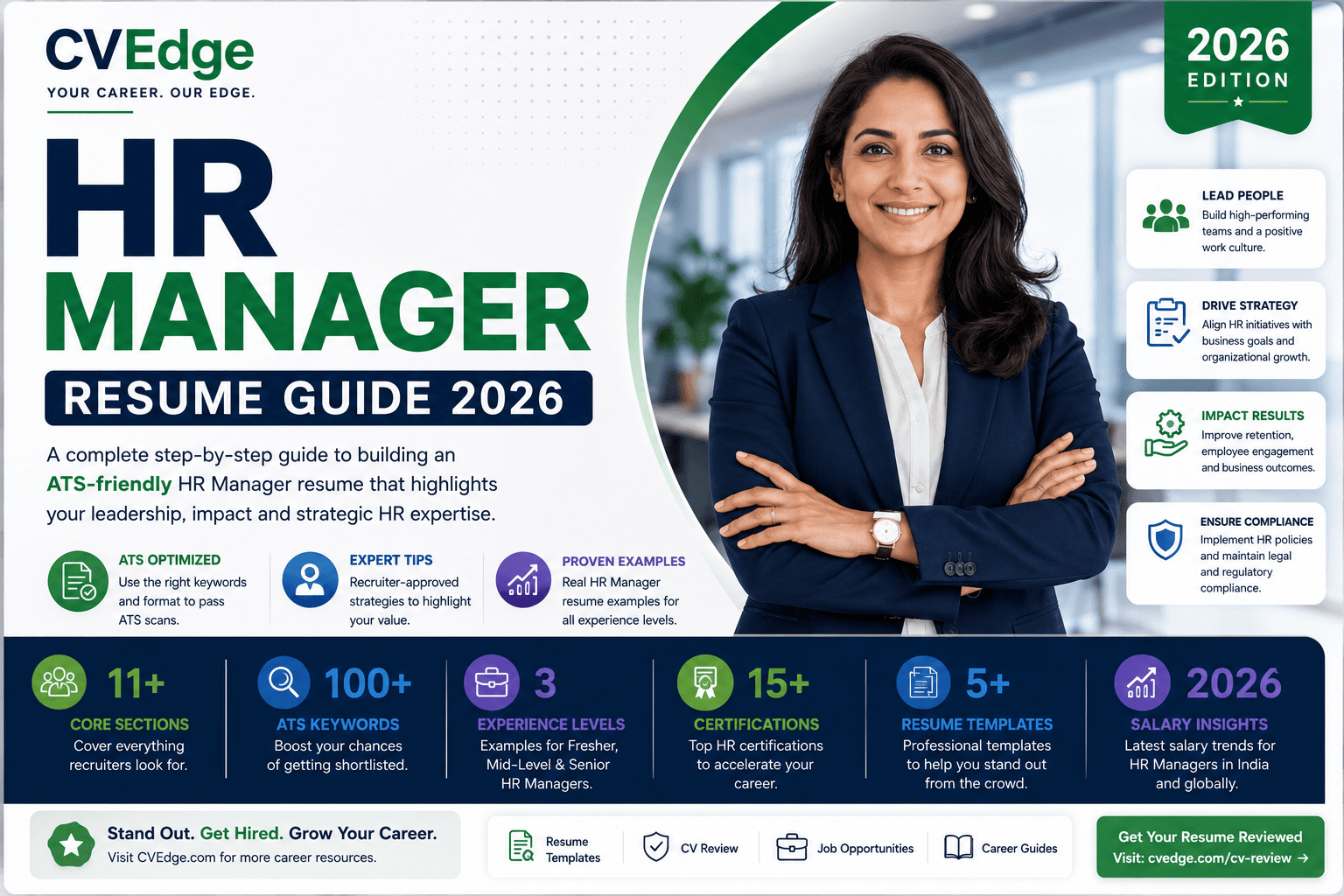
HR managers have a distinctive problem when they apply for jobs: they are being screened by people who screen CVs professionally. Every shortcut is familiar to the reader, because the reader uses the same ones. Generic competency language ("strong communicator", "passionate about people", "strategic HR business partner") lands worse here than in any other field, because the person reading it has rejected a hundred CVs that said the same thing.
The compensating advantage is that a specific, well-evidenced HR CV stands out sharply against that background.
Define the scope in the first two lines
"HR Manager" spans an enormous range. It can mean the entire people function at a 60-person company, or a specialist managing employee relations in a division of 4,000. It can be generalist or heavily weighted toward one discipline. It can include payroll or not, recruitment or not, and the difference between operating in one jurisdiction and eleven is substantial.
State it immediately: "HR Manager, six years: sole HR lead for a 180-person manufacturing business across two UK sites, covering the full employee lifecycle including ER, payroll oversight and H&S coordination." A reviewer knows exactly what you are in one sentence.
Include headcount supported, number of sites or jurisdictions, whether you manage a team, sector, and which disciplines you own directly versus partner on.
The metrics that actually mean something
HR is measurable, and HR CVs routinely fail to measure. But not all the available numbers say what people think they say.
Numbers that land:
- Time to hire and cost per hire, with the before and after. "Reduced average time to hire from 47 to 29 days by restructuring the interview process and introducing structured scorecards."
- Retention or regretted attrition, ideally segmented. "Cut first-year attrition in the warehouse population from 38% to 22% over eighteen months."
- Employee relations volume and outcome. "Handled 40+ formal ER cases including twelve disciplinaries and four grievances; no tribunal claims arising."
- Engagement survey movement, with participation rate: a score that moved on 30% participation means much less than one on 85%, and quoting the participation rate signals you know that.
- Absence rates, where you ran an intervention against them.
- Cost. Recruitment agency spend reduced, benefits renegotiated, restructures delivered within budget.
Numbers that do not: "Managed HR for 200 employees" is scope, not achievement. Useful context, but not a result. "Improved company culture" is unmeasurable as written. "Achieved 95% employee satisfaction" without the participation rate or the instrument is a number a fellow HR professional will immediately discount.
Employee relations is where credibility is established
ER is the discipline that separates HR managers who have handled hard things from those who have administered easy ones, and it is the most under-described area on most HR CVs.
Be concrete about volume and type: disciplinaries, grievances, performance management, sickness and capability, TUPE, redundancy and restructure, tribunal exposure. Name the frameworks you have worked within, and be accurate about your role: whether you advised managers, ran cases yourself, or led the organisational process.
Confidentiality obviously applies. Describe the category and the outcome, never the individual. "Led a 40-role redundancy consultation across two sites, completed on schedule with no successful claims" says everything needed without identifying anyone.
Systems and compliance are searchable
HRIS experience is a hard filter in many screens, and recruiters search by product name. List the actual systems: Workday, SAP SuccessFactors, BambooHR, Personio, HiBob, ADP, Sage, Ceridian, Oracle HCM. Add applicant tracking systems separately (Greenhouse, Lever, Workable, Teamtailor) and payroll systems if you have owned payroll.
Name the employment law framework you operate under, because it does not transfer automatically across jurisdictions: UK employment law, TUPE, GDPR as it applies to employee data, or the equivalents for your market. If you have multi-jurisdiction experience, say which jurisdictions: it is a genuine differentiator and reviewers will not assume it.
Qualifications carry real weight. CIPD level and membership status, SHRM-CP or SHRM-SCP, PHR or SPHR, or an in-progress qualification with its expected date. Put them near the top.
The strategic claim needs evidence
Almost every HR CV claims to be strategic rather than transactional. The claim is only worth making if something on the page demonstrates it.
What demonstrates it: a workforce plan you built and what it changed. A restructure you designed rather than administered. A pay and grading framework you introduced. A policy change you drove that had a measurable effect. Evidence of influencing a decision above your level.
What does not: the word "strategic".
The document is being read as a work sample
More than in most professions, an HR manager's CV is assessed as evidence of professional judgment about CVs. Typos, inconsistent formatting, three pages of undifferentiated duties, an objective statement, or a photograph on a UK or US application all read as an HR professional who does not follow their own guidance.
Two pages maximum, one if you are earlier in your career. Standard headings. Contact details in the body of the page, not a document header, and yes, HR CVs get parsed by applicant tracking systems too, which is a detail worth getting right when you administer one.
Check yours against the free ATS checker to see what the extraction actually produces.