

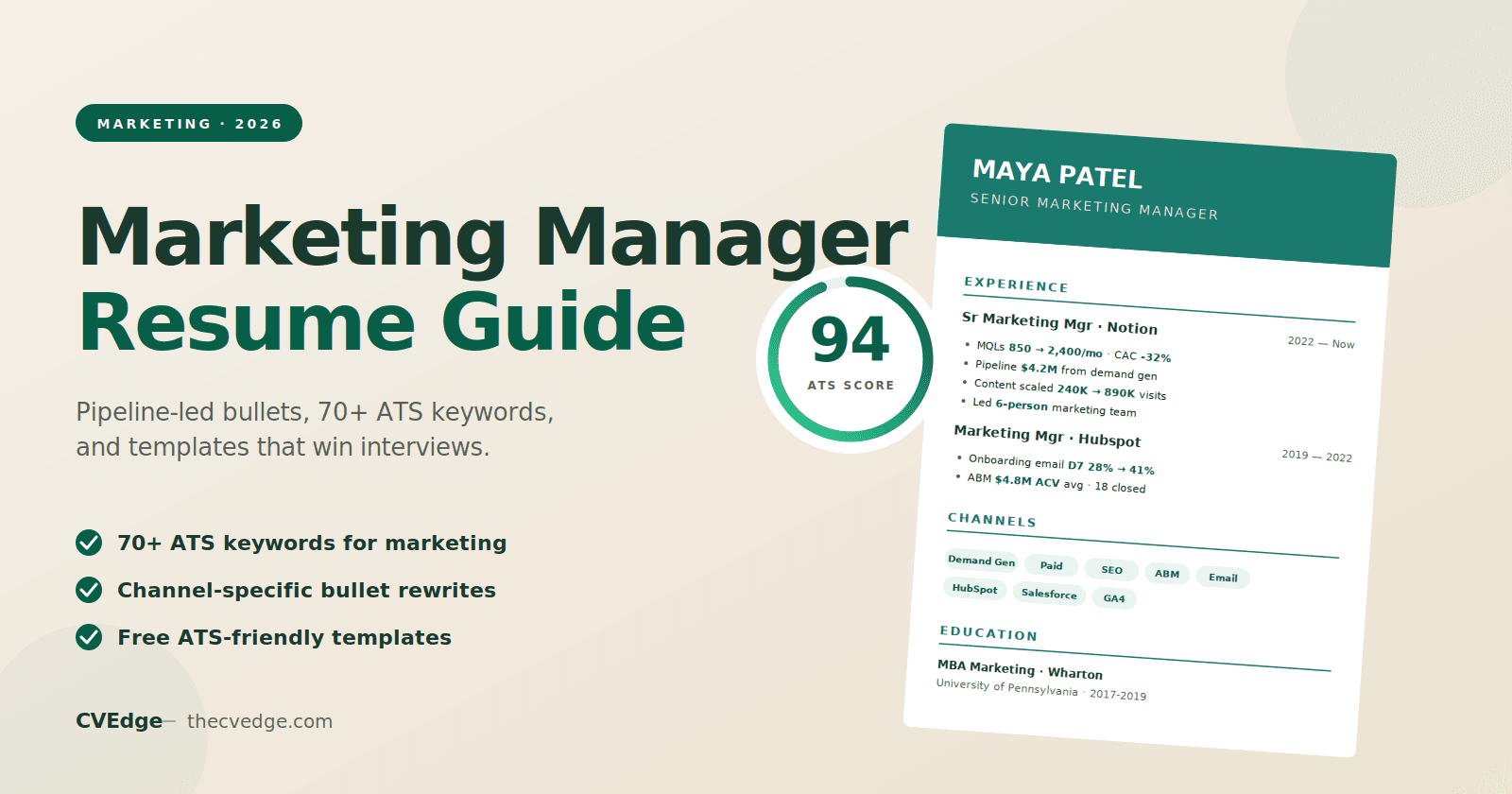
Marketing managers face a uniquely competitive resume market.
The role attracts generalists, specialists, brand people, growth hackers, content people, performance marketers — all applying to similar-sounding job titles. ATS systems sort through hundreds of applicants per role, looking for specific signals.
If your resume reads like a generic "marketing professional with strong communication skills," you'll never make the shortlist. Even if you've delivered real results.
This guide shows you how to write a marketing manager resume that signals specialisation, quantifies impact, and passes ATS in 2026.
What Marketing Hiring Managers Actually Look For
Marketing leaders scan resumes for four signals:
- Channel specialisation — Are you a paid media person, content person, brand person, growth person?
- Pipeline impact — Did your work move revenue, leads, or retention metrics?
- Stack fluency — Do you know the modern tools (HubSpot, Salesforce, GA4, Marketo)?
- Cross-functional credibility — Can you work with sales, product, and exec teams?
Generic descriptions like "managed marketing campaigns" don't signal any of these. Specific outcomes do.
The Marketing Manager Resume Bullet Formula
Every strong marketing bullet follows the same shape:
[Action verb] + [channel/tactic] + [scope or scale] + [pipeline outcome]
Compare these two bullets:
Weak:
Managed paid media campaigns
Strong:
Scaled paid acquisition across Google, Meta, and LinkedIn — grew MQLs from 850/mo to 2,400/mo while reducing CAC 32% ($240 → $163)
The strong version answers all four signals: channel specialisation (paid acquisition, three platforms), scope (1,500+ MQL increase), stack (named platforms), business impact (CAC reduction).
Real Examples: Before vs After
Six common marketing bullets, rewritten:
1. Demand generation
- ❌ Ran lead generation campaigns
- ✅ Built integrated demand gen program (paid + content + email) generating $4.2M pipeline in 12 months — 38% of new business sourced
2. Content marketing
- ❌ Created content for blog and social
- ✅ Scaled content engine from 4 to 16 posts/month — grew organic traffic 240K → 890K monthly visits, 28 first-page rankings
3. Brand campaigns
- ❌ Led brand awareness initiatives
- ✅ Led rebrand and Q4 launch campaign — 14M impressions, 38% lift in unaided brand recall (HubSpot survey, n=1,200)
4. Email & lifecycle
- ❌ Improved email performance
- ✅ Rebuilt onboarding email flow in HubSpot — D7 activation 28% → 41%, retention curve flattened, $620K ARR retained annually
5. Team leadership
- ❌ Managed marketing team
- ✅ Hired and led 6-person team across content, paid, lifecycle — quarterly OKR attainment averaged 92% over 18 months
6. ABM / Enterprise
- ❌ Worked on enterprise account marketing
- ✅ Designed ABM program targeting 120 enterprise accounts — 18 closed-won at $4.8M ACV avg, 40% influenced pipeline expansion
Notice the pattern: every strong bullet names a channel, gives a scope, and ends with a number tied to revenue or growth.
70+ ATS Keywords Every Marketing Resume Needs in 2026
ATS systems for marketing roles search across six categories. Include the ones matching your real experience.
Strategy & Channels
Demand generation · Content marketing · Brand strategy · Performance marketing · Growth marketing · Paid media · SEO · SEM · Email marketing · Lifecycle marketing · ABM · Influencer marketing · Partnership marketing · Field marketing
Tactics & Methodologies
Funnel optimisation · Conversion rate optimisation (CRO) · A/B testing · Lead scoring · Lead nurturing · Marketing automation · Persona development · Customer journey mapping · Attribution modelling · Multi-touch attribution
Tools & Platforms
HubSpot · Salesforce · Marketo · Pardot · Mailchimp · Klaviyo · Google Analytics (GA4) · Google Tag Manager · Looker · Tableau · Hotjar · Mixpanel · Segment · Iterable · Customer.io · Webflow · WordPress
Paid Channels
Google Ads · Meta Ads · LinkedIn Ads · TikTok Ads · YouTube Ads · Display advertising · Programmatic · Retargeting · Performance Max · Demand Gen campaigns
Metrics & Outcomes
Pipeline · MQL · SQL · CAC · LTV · LTV:CAC · ROAS · CPL · CPA · CPC · Click-through rate (CTR) · Conversion rate · Engagement rate · Brand lift
Soft Skills (use sparingly)
Stakeholder management · Cross-functional leadership · Storytelling · Brand voice · Creative direction · Budget management · Vendor management
Watch out: Listing 70 keywords looks junior. Pick the 20-25 you've genuinely used in production and weave them into bullets naturally.
How to Structure a Marketing Manager Resume
For Manager to Senior Manager: one page. For Director+ with 10+ years: two pages maximum.
The order that consistently performs best:
- Contact — Name, target title (e.g. "Senior Marketing Manager · Demand Gen"), location, LinkedIn, portfolio if applicable
- Summary — 3-4 lines. Lead with years of experience, channel specialisation, signature achievement
- Experience — Reverse chronological. Most recent role gets 5-6 bullets; older roles get 2-3
- Skills — Grouped by category (Channels, Tools, Strategy)
- Education — Brief unless early career
- Certifications — HubSpot, Google Analytics, Google Ads, Meta Blueprint, Marketo
Avoid: tables, columns, infographic-style layouts. ATS parsers strip or mangle these.
What a Strong Marketing Summary Looks Like
This is the most over-written section on most marketing resumes. Cut every word that doesn't add specificity.
Weak:
Results-driven marketing professional with proven track record of driving brand awareness and customer engagement through innovative campaigns.
Strong:
Senior Marketing Manager · 7 years leading B2B SaaS demand gen. Grew MQL pipeline 3x at $40M ARR company. Led $2.4M annual paid budget across Google, LinkedIn, Meta. HubSpot + Marketo certified.
The strong version is shorter, more specific, and signals scope in three numbers.
The 5 Mistakes That Kill Marketing Resumes
After scoring thousands of marketing resumes through CVEdge, the same five mistakes recur:
1. "Managed campaigns" syndrome — A resume full of bullets that describe activities ("ran", "managed", "executed") with no business outcome. Hiring managers want to see you grew something, not that you stayed busy.
2. Vanity metrics — "Increased social engagement 25%" without baseline or business outcome reads as fluff. Tie everything to pipeline, revenue, or retention.
3. Channel ambiguity — Listing every channel (paid, content, brand, lifecycle, partnerships, events) at the same depth. Pick a primary specialisation. Generalist resumes lose to specialist ones at the senior level.
4. Tool-stuffing — Listing 30 tools doesn't make you sound experienced. Pick the 8-10 you actually used in depth.
5. No revenue context — Marketing exists to drive revenue. If your bullets don't mention pipeline, ARR, ROAS, CAC, or LTV at least somewhere, hiring managers can't size your impact.
ATS-Friendly Templates for Marketing Roles
The templates that consistently parse cleanly for marketing:
- Sharp — clean modern layout with strong skill chips, popular for senior marketers
- Executive — dark header bar, signals seniority for Director+ marketing
- Minimal — perfect for senior individual contributors who let craft show
- Coastal — warm two-column with photo space (good for international markets)
- Aurora — chip-style skills section that signals stack fluency at a glance
All five are free in CVEdge and tested against major ATS platforms.
Pro tip: For marketing, your portfolio link matters. If you have a personal site, case studies, or a Notion portfolio, link it in the summary line — recruiters click through.
Free Marketing Resume Template (Pre-built)
Sign up free at thecvedge.com and you'll get:
- 24 ATS-tested templates including all five above
- Real-time ATS scoring with category-level feedback
- AI rewrites that turn vague bullets into measurable ones
- Job match scoring against any marketing JD you paste in
- Cover letter generation in three tones
Free forever tier: 3 CVs, 10 ATS scans, 25 AI rewrites, 5 job matches per week. No credit card. No watermark.
The Bottom Line
A strong marketing manager resume isn't about adding more — it's about cutting until only the signals remain.
Channel. Scope. Stack. Revenue.
Every bullet should hit at least two of those four. The 70+ keywords above tell ATS what you do. The bullet formula tells humans why you're worth interviewing.