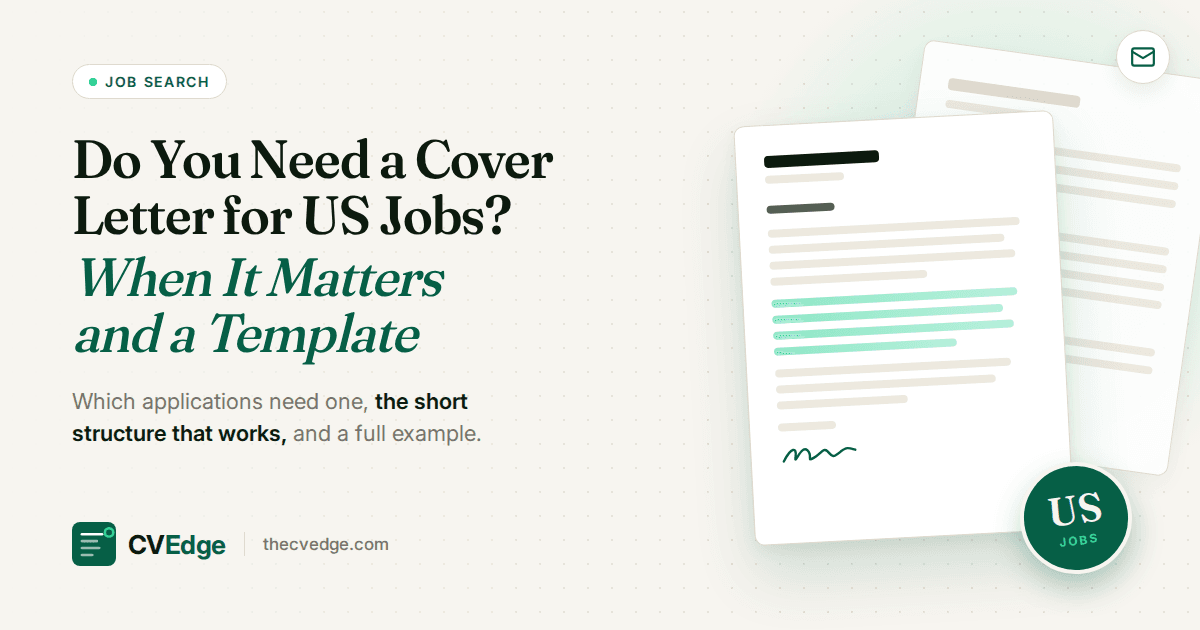
Do You Need a Cover Letter for US Jobs?
Ask ten American recruiters whether they read cover letters and you will get a split answer, because it depends on the role, the company size and whether the letter says anything the resume does not. At high-volume employers the letter is usually never opened. At small companies, in writing-heavy roles, and in any application where you need to explain something (a career change, a relocation, a gap, a specific reason for wanting that employer) it can decide the interview. The trick is knowing which application you are in, and writing a letter short enough that it gets read when it matters.
When the Cover Letter Matters
- The posting requires it. Then a missing letter is an incomplete application.
- Small companies and startups. The hiring manager often reads applications directly.
- Writing-heavy roles: marketing, communications, content, policy, law, journalism, grant work.
- Career changes. The resume shows what you did; the letter explains why the change makes sense.
- A specific reason for this employer. A product you use, a mission you have worked toward, a referral.
- Anything the resume cannot say gracefully: relocation, a gap, returning to the workforce.
When It Is Usually Ignored
- Large employers hiring through Workday, Greenhouse or iCIMS at volume, where the recruiter screens parsed resume data.
- Engineering roles at most technology companies, where the take-home or screen is the filter.
- Any application where the letter is marked optional and you have nothing specific to add.
Even then, a short letter costs little and occasionally helps. It never helps if it is generic.
The Structure That Gets Read
Three paragraphs, under 250 words, on one page with the same header as your resume.
- Why this role, in one specific sentence. Name the company and the role, and give the one reason that is true for you and not for every applicant.
- The proof. One or two results from your resume that map directly to the posting's top requirement, with numbers. Not a summary of the resume; a selection from it.
- The close. What you would bring in the first months, and a direct line asking for the conversation.
No "I am writing to apply for", no "I believe I would be a great fit", no restating the job description back to them.
A Full Example
Dear Ms. Alvarez,
Northwind's move into mid-market payroll is the reason I am applying for the Customer Success Manager role: I spent the last four years retaining exactly that segment at Brightline, and the problems your product page describes (multi-state compliance, onboarding time) are the ones I built programs to solve.
At Brightline I managed a $6M book of 45 mid-market accounts at 94% gross retention and 115% net revenue retention. When onboarding was the main driver of early churn, I rebuilt it into a 21-day guided program in Gainsight; time-to-first-value dropped from 45 days to 21, and 90-day churn fell from 8% to 2%. I would start at Northwind by mapping the first 30 days of a new customer's experience and finding the same leaks.
I would welcome a conversation about how that work translates to your book. Thank you for your time.
Priya Natarajan
That is 170 words, three specific facts, and a reason for the application that could not be pasted into another letter.
Format
- Same name, contact line and font as the resume.
- Date and the hiring manager's name if you can find it; "Dear Hiring Manager" if you cannot. Never "To Whom It May Concern".
- Letter size, one page, PDF, file named like your resume: Firstname-Lastname-Cover-Letter.pdf.
- If the application has a text box rather than an upload, paste the body without the address block.
Using AI to Draft It
AI tools produce serviceable cover letters quickly, and they produce generic ones by default. Give the tool the posting, your resume and the one specific reason you want the role, then cut what it returns to three paragraphs and check every fact. A letter that reads as generated is worse than no letter. The AI resume builder comparison covers the same trade-off for resumes.
Mistakes That Get Letters Skipped
- Over a page, or over 300 words.
- Opening with "I am writing to apply for".
- Repeating the resume instead of selecting from it.
- Adjectives about yourself in place of results.
- A generic letter with the company name swapped in.
- Addressing the wrong company. It happens more than you would think.
Templates That Parse Cleanly
Harvard Resume Template: the single-column academic-standard layout and the most downloaded template on CVEdge. Set it to Letter and it is the safest US default.
Classic Resume Template: standard headings, no graphics, parses cleanly in Greenhouse, Workday, Lever and iCIMS.
Executive Resume Template: for senior candidates who need the summary and leadership scope to land before the role history.
Related Guides
- Career Change Resume: Reframe Your Experience
- How to Tailor Your Resume for a Job Description
- US Resume Format 2026
Frequently asked questions
Are cover letters still necessary in 2026?
Only sometimes. Required by the posting, small employers, writing roles, career changes and applications with something to explain: yes. High-volume corporate applications: usually not read, but a short specific one does no harm.
How long should a US cover letter be?
Three paragraphs and under 250 words, on one page. Anything longer is skimmed or skipped.
Should I address the cover letter to a specific person?
If the name is findable on the posting, the team page or LinkedIn, yes. Otherwise "Dear Hiring Manager". Do not guess a name.
Can I use the same cover letter for every job?
No. The first sentence must be specific to the employer and the proof paragraph must match the posting's top requirement. A template with the company name swapped is recognised immediately.
Next Step
Upload your resume to the free ATS resume checker to see what an employer's system extracts from it, then fix the gaps before you apply.