

Business Analyst Resume Example 2026
Real bullet examples, ATS keywords, common mistakes, and free templates for business analyst roles. Know your ATS score before you apply.
No credit card · No watermarks · ATS score included
Writing a strong business analyst resume
Business analyst resumes prove two things: you can elicit and translate complex requirements, and your analysis drives real decisions. Show the size of the projects you influenced (budget, team, scope), the quality of your analysis (fewer change requests, on-time delivery), and the business outcomes your recommendations enabled.
Strong business analyst resume bullet examples
These are examples of well-written resume bullets for business analyst roles — metric-led, action-verb-first, and specific enough to be credible.
Led requirements definition for £2.4M ERP migration: facilitated 30+ stakeholder workshops, documented 180 user stories, and reduced scope creep by 45% versus comparable previous project
Analysed customer journey data across 4 touchpoints to identify £600K annual cost in manual rework; recommended and shepherded 3 process automations that eliminated the rework within 6 months
Developed business case for real-time inventory system: modelled 3 scenarios, stress-tested assumptions with finance team, secured board approval for £800K investment
Struggling with your own bullets? CVEdge's AI rewriter converts weak bullets like “Responsible for X” into strong, metric-led statements in one click. Paste your bullet, pick a mode, and get a better version instantly. Try it free
ATS keywords for business analyst resumes
These are commonly screened keywords for business analyst roles. Include the ones relevant to your experience — naturally integrated in your bullets and skills section, not keyword-stuffed.
Get role-specific keywords for your exact job description. CVEdge's Job Match tool compares your resume against any business analyst job description and shows which keywords are missing — with one-click add. Try it free
Common mistakes on business analyst resumes
Avoid these and you're already ahead of most applicants.
Process-only bullets — "Ran workshops" or "Wrote requirements" without the business impact
Missing stakeholder context — specify seniority ("C-suite stakeholders", "technical teams and business sponsors")
No value evidence — always state the financial or operational outcome your analysis enabled
The bullet formula that works for business analyst roles
Action verb
"Led", "Built", "Reduced", "Grew"
Strong opening that shows agency and ownership.
What you did
"migration of X", "dashboard covering Y"
Specific enough to be credible — avoid vague 'improved process'.
Measurable result
"by 40% for 2M users", "saving $420K"
The number that makes a recruiter stop scrolling.
Before (weak)
“Responsible for improving performance of the platform.”
After (strong)
“Reduced platform response time by 65% through caching and query optimisation, improving reliability for 500K monthly active users.”
What to include in each section of your business analyst resume
Professional Summary
3–4 sentences: your job title + years of experience + 2 core specialisms + what you're looking for. For business analyst roles, lead with your most relevant strength. Keep it under 80 words. Avoid clichés like 'results-driven' — be specific about what you actually do.
Experience
Reverse chronological order. 3–5 bullet points per role for the last 3 positions; 1–3 for older roles. Every bullet should have an action verb, what you did, and a measurable result. For business analyst roles, prioritise bullets that show scale, impact, and technical/functional depth.
Skills
List role-relevant tools, technologies, methodologies, and certifications. Group into categories where you have 5+ skills (e.g. Languages, Cloud, Frameworks). For ATS, ensure exact keyword matches with the job description — spell tools and technologies exactly as they appear in JDs.
Education
Degree, institution, year. Add relevant certifications below. For senior professionals (8+ years), education moves below experience and can be a single line. For graduates and early-career professionals, lead with education and include relevant coursework, projects, and academic achievements.
Best resume templates for business analyst roles
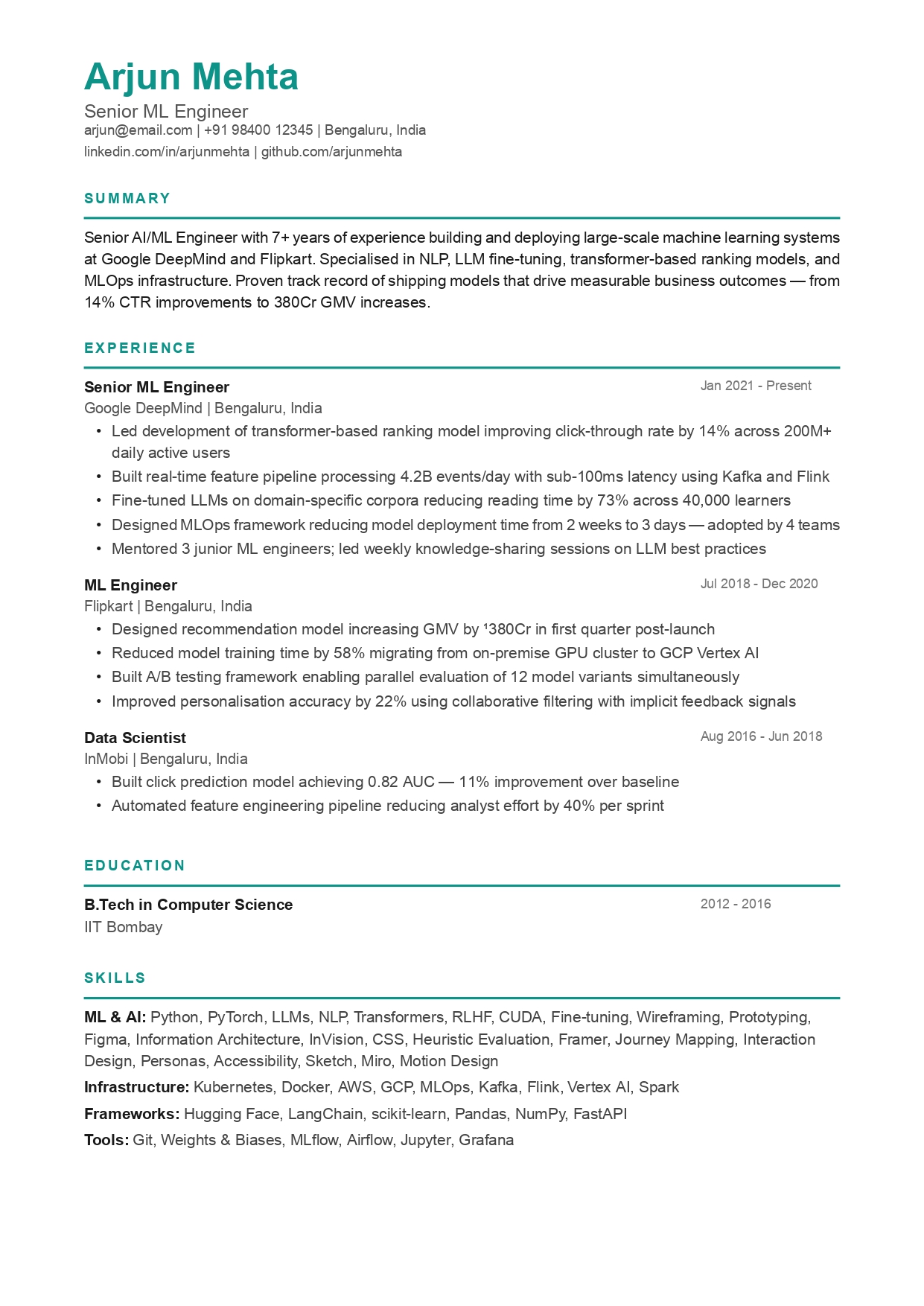
Classic template
The safe bet. Scores 95+ on ATS. Works for every company from startup to FAANG.
Use template
Executive template
Built for twenty years of career on two pages — premium spacing and a summary that leads, on a single ATS-safe column. Free to edit online, or download as Word or PDF.
Use templateHarvard template
experienced
Use templateLooking for business analyst jobs?
Browse live business analyst roles and match your resume against specific job descriptions before applying.
Business Analyst professional summary example
Three or four sentences that state your specialisation, your level, and the single result you most want read first.
Business analyst with 6 years in insurance operations and systems change. Redesigned claims intake across 4 teams, cutting handling time from 6 days to 2 and removing 3 duplicate approval steps. Led requirements for a policy-admin migration affecting 400 users, delivered with under 5% post-release change requests. SQL-fluent; validates assumptions in the data before specifying.
Before and after: business analyst resume bullets
Each pair below rewrites a bullet we see constantly on business analyst CVs, with the reason the rewrite works for this role specifically.
Gathered and documented business requirements from stakeholders.
Ran 30 stakeholder interviews across 4 departments for a policy-admin migration affecting 400 users, producing specifications that delivered with under 5% post-release change requests.
Why it works: Requirements gathering is the role definition. Scope, user scale, and the post-release change rate prove the specifications were actually right — which is the only real measure of BA quality.
Analysed business processes and recommended improvements.
Mapped the claims intake process end to end, finding 3 duplicate approval steps and a handoff causing 2-day queues; the redesign cut handling time from 6 days to 2 with no headcount change.
Why it works: "Recommended improvements" often means recommendations that went nowhere. Naming the specific waste found, the redesign and the outcome — with the constraint that headcount stayed flat — makes it concrete and credible.
Created user stories and acceptance criteria for the development team.
Reframed a requested 'export button' as a reporting-trust problem after finding users were exporting to rebuild figures they did not believe; the scheduled-reports feature that followed reached 60% adoption versus 8% for the original request.
Why it works: Writing stories is transcription. Changing what got built based on analysis is the BA's actual contribution, and the adoption comparison proves the reframing was right rather than merely clever.
Metrics that belong on a business analyst resume
Reviewers rank candidates on comparable numbers. These are the ones that carry weight in this role.
What changes by level
The same experience reads differently depending on the level you are targeting. Position your CV for the band you are applying to.
Junior (0–2 yrs)
Documents requirements within a defined scope. CV should show a delivered project and process-mapping ability.
Mid (2–5 yrs)
Owns analysis for a workstream. CV should show a process outcome you measured.
Senior (5–8 yrs)
Leads analysis across teams and shapes solutions. CV should show a reframed problem and cross-functional agreement.
Lead / Principal (8+ yrs)
Sets analysis practice and owns programme-level change. CV should show organisational outcomes.
What gets business analyst CVs screened out
Documentation output described with no outcome attached.
No metrics anywhere, which is common on BA CVs and therefore an easy differentiator.
Methodology names (Agile, BPMN, MoSCoW) without a decision they produced.
No evidence of ever challenging a stated requirement.
Skills and tools reviewers scan for
Core skills
Tools & platforms
CV sorted — now the interview
Real business analyst interview questions and what each round is scored on.
Business Analyst resume questions
What is the most common Business Analyst interview question?+
A vague stakeholder request that you must unpack — typically "someone asks for a new report, what do you do?" The expected answer is not to gather report specifications. It is to establish what decision the report is meant to support, who makes it, how often, what they do today, and whether existing data already answers it. Interviewers are checking whether you find the underlying need rather than transcribing the requested solution, because that distinction is the entire value of the role.
What is the difference between a Business Analyst and a Product Owner?+
BAs analyse problems and specify solutions; Product Owners prioritise and own outcomes. In practice the roles overlap heavily and many organisations use the titles interchangeably. The clearest distinction is decision authority — a Product Owner decides what gets built and in what order, while a BA informs that decision with analysis and then specifies it properly. If you want the decision rights, target PO or PM roles; the analysis skills transfer directly.
What metrics belong on a Business Analyst CV?+
Process outcomes and delivery impact. Cycle time reduced, manual hours removed, error rates cut, cost saved, systems or users affected, and requirements delivered without rework. "Mapped and redesigned the claims intake process across 4 teams, cutting handling time from 6 days to 2 and removing 3 duplicate approval steps" works because it names the scope, the mechanism and the measurable result — which is unusual on BA CVs and therefore stands out.
Do Business Analysts need technical skills?+
SQL is the one that consistently pays back, because it lets you validate assumptions yourself rather than queuing for data. Beyond that, understanding how systems integrate, being able to read an API specification, and comfort with process notation (BPMN) cover most expectations. You do not need to code. What is increasingly expected is data literacy — being able to define a metric precisely and check whether the change you specified actually moved it.
Build your business analyst resume — free
Upload your existing CV or start fresh. Get an ATS score in seconds and fix every issue before you apply.