

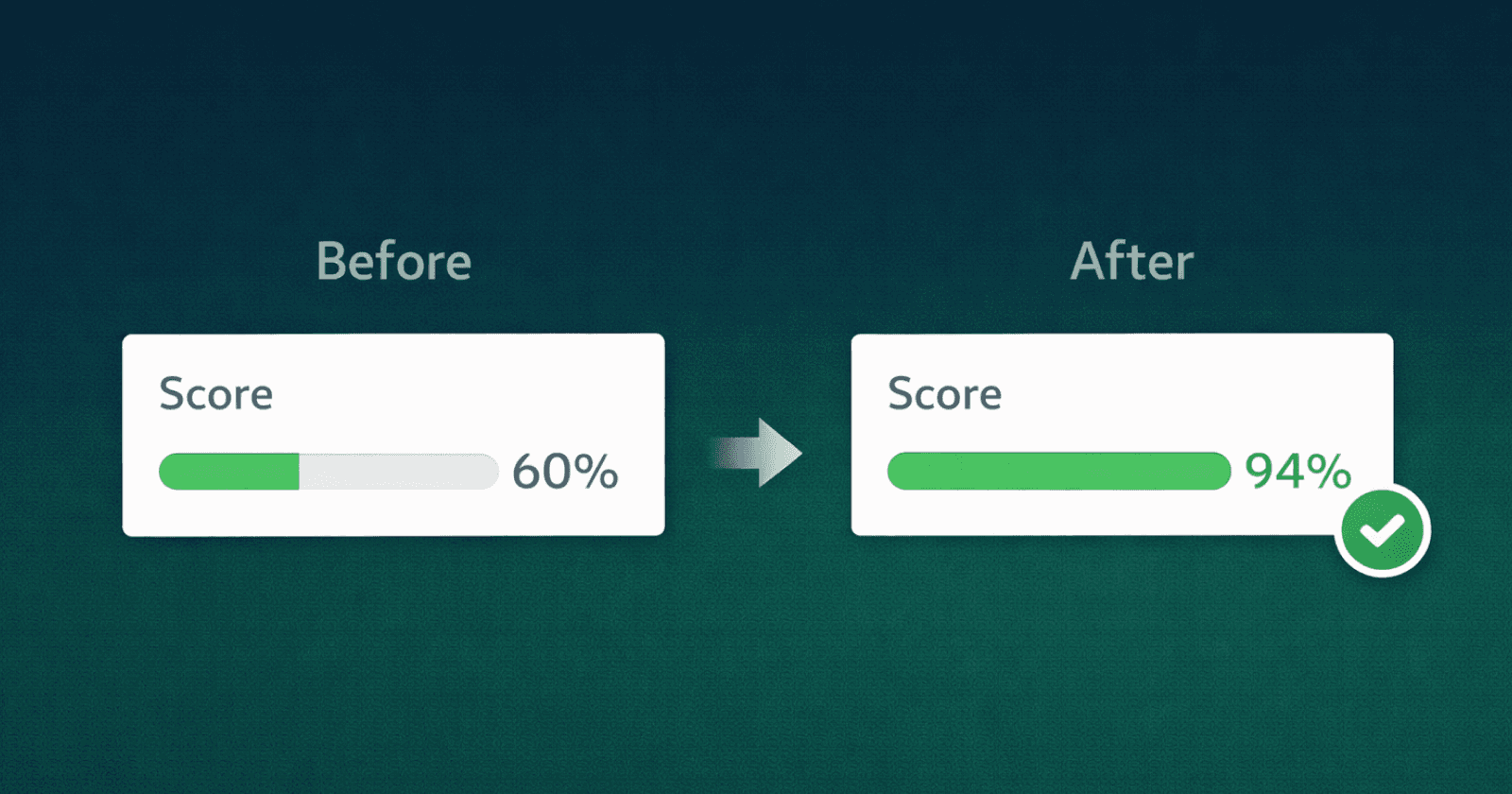
A 60% ATS score is a specific diagnosis, not a vague warning. Scores in that band almost always come from the same four problems, and each one is fixable in an afternoon. This guide walks through diagnosing which are costing you points, in the order that recovers the most score for the least work.
What an ATS score actually measures
An applicant tracking system does not read your CV the way a person does. It parses your document into structured fields — contact block, work history, education, skills — and then evaluates how well that structured data matches the role. Scoring tools model the same process, which is why a beautifully designed CV can score badly: the design interferes with parsing before content is ever assessed.
Most scoring breaks into six areas: contact details, section completeness, keyword coverage, measurable results, bullet quality, and formatting. A 60% score usually means passing three or four of these and failing badly on the rest. The fix is finding out which.
Problem 1: keyword coverage (usually the biggest single gap)
Keyword matching is the heaviest-weighted component in most scoring models, and it is where mid-range scores lose the most ground. The mistake is not that people omit keywords entirely — it is that they use a different vocabulary than the job description.
If a posting asks for "stakeholder management" and your CV says "worked with business partners", a human reads them as the same thing and a keyword matcher does not. The same applies to tool names: "AWS" and "Amazon Web Services" are not automatically equivalent, and neither are "CI/CD" and "continuous integration".
How to fix it: pull the ten most repeated terms out of the job description and check each one against your CV. Where a term is genuinely part of your experience but phrased differently, adopt the posting's wording. Where you have a real gap, leave it — inserting skills you do not have simply moves the failure to the interview.
One practical detail: spell out the acronym and the expansion together on first use, as in "continuous integration (CI/CD)". That satisfies both a literal matcher and a human reader.
Problem 2: bullets without results
The second-largest source of lost points is bullets that describe responsibilities instead of outcomes. "Responsible for managing the reporting process" states a job description. It contains no evidence of scale, no result, and nothing to distinguish you from every other applicant with the same title.
The structure that scores well is consistent across roles: a strong action verb, the specific thing you did, and a measurable result.
- Before: "Responsible for improving the reporting process."
- After: "Automated 30 recurring reports into self-serve dashboards, removing 12 analyst-hours per week and cutting stakeholder turnaround from 2 days to immediate."
Aim for a result on the majority of your bullets rather than all of them — some genuinely have no number attached, and forcing one produces obviously invented figures.
If you do not know the number: estimate a defensible range rather than omitting it. "Reduced processing time by roughly 40%" is credible and can be discussed in an interview. Precision you cannot defend is worse than an honest approximation.
Problem 3: missing or non-standard sections
Parsers look for conventional section headings. Creative alternatives — "Where I've Been" instead of "Experience", "My Toolkit" instead of "Skills" — frequently fail to map, and content underneath an unrecognised heading may be dropped from the structured record entirely.
Use the standard headings: Professional Summary, Experience, Education, Skills, and Certifications where relevant. This is one of the rare cases where being conventional is strictly better.
A missing skills section is especially costly, because it is where keyword matching does most of its work. If yours is absent or buried at the bottom in prose, adding a clean, scannable list is often worth several points on its own.
Problem 4: formatting that breaks parsing
These issues are invisible on screen and severe in effect:
- Tables and text boxes. Multi-column layouts built with tables often parse in the wrong reading order, interleaving unrelated lines.
- Headers and footers. Contact details placed in a document header are sometimes not extracted at all — the single most damaging version of this problem, since it can make you unreachable.
- Images and icons. Skill ratings shown as filled circles carry no text. An icon beside your phone number is not a phone number.
- Unusual fonts. Decorative or non-embedded fonts can extract as garbled characters.
- Wrong file type. Submit PDF unless the posting asks for .docx. Never submit an image or a design-tool export that contains no selectable text.
A quick self-test: open your PDF, select all, copy, and paste into a plain text editor. What you see is approximately what the parser sees. If the order is scrambled or your contact details are missing, that is your score problem.
The order to work in
Fixing these in sequence recovers score efficiently:
- Formatting first. No other fix matters if half your CV is not being read. Move contact details into the body, remove tables, flatten to a single column.
- Sections second. Standard headings, with a real skills section present.
- Keywords third. Align vocabulary with the posting, honestly.
- Bullets last. The most time-consuming and the most valuable in interviews, so it repays the effort twice.
Most CVs stuck in the 60s clear the 85–90 band after the first three steps alone.
A caution about scores
An ATS score is a proxy, not the goal. It measures whether your CV is machine-readable and relevant to a specific posting; it cannot measure whether your experience is compelling. A 95% score on a CV of vague, unmeasured bullets will still lose to a 78% CV that clearly demonstrates someone shipped valuable work.
Treat the score as a floor to clear rather than a number to maximise. Once you are consistently above 85, further effort is better spent on the strength of your bullets than on chasing the last few points.
Check where you actually stand
Guessing which of the four problems applies to you is slower than measuring it. Upload your CV for a free ATS score and you will see the category-level breakdown — which area is costing you points and the specific issues inside it — so you can start with whichever fix moves you the furthest.