

Security Architect Resume Example 2026
Real bullet examples, ATS keywords, common mistakes, and free templates for security architect roles. Know your ATS score before you apply.
No credit card · No watermarks · ATS score included
Writing a strong security architect resume
For Security Architect roles, the most important thing on your resume is demonstrable impact. Every bullet should connect what you did to what changed as a result. Use the format: action verb + what you did + the specific result. Quantify wherever possible — size, percentage improvement, revenue, cost, or time saved.
Strong security architect resume bullet examples
These are examples of well-written resume bullets for security architect roles — metric-led, action-verb-first, and specific enough to be credible.
Led security architect initiative from scoping to delivery, coordinating across 3 teams and delivering on time and within budget with measurable business outcome
Identified process inefficiency in core security architect workflow; designed and implemented solution that saved 20+ hours per week across the team
Managed cross-functional project involving senior stakeholders; maintained alignment through weekly reviews and delivered key milestones 2 weeks ahead of schedule
Struggling with your own bullets? CVEdge's AI rewriter converts weak bullets like “Responsible for X” into strong, metric-led statements in one click. Paste your bullet, pick a mode, and get a better version instantly. Try it free
ATS keywords for security architect resumes
These are commonly screened keywords for security architect roles. Include the ones relevant to your experience — naturally integrated in your bullets and skills section, not keyword-stuffed.
Get role-specific keywords for your exact job description. CVEdge's Job Match tool compares your resume against any security architect job description and shows which keywords are missing — with one-click add. Try it free
Common mistakes on security architect resumes
Avoid these and you're already ahead of most applicants.
Vague responsibility statements — "responsible for X" instead of "led X and achieved Y"
Missing metrics — every achievement should have a number: size, percentage, time, or money
No business impact context — show how your work connected to company goals or customer value
The bullet formula that works for security architect roles
Action verb
"Led", "Built", "Reduced", "Grew"
Strong opening that shows agency and ownership.
What you did
"migration of X", "dashboard covering Y"
Specific enough to be credible — avoid vague 'improved process'.
Measurable result
"by 40% for 2M users", "saving $420K"
The number that makes a recruiter stop scrolling.
Before (weak)
“Responsible for improving performance of the platform.”
After (strong)
“Reduced platform response time by 65% through caching and query optimisation, improving reliability for 500K monthly active users.”
What to include in each section of your security architect resume
Professional Summary
3–4 sentences: your job title + years of experience + 2 core specialisms + what you're looking for. For security architect roles, lead with your most relevant strength. Keep it under 80 words. Avoid clichés like 'results-driven' — be specific about what you actually do.
Experience
Reverse chronological order. 3–5 bullet points per role for the last 3 positions; 1–3 for older roles. Every bullet should have an action verb, what you did, and a measurable result. For security architect roles, prioritise bullets that show scale, impact, and technical/functional depth.
Skills
List role-relevant tools, technologies, methodologies, and certifications. Group into categories where you have 5+ skills (e.g. Languages, Cloud, Frameworks). For ATS, ensure exact keyword matches with the job description — spell tools and technologies exactly as they appear in JDs.
Education
Degree, institution, year. Add relevant certifications below. For senior professionals (8+ years), education moves below experience and can be a single line. For graduates and early-career professionals, lead with education and include relevant coursework, projects, and academic achievements.
Best resume templates for security architect roles
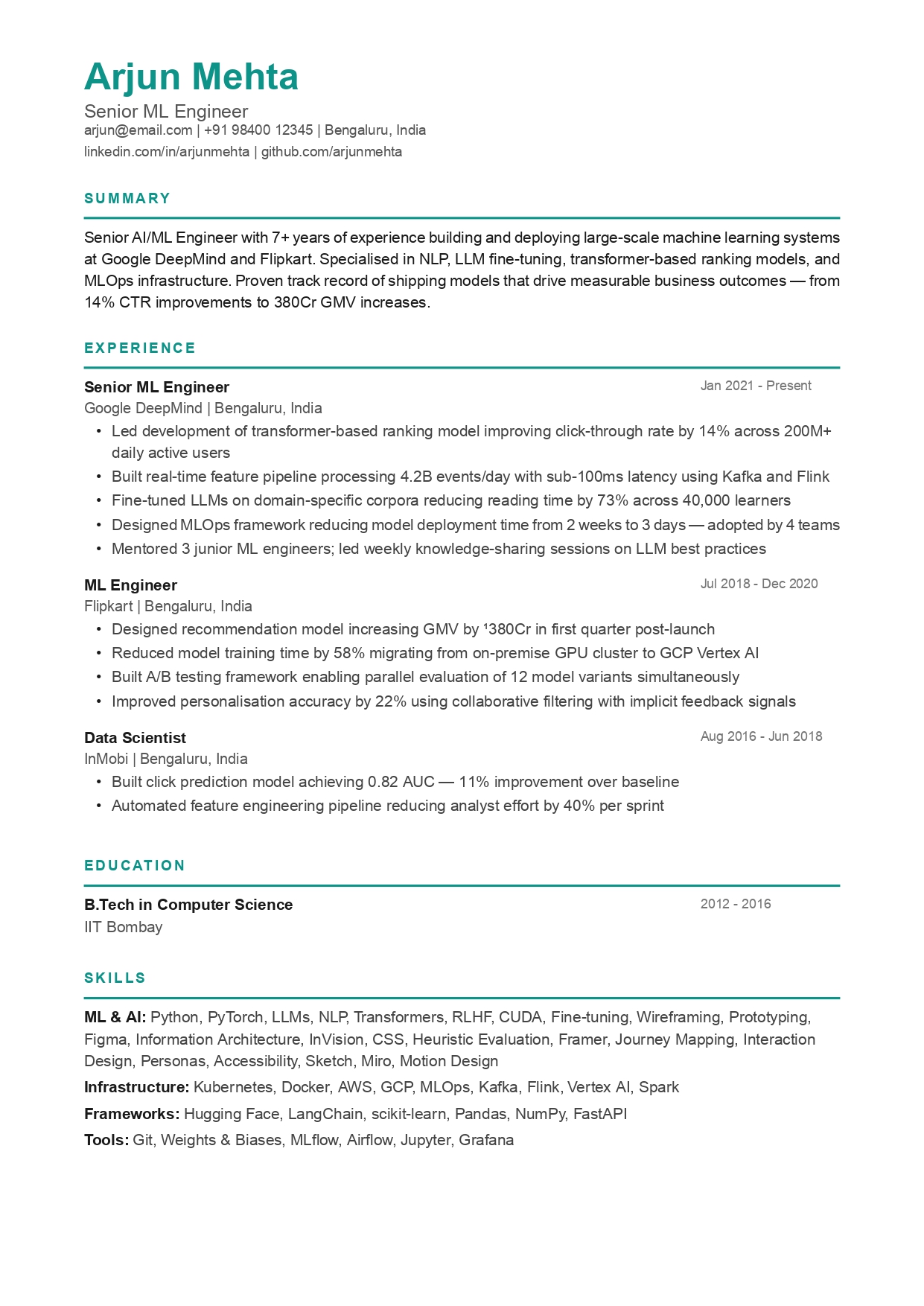
Classic template
The safe bet. Scores 95+ on ATS. Works for every company from startup to FAANG.
Use template
Executive template
Built for twenty years of career on two pages — premium spacing and a summary that leads, on a single ATS-safe column. Free to edit online, or download as Word or PDF.
Use template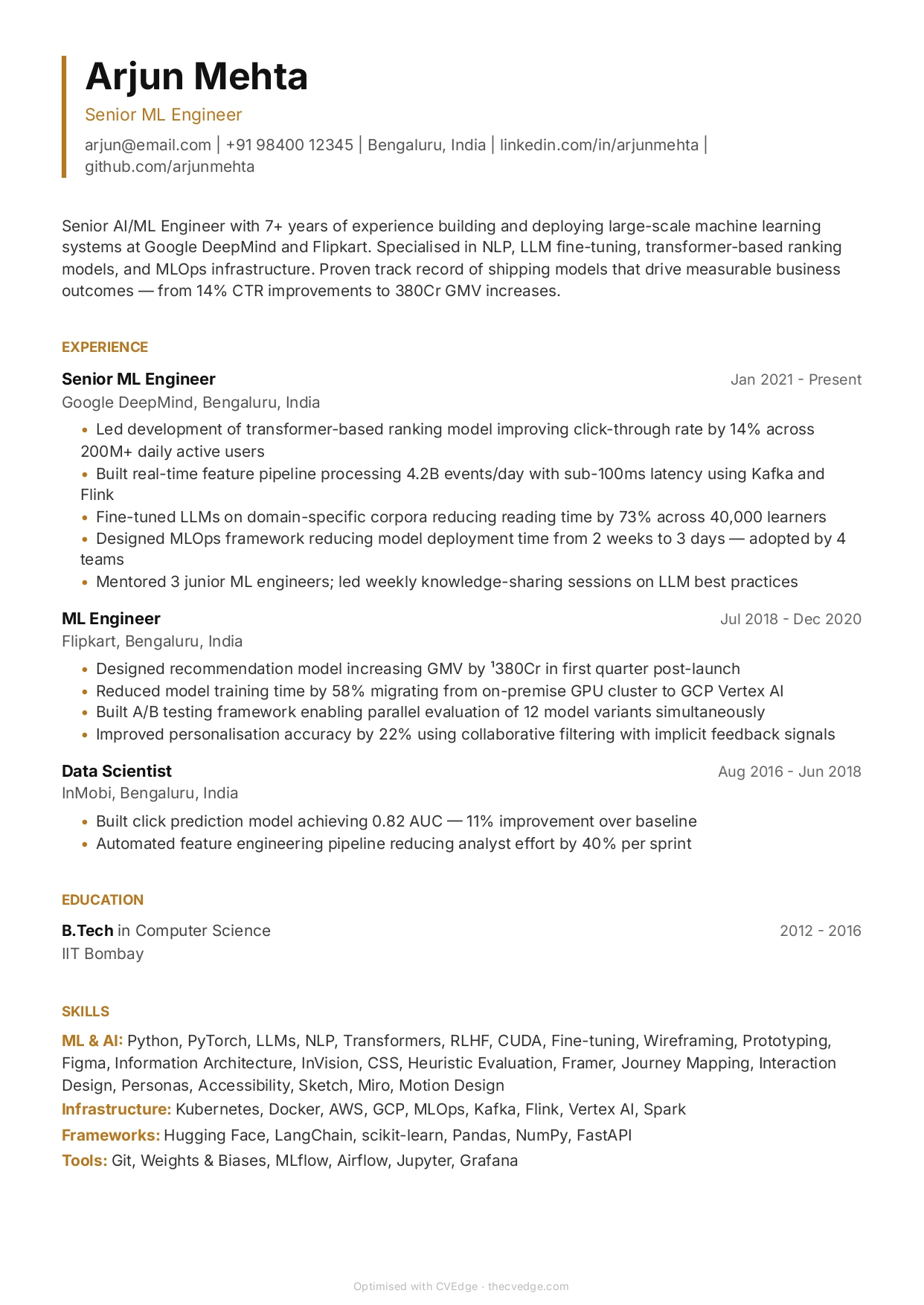
Sharp template
Bold section dividers, modern look. Passes ATS while standing out from generic formats.
Use templateLooking for security architect jobs?
Browse live security architect roles and match your resume against specific job descriptions before applying.
Security Architect professional summary example
Three or four sentences that state your specialisation, your level, and the single result you most want read first.
Security architect with 9 years across financial services and SaaS. Designed the cloud landing zone adopted by 14 engineering teams, cutting misconfiguration findings per deployment 78%, and led the threat-modelling programme covering 40 systems. Comfortable defending risk-acceptance decisions to an audit committee. CISSP, AWS Security Specialty.
Before and after: security architect resume bullets
Each pair below rewrites a bullet we see constantly on security architect CVs, with the reason the rewrite works for this role specifically.
Designed security architecture for enterprise applications.
Designed a secure-by-default AWS landing zone — enforced encryption, private networking and guardrail SCPs — adopted by 14 teams and cutting misconfiguration findings per deployment 78%.
Why it works: Design work only counts if it is used. Naming the controls and, critically, the adoption across 14 teams converts an architecture document into organisational change with a measured effect.
Conducted threat modelling and security reviews.
Ran threat modelling across 40 systems, prioritising by realistic exploitability rather than CVSS alone — 31 criticals remediated, 9 formally risk-accepted with compensating monitoring and quarterly review.
Why it works: Review counts alone say nothing about outcomes. Splitting remediated from accepted shows the judgement the role exists for, and the compensating controls demonstrate that acceptance was deliberate rather than neglect.
Advised engineering teams on security best practices.
Replaced advisory review with a self-serve control library and automated policy checks in CI, cutting mean security-review turnaround from 11 days to same-day and removing architecture as a delivery bottleneck.
Why it works: "Advised teams" is unmeasurable and often means being ignored. Turning advice into tooling is the senior move, and removing yourself as a bottleneck is the outcome engineering leadership cares about.
Metrics that belong on a security architect resume
Reviewers rank candidates on comparable numbers. These are the ones that carry weight in this role.
What changes by level
The same experience reads differently depending on the level you are targeting. Position your CV for the band you are applying to.
Associate (3–5 yrs)
Reviews designs within a domain. CV should show hands-on depth plus one design you owned.
Architect (5–9 yrs)
Owns architecture for a business area. CV should show standards adopted and risk decisions made.
Senior / Principal (9+ yrs)
Sets enterprise security architecture. CV should show transformation programmes and board-level risk communication.
What gets security architect CVs screened out
Frameworks listed with no design you personally owned.
No adoption evidence — standards written but not taken up.
Every finding presented as remediated, implying no real prioritisation.
No cloud architecture experience, which is now assumed in most postings.
Skills and tools reviewers scan for
Core skills
Tools & platforms
CV sorted — now the interview
Real security architect interview questions and what each round is scored on.
Security Architect resume questions
What separates a Security Architect from a senior Security Engineer?+
Breadth and influence rather than depth. Engineers own and operate specific controls; architects design across domains — identity, network, application, cloud, data — and are measured on whether teams adopt what they specify. The interview reflects this: architect loops centre on reviewing a design and defending trade-offs, including which risks you would accept, while engineer loops go deeper hands-on in one area. If you cannot yet reason across all the domains, the engineer track is the stronger application.
How important is risk acceptance in these interviews?+
More than candidates expect, and it is a common failure point. Architects who require every finding remediated get routed around by delivery teams, which makes them ineffective regardless of technical correctness. Strong answers show a framework — likelihood, impact, exploitability, compensating controls — and at least one concrete example of a risk you accepted, documented, and revisited. Being able to say "we accepted it for two quarters with monitoring in place, and here is what would have changed my mind" signals real seniority.
What metrics belong on a Security Architect CV?+
Adoption and risk reduction, not activity. Systems reviewed or threat modelled, standards published and the number of teams that adopted them, critical findings remediated versus accepted, reduction in a measurable exposure (internet-facing services, standing privilege, unencrypted data stores), and audit or certification outcomes achieved. "Published a secure-by-default cloud landing zone adopted by 14 teams, cutting misconfiguration findings per deployment by 78%" is strong because adoption is the architect's real product.
Do I need CISSP to be a Security Architect?+
It is not universally required but it appears in a large share of postings and is frequently used as a screening filter, particularly in regulated industries and for roles with management scope. CCSP or a cloud provider's security specialty certification is increasingly valuable as estates move to cloud, and SABSA or TOGAF appear in more formal architecture functions. Practically: if you are applying to enterprises, CISSP removes a filter; if you are applying to product companies, demonstrated design work matters more.
Build your security architect resume — free
Upload your existing CV or start fresh. Get an ATS score in seconds and fix every issue before you apply.