

Cybersecurity Engineer Resume Example 2026
Real bullet examples, ATS keywords, common mistakes, and free templates for cybersecurity engineer roles. Know your ATS score before you apply.
No credit card · No watermarks · ATS score included
Writing a strong cybersecurity engineer resume
Cybersecurity resumes succeed with specificity and evidence. Hiring managers want to know: what attack surface did you defend, what was your detection/response capability improvement, and what compliance frameworks did you satisfy? Vague security experience is a red flag, not a green one.
Strong cybersecurity engineer resume bullet examples
These are examples of well-written resume bullets for cybersecurity engineer roles — metric-led, action-verb-first, and specific enough to be credible.
Led ISO 27001 certification programme across 400-person company: identified and remediated 47 critical controls over 6 months, achieving first-time audit pass with zero major findings
Built SIEM detection rules in Splunk covering MITRE ATT&CK T1055–T1190 attack vectors; reduced mean time to detect from 6.2 hours to 22 minutes across 1,200 monitored endpoints
Conducted red team exercise against critical financial infrastructure: discovered 3 critical RCE vulnerabilities in external-facing services; all remediated before external report delivery
Struggling with your own bullets? CVEdge's AI rewriter converts weak bullets like “Responsible for X” into strong, metric-led statements in one click. Paste your bullet, pick a mode, and get a better version instantly. Try it free
ATS keywords for cybersecurity engineer resumes
These are commonly screened keywords for cybersecurity engineer roles. Include the ones relevant to your experience — naturally integrated in your bullets and skills section, not keyword-stuffed.
Get role-specific keywords for your exact job description. CVEdge's Job Match tool compares your resume against any cybersecurity engineer job description and shows which keywords are missing — with one-click add. Try it free
Common mistakes on cybersecurity engineer resumes
Avoid these and you're already ahead of most applicants.
Generic security language — "security experience" without specifics on attack surface, frameworks, or tooling
Missing compliance context — for enterprise roles, specify which standards (SOC 2, ISO 27001, HIPAA, PCI-DSS) you've worked against
No metrics — security improvements need quantification: detection time, false positive rates, vulnerabilities found
The bullet formula that works for cybersecurity engineer roles
Action verb
"Led", "Built", "Reduced", "Grew"
Strong opening that shows agency and ownership.
What you did
"migration of X", "dashboard covering Y"
Specific enough to be credible — avoid vague 'improved process'.
Measurable result
"by 40% for 2M users", "saving $420K"
The number that makes a recruiter stop scrolling.
Before (weak)
“Responsible for improving performance of the platform.”
After (strong)
“Reduced platform response time by 65% through caching and query optimisation, improving reliability for 500K monthly active users.”
What to include in each section of your cybersecurity engineer resume
Professional Summary
3–4 sentences: your job title + years of experience + 2 core specialisms + what you're looking for. For cybersecurity engineer roles, lead with your most relevant strength. Keep it under 80 words. Avoid clichés like 'results-driven' — be specific about what you actually do.
Experience
Reverse chronological order. 3–5 bullet points per role for the last 3 positions; 1–3 for older roles. Every bullet should have an action verb, what you did, and a measurable result. For cybersecurity engineer roles, prioritise bullets that show scale, impact, and technical/functional depth.
Skills
List role-relevant tools, technologies, methodologies, and certifications. Group into categories where you have 5+ skills (e.g. Languages, Cloud, Frameworks). For ATS, ensure exact keyword matches with the job description — spell tools and technologies exactly as they appear in JDs.
Education
Degree, institution, year. Add relevant certifications below. For senior professionals (8+ years), education moves below experience and can be a single line. For graduates and early-career professionals, lead with education and include relevant coursework, projects, and academic achievements.
Best resume templates for cybersecurity engineer roles
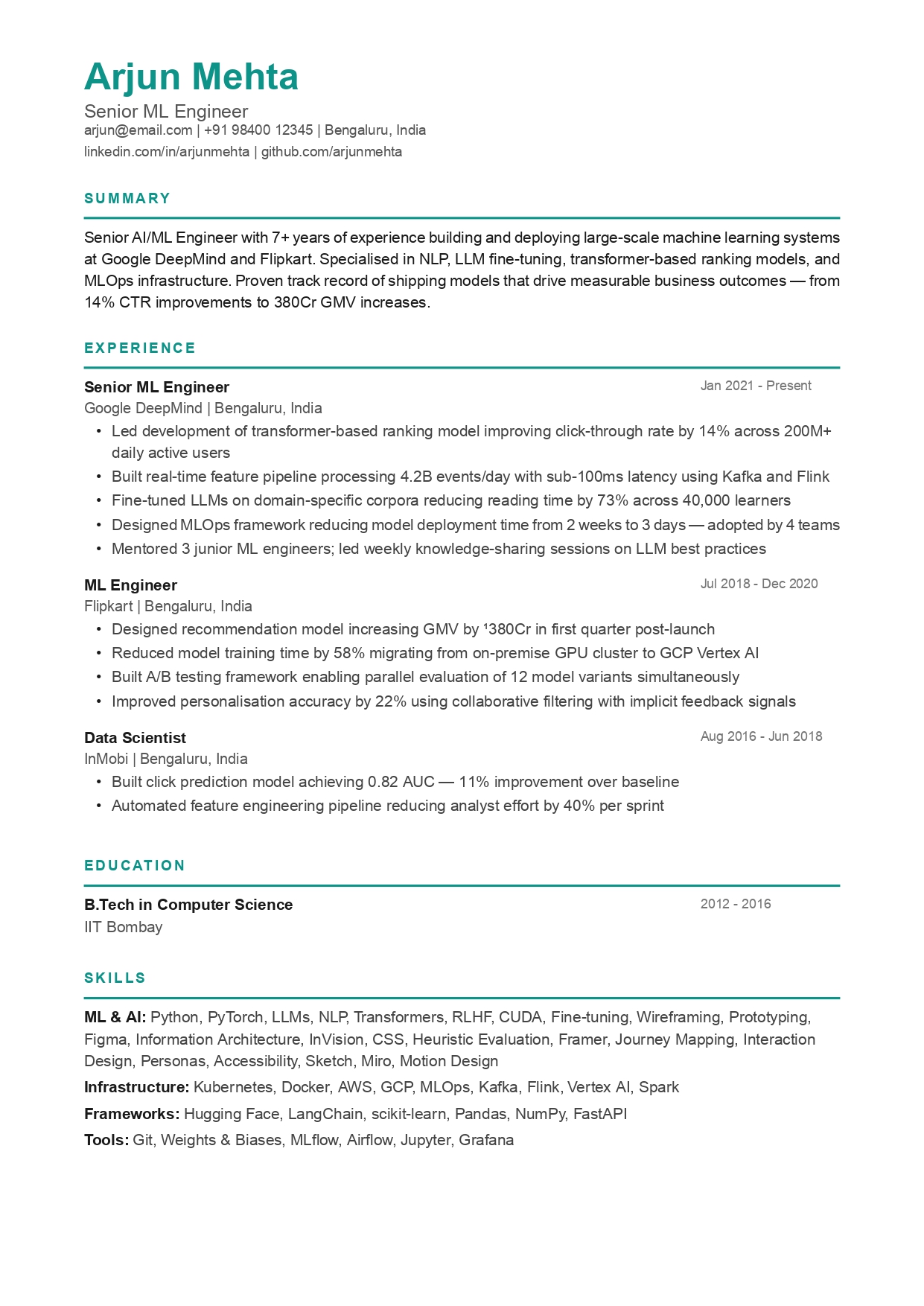
Classic template
The safe bet. Scores 95+ on ATS. Works for every company from startup to FAANG.
Use template
Executive template
Built for twenty years of career on two pages — premium spacing and a summary that leads, on a single ATS-safe column. Free to edit online, or download as Word or PDF.
Use template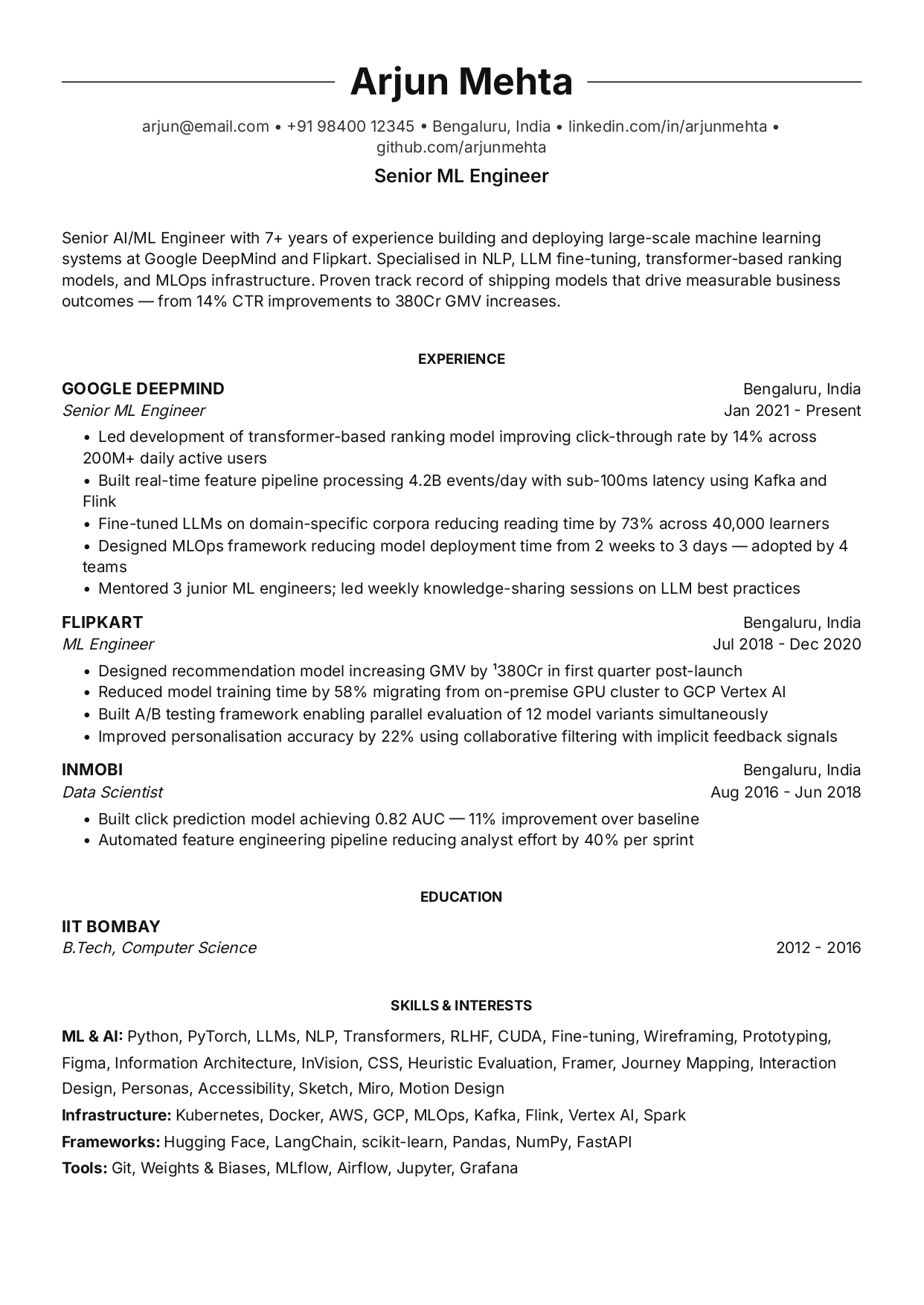
Harvard template
The single-column academic format Harvard's career-services guidance describes — rebuilt to parse cleanly through every major ATS. Free to edit online, or download as Word or PDF.
Use templateLooking for cybersecurity engineer jobs?
Browse live cybersecurity engineer roles and match your resume against specific job descriptions before applying.
Cybersecurity Engineer professional summary example
Three or four sentences that state your specialisation, your level, and the single result you most want read first.
Security engineer with 6 years building and operating controls for a 5,000-endpoint estate in fintech. Deployed EDR to 98% coverage and automated tier-1 triage, cutting analyst manual handling 60%. Drove critical vulnerability time-to-patch from 40 days to 7 by integrating scanning into CI and agreeing SLAs with engineering. Python-first; GCIH certified.
Before and after: cybersecurity engineer resume bullets
Each pair below rewrites a bullet we see constantly on cybersecurity engineer CVs, with the reason the rewrite works for this role specifically.
Implemented and managed security tools across the organisation.
Deployed CrowdStrike EDR to 5,000 endpoints reaching 98% coverage in 9 weeks, running a phased detect-only rollout that caught 40 legitimate applications before prevention was enabled.
Why it works: Tool deployment is the role's baseline. Coverage, timeline and the phased approach show a rollout that did not break production — which is the part that actually distinguishes competent security engineering.
Managed vulnerability scanning and remediation efforts.
Cut critical vulnerability time-to-patch from 40 days to 7 by embedding scanning into CI, auto-filing tickets with owning-team routing, and agreeing remediation SLAs with 6 engineering leads.
Why it works: Finding vulnerabilities is easy; the hard part is getting them fixed. The time-to-patch movement plus the mechanism — automation and negotiated SLAs — shows both engineering and influence.
Responded to security incidents and performed investigations.
Automated tier-1 alert triage with enrichment and auto-containment playbooks, cutting analyst manual handling 60% and mean time to contain from 4 hours to 25 minutes across 200 incidents.
Why it works: Incident response participation is expected. Automating it is the engineering contribution, and containment time across a stated incident volume is the number a security leader compares directly.
Metrics that belong on a cybersecurity engineer resume
Reviewers rank candidates on comparable numbers. These are the ones that carry weight in this role.
What changes by level
The same experience reads differently depending on the level you are targeting. Position your CV for the band you are applying to.
Junior (0–2 yrs)
Operates existing tooling. CV should show hands-on work with one security platform and scripting basics.
Mid (2–5 yrs)
Owns a control domain. CV should show a deployment with coverage numbers and incident experience.
Senior (5–8 yrs)
Designs and automates controls across domains. CV should show automation and risk-reduction metrics.
Principal (8+ yrs)
Sets security engineering direction. CV should show programme-level outcomes and engineering partnership.
What gets cybersecurity engineer CVs screened out
Tool lists with no coverage or outcome numbers.
No coding or automation evidence, limiting the role to console operation.
Incident response described in framework language with no specific incident.
Certifications leading the CV ahead of applied work.
Skills and tools reviewers scan for
Core skills
Tools & platforms
CV sorted — now the interview
Real cybersecurity engineer interview questions and what each round is scored on.
Cybersecurity Engineer resume questions
What is the difference between a Security Engineer and a Security Analyst?+
Engineers build and automate controls; analysts operate and monitor them. A security engineer deploys the EDR, writes the detection logic, integrates scanning into CI and automates response playbooks. An analyst triages the alerts those systems produce and investigates incidents. Engineering roles expect real coding ability and pay accordingly; analyst roles are the more common entry point and frequently lead into engineering after two or three years.
How much programming do security engineering interviews require?+
Enough Python to automate meaningfully, and increasingly it is tested directly. Typical asks include parsing and enriching log data, calling an API to pull threat intelligence, or writing a script that quarantines an endpoint via an EDR API. You are not expected to pass an algorithm loop, but security engineers who cannot code are limited to clicking through consoles, and interviewers screen for that explicitly now.
What metrics belong on a Cybersecurity Engineer CV?+
Coverage, risk reduction and toil removed. Endpoints or systems protected, controls deployed and their coverage percentage, critical vulnerability time-to-patch, mean time to detect and respond, alerts auto-triaged through automation, and audit findings closed. "Deployed EDR across 5,000 endpoints reaching 98% coverage and automated tier-1 triage, cutting analyst manual handling 60%" pairs scale with the operational gain.
Which certifications are worth having?+
Security+ establishes a baseline for entry-level roles. GIAC certifications (GCIH, GCIA, GCED) carry genuine weight for hands-on engineering because they are practical. CISSP matters for senior and management-track roles and is often a screening filter in enterprises. Cloud security certifications are increasingly valuable as estates move. The general rule holds though: certifications get you past filters, and evidence of applied work gets you the offer.
Build your cybersecurity engineer resume — free
Upload your existing CV or start fresh. Get an ATS score in seconds and fix every issue before you apply.