

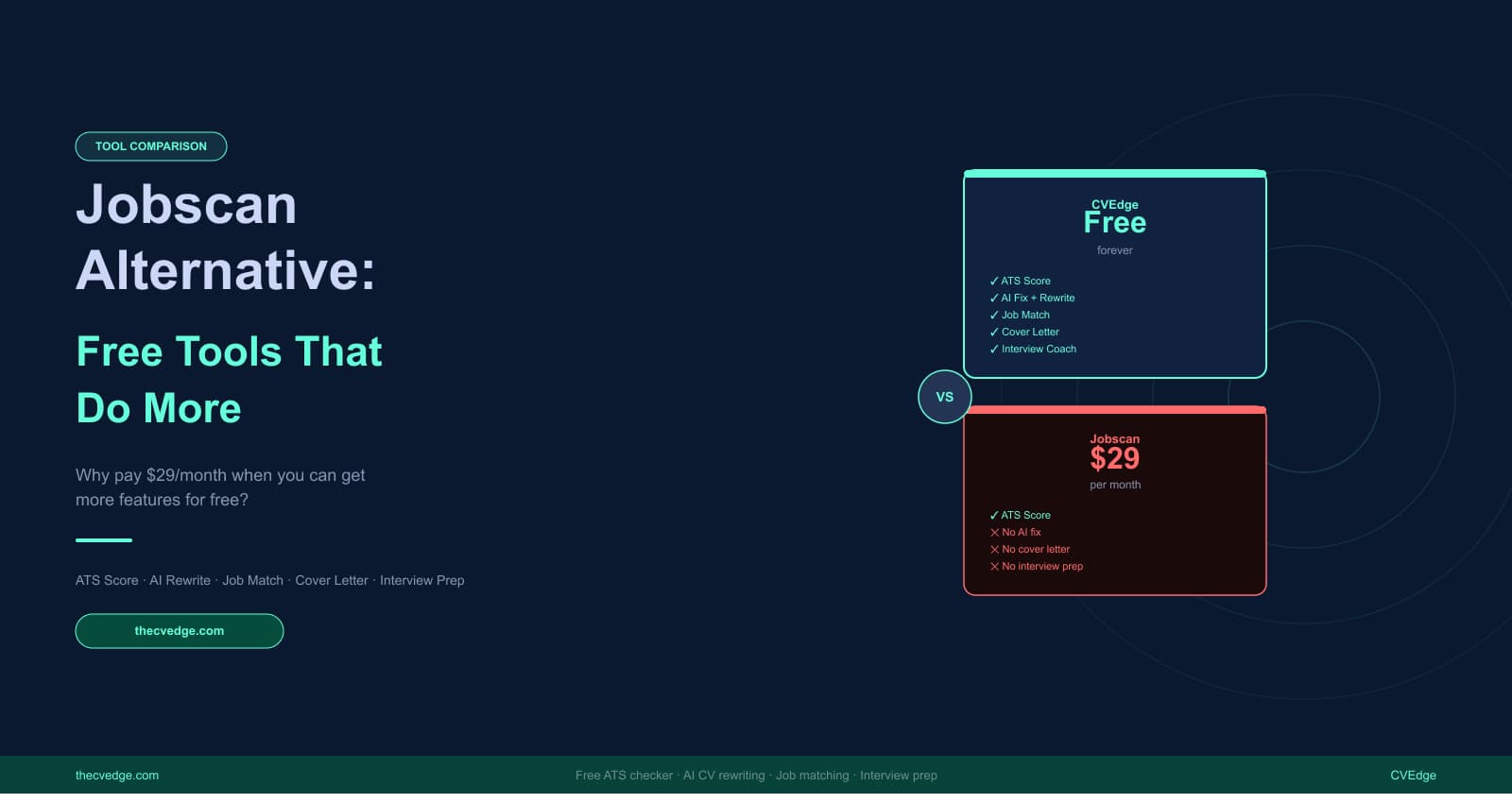
Jobscan does one thing and does it well: it compares your CV against a specific job description and tells you how closely they match, which keywords the posting uses that your CV does not, and roughly where you stand. For a tool with that narrow a remit, the execution is good and the keyword extraction is better than most.
The reason people look for alternatives is almost never quality. It is that the free tier is metered to a small number of scans per month, and CV tailoring is inherently repetitive — you want to run it against every posting you apply to, which is exactly the usage the free tier is designed to limit.
We make one of the alternatives, so read this as an interested party trying to be accurate. Where Jobscan is better, it is said so below.
What a match score actually tells you
Worth being clear about this before comparing tools, because it changes how much any of them are worth.
A match score is a vocabulary comparison. It measures overlap between the language of the posting and the language of your CV. That is genuinely useful, because recruiters search their applicant database by keyword and a CV that describes your work in different words than the recruiter searches for will not appear in the results.
What it does not measure is whether you are a good candidate. A CV can reach a high match rate by echoing the posting's vocabulary while saying nothing specific about what you achieved. Treating the score as a target rather than a diagnostic is how people end up with keyword-dense CVs that read as hollow to the human who eventually opens them.
So the honest framing: use any of these tools to find vocabulary gaps, then close the real ones and ignore the rest.
Where Jobscan is genuinely strong
- Keyword extraction from the posting. Its parsing of which terms matter in a job description, and how it weights hard skills against soft ones, is well tuned.
- The comparison view. Side-by-side presentation of what the posting asks for against what your CV contains is clear and immediately actionable.
- LinkedIn optimisation. A separate feature that several free alternatives, including ours, do not offer at all.
- Focus. It does not try to be a builder, a tracker and a cover letter generator. There is real value in a tool that does one job.
Where the limits bite
The free tier's scan limit is the main one, and it interacts badly with the workflow the tool is for. Tailoring is worth doing per application; a small monthly allowance means either paying or rationing the thing the tool is best at.
The second limit is scope. Jobscan diagnoses vocabulary gaps and stops there. It will not rewrite the bullet, will not tell you your contact details are in a document header that parsers do not read, and will not help with the content quality problem that is usually the real reason a CV underperforms. That is a reasonable product decision, but it means a match score alone is rarely the whole answer.
The alternatives
CVEdge
Scores your CV against a job description without a scan cap or an account, and adds the parts Jobscan deliberately leaves out: an ATS analysis across six categories, the extracted fields so you can see what a parser actually got from your file, and bullet rewriting that works from what you wrote rather than generating claims from your job title.
Where it is weaker: no LinkedIn optimisation. Our keyword extraction is good but Jobscan's is arguably better tuned on ambiguous postings. And because we also build CVs, the tool is broader and therefore less focused than a dedicated scanner.
Resume Worded
Sharper line-by-line critique of individual bullets than either of the above, plus a LinkedIn review. Best if what you want is feedback on writing quality rather than keyword coverage. The free tier is limited enough that regular use means paying.
Teal
Includes CV-to-posting matching, but its real strength is managing the search — saving postings, tracking applications, keeping per-job CV versions. If you are running many applications at once, the tracking is worth more than the matching.
Doing it manually
Genuinely viable and worth saying. Paste the job description into a document, highlight every noun that names a skill, tool, methodology or qualification, and check each against your CV. It takes fifteen minutes and produces most of the value of an automated scan, because the analysis is not complicated — the tools are selling convenience and consistency, not a capability you lack.
How to choose
- You tailor for most applications and hit the scan cap: an uncapped free tool, or pay for Jobscan if you value its extraction specifically.
- You have a match score and still get no responses: the problem is not vocabulary. Look at parsing and content quality — a broader ATS analysis will tell you which.
- You want your writing critiqued: Resume Worded.
- You are drowning in applications: Teal, for the tracking.
- You apply to a handful of carefully chosen roles: do it manually and spend the time on the cover letter instead.
The honest summary
If Jobscan is working for you and the cost is manageable, there is no strong reason to move. If the scan cap is the friction, an uncapped alternative removes it. And if you have optimised your match rate and are still not hearing back, that is genuinely useful information: it means keyword coverage was not your bottleneck, and the effort belongs on parsing, on what your bullets actually say, or on whether the roles you are applying to are the right ones.
You can check parsing, extracted fields and an ATS score for your CV free at CVEdge, without an account.