

Security Analyst Resume Example 2026
Real bullet examples, ATS keywords, common mistakes, and free templates for security analyst roles. Know your ATS score before you apply.
No credit card · No watermarks · ATS score included
Writing a strong security analyst resume
Security analyst resumes prove vigilance and speed. Show your detection and response metrics, the tools you've mastered, and specific incidents or vulnerabilities you caught. The hiring manager wants to know: how fast are you, how thorough, and have you found real threats? Answer those three questions and you'll get interviews.
Strong security analyst resume bullet examples
These are examples of well-written resume bullets for security analyst roles — metric-led, action-verb-first, and specific enough to be credible.
Triaged and responded to 1,200+ security incidents over 18 months as L2 SOC analyst: reduced average investigation time from 45 minutes to 11 minutes through automation and custom SIEM playbooks
Identified and reported critical supply chain vulnerability in third-party auth library affecting 200,000 users; coordinated emergency patch deployment within 6 hours of discovery
Ran phishing simulation programme across 3,000 employees quarterly: improved click-through rate from 24% to 6% over 12 months, reducing successful phishing incidents by 70%
Struggling with your own bullets? CVEdge's AI rewriter converts weak bullets like “Responsible for X” into strong, metric-led statements in one click. Paste your bullet, pick a mode, and get a better version instantly. Try it free
ATS keywords for security analyst resumes
These are commonly screened keywords for security analyst roles. Include the ones relevant to your experience — naturally integrated in your bullets and skills section, not keyword-stuffed.
Get role-specific keywords for your exact job description. CVEdge's Job Match tool compares your resume against any security analyst job description and shows which keywords are missing — with one-click add. Try it free
Common mistakes on security analyst resumes
Avoid these and you're already ahead of most applicants.
Tool lists without threat context — "used Splunk" vs "wrote Splunk queries detecting lateral movement in 1,200 endpoints"
No incident volume — quantify your caseload: incidents triaged, vulnerabilities managed, or investigations led
Missing outcome — every security action must end with what was prevented, remediated, or improved
The bullet formula that works for security analyst roles
Action verb
"Led", "Built", "Reduced", "Grew"
Strong opening that shows agency and ownership.
What you did
"migration of X", "dashboard covering Y"
Specific enough to be credible — avoid vague 'improved process'.
Measurable result
"by 40% for 2M users", "saving $420K"
The number that makes a recruiter stop scrolling.
Before (weak)
“Responsible for improving performance of the platform.”
After (strong)
“Reduced platform response time by 65% through caching and query optimisation, improving reliability for 500K monthly active users.”
What to include in each section of your security analyst resume
Professional Summary
3–4 sentences: your job title + years of experience + 2 core specialisms + what you're looking for. For security analyst roles, lead with your most relevant strength. Keep it under 80 words. Avoid clichés like 'results-driven' — be specific about what you actually do.
Experience
Reverse chronological order. 3–5 bullet points per role for the last 3 positions; 1–3 for older roles. Every bullet should have an action verb, what you did, and a measurable result. For security analyst roles, prioritise bullets that show scale, impact, and technical/functional depth.
Skills
List role-relevant tools, technologies, methodologies, and certifications. Group into categories where you have 5+ skills (e.g. Languages, Cloud, Frameworks). For ATS, ensure exact keyword matches with the job description — spell tools and technologies exactly as they appear in JDs.
Education
Degree, institution, year. Add relevant certifications below. For senior professionals (8+ years), education moves below experience and can be a single line. For graduates and early-career professionals, lead with education and include relevant coursework, projects, and academic achievements.
Best resume templates for security analyst roles
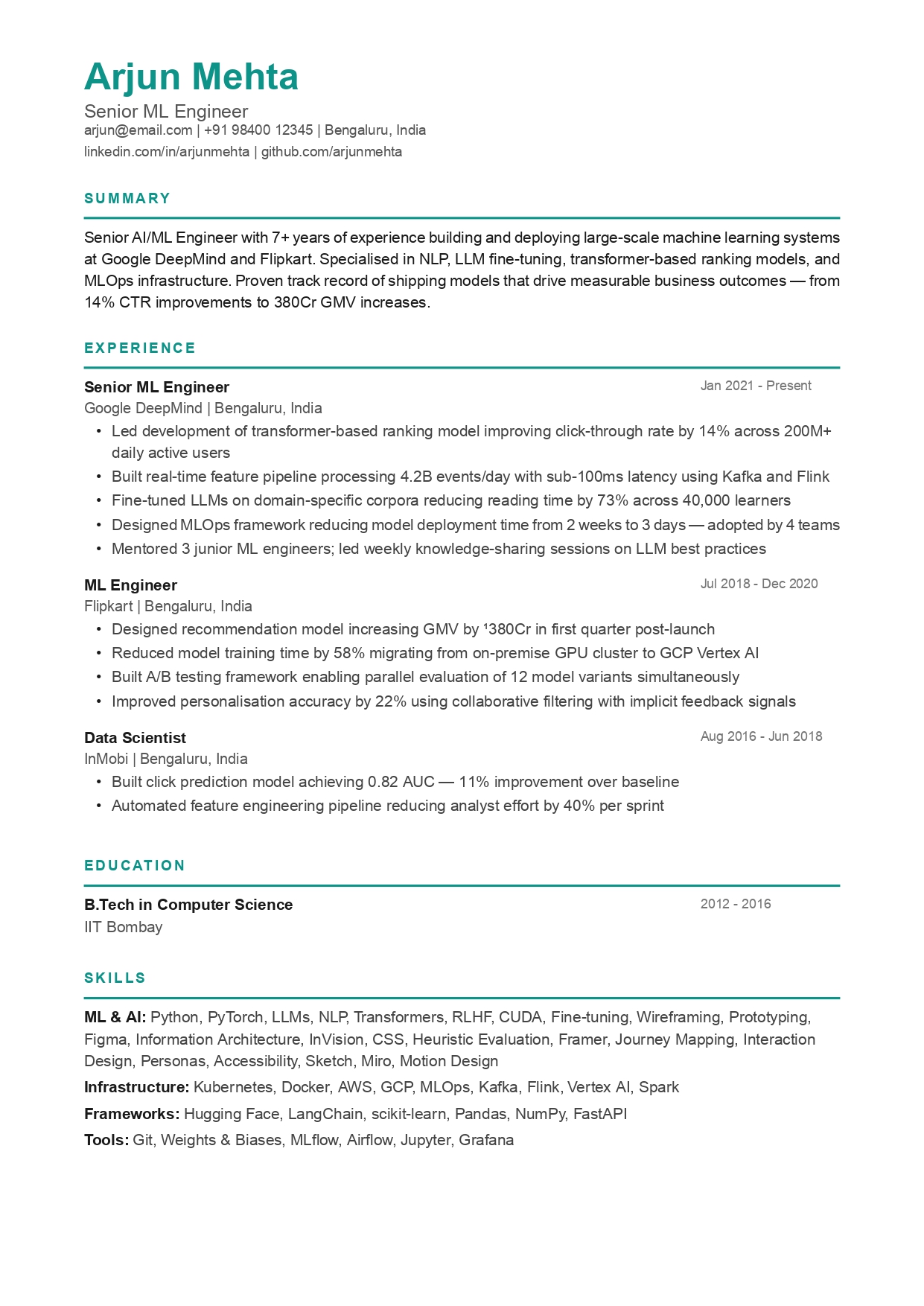
Classic template
The safe bet. Scores 95+ on ATS. Works for every company from startup to FAANG.
Use template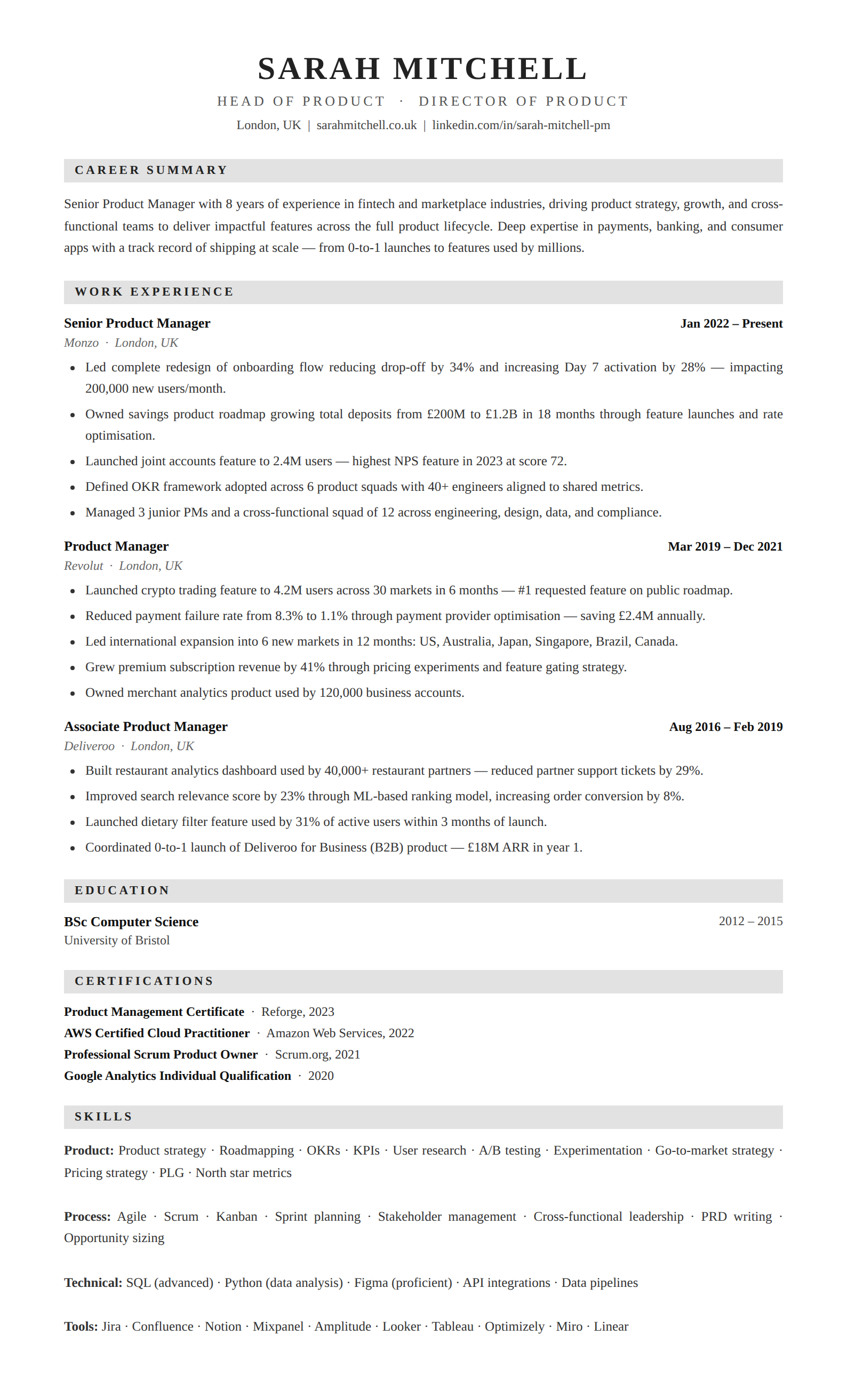
Classic Serif template
Formal and ATS-safe. Grey section bands with elegant serif for traditional industries.
Use template
Executive template
Built for twenty years of career on two pages — premium spacing and a summary that leads, on a single ATS-safe column. Free to edit online, or download as Word or PDF.
Use templateLooking for security analyst jobs?
Browse live security analyst roles and match your resume against specific job descriptions before applying.
Security Analyst professional summary example
Three or four sentences that state your specialisation, your level, and the single result you most want read first.
Security analyst with 3 years in a 24/7 SOC covering 8,000 endpoints. Triage ~350 alerts/week and cut false positives 58% by rewriting 30 detection rules, freeing roughly 12 analyst-hours weekly. Caught the credential-stuffing campaign that standard detections missed by baselining authentication patterns. Security+ and GCIH; automating enrichment in Python.
Before and after: security analyst resume bullets
Each pair below rewrites a bullet we see constantly on security analyst CVs, with the reason the rewrite works for this role specifically.
Monitored security alerts and escalated incidents as needed.
Triaged ~350 alerts/week across 8,000 endpoints in Splunk, escalating 40 confirmed incidents with a 91% true-positive rate on escalations.
Why it works: Monitoring is the role definition. Volume, estate size and — critically — the true-positive rate on your escalations show you exercise judgement rather than forwarding everything upward.
Investigated potential security threats and documented findings.
Identified a credential-stuffing campaign that signature detections missed, by baselining normal authentication timing and spotting a 3am success pattern from 40 source IPs — leading to MFA enforcement on 1,200 legacy accounts.
Why it works: "Investigated threats" is unmeasurable. A specific catch that standard tooling missed, the method behind it, and the control change it drove is the single most persuasive bullet an analyst can have.
Helped tune security tools to reduce false positives.
Rewrote 30 detection rules using process-lineage context instead of filename matching, cutting false positives 58% and returning ~12 analyst-hours per week to real investigation.
Why it works: Tuning is common; the mechanism and the hours returned are what make it credible. Naming why the old rules were noisy shows genuine detection understanding rather than threshold-raising.
Metrics that belong on a security analyst resume
Reviewers rank candidates on comparable numbers. These are the ones that carry weight in this role.
What changes by level
The same experience reads differently depending on the level you are targeting. Position your CV for the band you are applying to.
Tier 1 (0–2 yrs)
Triages alerts against runbooks. CV should show volume handled and log-analysis fundamentals.
Tier 2 (2–4 yrs)
Investigates independently and tunes detections. CV should show a catch others missed and tuning outcomes.
Tier 3 / Senior (4–7 yrs)
Leads investigations and hunts proactively. CV should show detection engineering and automation.
Lead (7+ yrs)
Owns SOC process and mentoring. CV should show operational metrics moved across the team.
What gets security analyst CVs screened out
No alert volume or estate size, making the environment impossible to gauge.
No specific investigation described — the discipline is judged on what you caught.
Only tool names, with no evidence of investigation methodology.
No sign of improving detections, which reads as pure queue consumption.
Skills and tools reviewers scan for
Core skills
Tools & platforms
CV sorted — now the interview
Real security analyst interview questions and what each round is scored on.
Security Analyst resume questions
What does a Security Analyst interview focus on?+
Investigation process above knowledge recall. The central round describes an alert — PowerShell spawning from a Word document is the classic — and asks what you check and in what order. Interviewers score whether you gather evidence systematically (parent process, command line, user context, network connections, whether this is normal for that host) before concluding, and whether you know what would make you escalate. Candidates who jump to "it's malware, isolate the host" without investigating fail this round even when the conclusion is right.
How do I get a Security Analyst job with no experience?+
It is the most common entry point into security, and the realistic routes are a home lab you can discuss in detail, Security+ or an equivalent baseline certification, and demonstrable log-analysis practice through platforms like TryHackMe or Blue Team Labs. Adjacent internal moves work well too — service desk and systems administration convert into SOC roles regularly because the troubleshooting instinct transfers. What interviewers want is evidence you have actually looked at logs and reasoned from them, not that you have watched courses about doing so.
What metrics belong on a Security Analyst CV?+
Volume, accuracy and improvement. Alerts triaged per week, true-positive rate, mean time to triage, incidents escalated and confirmed, and detections you tuned or wrote. "Triaged ~350 alerts/week across 8,000 endpoints, and cut false positives 58% by rewriting 30 detection rules" is strong because it shows both that you worked at real volume and that you improved the queue rather than only consuming it.
Is a SOC analyst role a dead end?+
Not if you treat it as a starting point, which is how the industry generally treats it. Typical progressions run to detection engineering, incident response, threat hunting, or security engineering — usually within two to four years. What accelerates it is doing more than the queue: writing detections, automating enrichment, building a home lab, learning Python. Analysts who only triage tend to plateau; those who improve the systems around the queue move quickly.
Build your security analyst resume — free
Upload your existing CV or start fresh. Get an ATS score in seconds and fix every issue before you apply.