

Network Security Engineer Resume Example 2026
Real bullet examples, ATS keywords, common mistakes, and free templates for network security engineer roles. Know your ATS score before you apply.
No credit card · No watermarks · ATS score included
Writing a strong network security engineer resume
For Network Security Engineer roles, the most important thing on your resume is demonstrable impact. Every bullet should connect what you did to what changed as a result. Use the format: action verb + what you did + the specific result. Quantify wherever possible — size, percentage improvement, revenue, cost, or time saved.
Strong network security engineer resume bullet examples
These are examples of well-written resume bullets for network security engineer roles — metric-led, action-verb-first, and specific enough to be credible.
Led network security engineer initiative from scoping to delivery, coordinating across 3 teams and delivering on time and within budget with measurable business outcome
Identified process inefficiency in core network security engineer workflow; designed and implemented solution that saved 20+ hours per week across the team
Managed cross-functional project involving senior stakeholders; maintained alignment through weekly reviews and delivered key milestones 2 weeks ahead of schedule
Struggling with your own bullets? CVEdge's AI rewriter converts weak bullets like “Responsible for X” into strong, metric-led statements in one click. Paste your bullet, pick a mode, and get a better version instantly. Try it free
ATS keywords for network security engineer resumes
These are commonly screened keywords for network security engineer roles. Include the ones relevant to your experience — naturally integrated in your bullets and skills section, not keyword-stuffed.
Get role-specific keywords for your exact job description. CVEdge's Job Match tool compares your resume against any network security engineer job description and shows which keywords are missing — with one-click add. Try it free
Common mistakes on network security engineer resumes
Avoid these and you're already ahead of most applicants.
Vague responsibility statements — "responsible for X" instead of "led X and achieved Y"
Missing metrics — every achievement should have a number: size, percentage, time, or money
No business impact context — show how your work connected to company goals or customer value
The bullet formula that works for network security engineer roles
Action verb
"Led", "Built", "Reduced", "Grew"
Strong opening that shows agency and ownership.
What you did
"migration of X", "dashboard covering Y"
Specific enough to be credible — avoid vague 'improved process'.
Measurable result
"by 40% for 2M users", "saving $420K"
The number that makes a recruiter stop scrolling.
Before (weak)
“Responsible for improving performance of the platform.”
After (strong)
“Reduced platform response time by 65% through caching and query optimisation, improving reliability for 500K monthly active users.”
What to include in each section of your network security engineer resume
Professional Summary
3–4 sentences: your job title + years of experience + 2 core specialisms + what you're looking for. For network security engineer roles, lead with your most relevant strength. Keep it under 80 words. Avoid clichés like 'results-driven' — be specific about what you actually do.
Experience
Reverse chronological order. 3–5 bullet points per role for the last 3 positions; 1–3 for older roles. Every bullet should have an action verb, what you did, and a measurable result. For network security engineer roles, prioritise bullets that show scale, impact, and technical/functional depth.
Skills
List role-relevant tools, technologies, methodologies, and certifications. Group into categories where you have 5+ skills (e.g. Languages, Cloud, Frameworks). For ATS, ensure exact keyword matches with the job description — spell tools and technologies exactly as they appear in JDs.
Education
Degree, institution, year. Add relevant certifications below. For senior professionals (8+ years), education moves below experience and can be a single line. For graduates and early-career professionals, lead with education and include relevant coursework, projects, and academic achievements.
Best resume templates for network security engineer roles
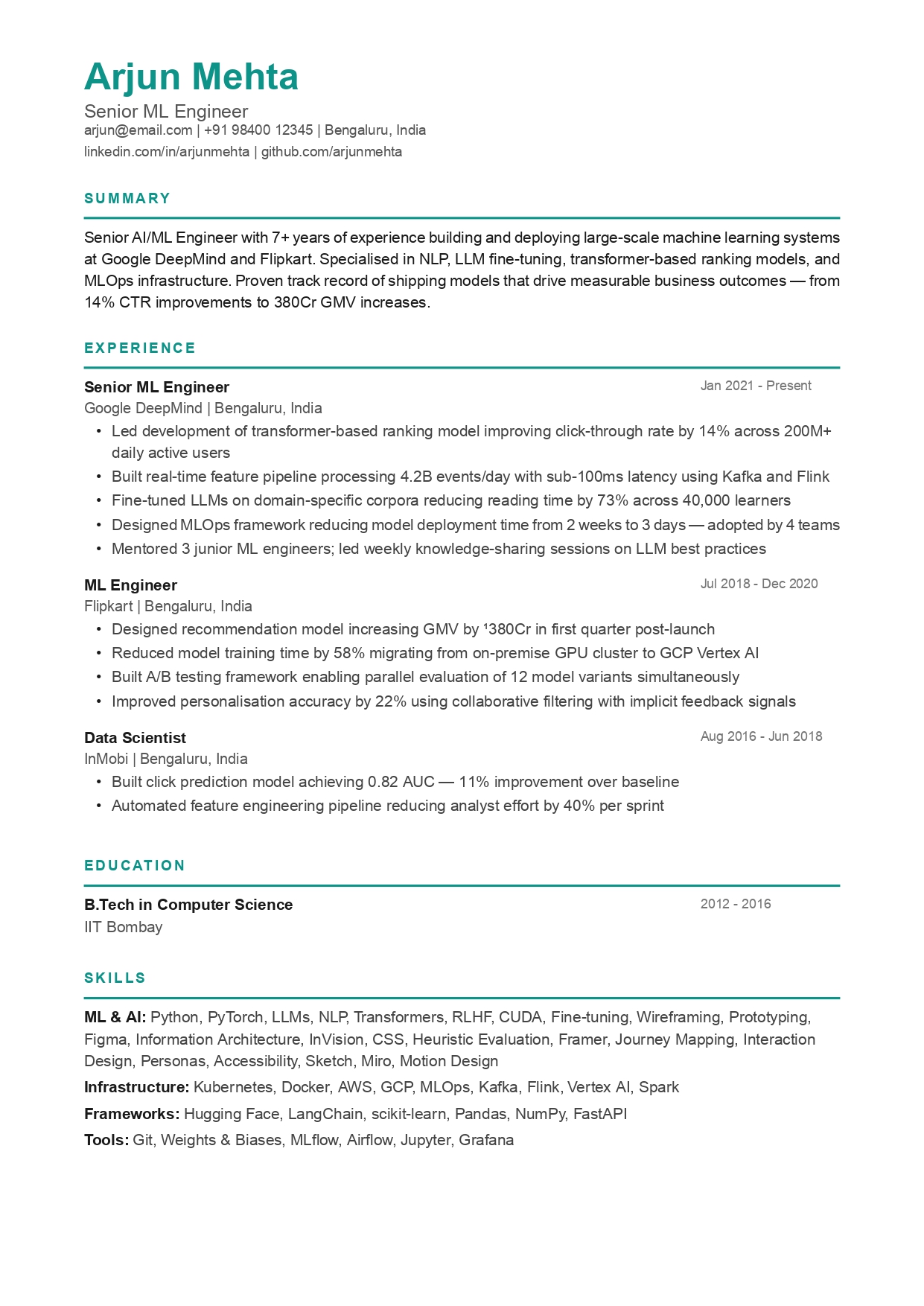
Classic template
The safe bet. Scores 95+ on ATS. Works for every company from startup to FAANG.
Use template
Executive template
Built for twenty years of career on two pages — premium spacing and a summary that leads, on a single ATS-safe column. Free to edit online, or download as Word or PDF.
Use template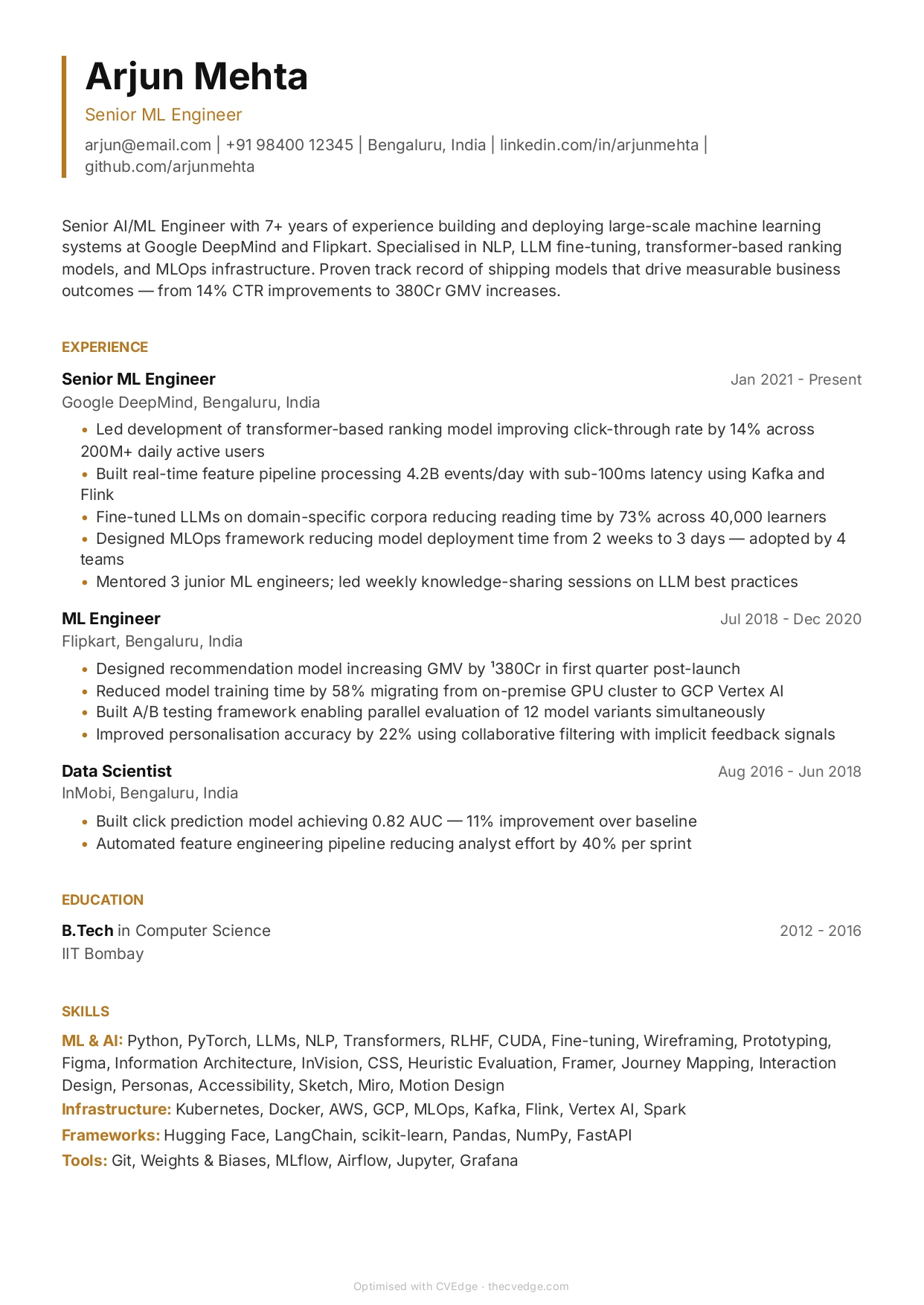
Sharp template
Bold section dividers, modern look. Passes ATS while standing out from generic formats.
Use templateLooking for network security engineer jobs?
Browse live network security engineer roles and match your resume against specific job descriptions before applying.
Network Security Engineer professional summary example
Three or four sentences that state your specialisation, your level, and the single result you most want read first.
Network security engineer with 7 years defending a 4,000-host multi-site estate in manufacturing. Led the segmentation programme that cut reachable attack surface 80% across 12 zones with zero unplanned outages, and rationalised a decade-old 3,000-rule firewall base down to 640. PCNSE certified; strongest in segmentation design and egress monitoring.
Before and after: network security engineer resume bullets
Each pair below rewrites a bullet we see constantly on network security engineer CVs, with the reason the rewrite works for this role specifically.
Managed firewalls and network security infrastructure.
Rationalised a 3,000-rule Palo Alto base to 640 by mapping every rule to an owning application, removing 41 any-any rules and 900 rules with no traffic hits in 12 months — with no service disruption.
Why it works: "Managed firewalls" is administration. The rule-count reduction, the method (mapping to owning applications), and the any-any removal show a disciplined project, and "no service disruption" pre-empts the obvious risk question.
Implemented network segmentation to improve security posture.
Segmented a flat 4,000-host network into 12 zones over three phases, cutting laterally reachable hosts from ~4,000 to ~300 per zone, with a monitor-first rollout that caught 60 undocumented dependencies before enforcement.
Why it works: "Improved posture" is unmeasurable. Lateral reachability is the number segmentation actually changes, and the monitor-first approach demonstrates the operational judgement that separates successful segmentation projects from outages.
Monitored network traffic and responded to security alerts.
Tuned 200+ IPS signatures and built egress baselining that surfaced DNS-tunnelled C2 traffic missed by endpoint tooling, cutting network-alert false positives 71% and enabling a move from detect-only to prevent mode.
Why it works: Monitoring is the job description. The DNS-tunnelling detection is a concrete, memorable win, and moving IPS from detect-only to prevent is a milestone every network security manager understands as hard-won.
Metrics that belong on a network security engineer resume
Reviewers rank candidates on comparable numbers. These are the ones that carry weight in this role.
What changes by level
The same experience reads differently depending on the level you are targeting. Position your CV for the band you are applying to.
Junior (0–2 yrs)
Executes firewall changes and triages alerts. CV should show protocol fundamentals and one vendor stack.
Mid (2–5 yrs)
Owns a site or domain. CV should show estate scale and a tuning or hygiene project.
Senior (5–8 yrs)
Designs segmentation and standards. CV should show a programme with measured attack-surface reduction.
Principal / Architect (8+ yrs)
Sets network security architecture. CV should show multi-site or cloud transformation and its risk outcome.
What gets network security engineer CVs screened out
Vendor GUI familiarity with no evidence of protocol-level understanding.
No estate scale stated, making the environment impossible to gauge.
Segmentation claimed with no mention of dependency discovery or rollout approach.
No operational outcomes — the discipline is judged on changes that did not break production.
Skills and tools reviewers scan for
Core skills
Tools & platforms
CV sorted — now the interview
Real network security engineer interview questions and what each round is scored on.
Network Security Engineer resume questions
How deep do network security interviews go on fundamentals?+
Deeper than most other security specialisations. It is normal to be asked to walk through a TCP handshake, explain where TLS inspection is possible and what it breaks, or interpret a packet capture live. The reason is practical: this role's daily work involves distinguishing a security control blocking traffic from a routing problem, and that requires genuine protocol knowledge rather than tool familiarity. Candidates who know firewall GUIs but not what is happening on the wire are found out quickly.
What metrics belong on a Network Security Engineer CV?+
Estate size, attack-surface reduction, and detection outcomes. Concretely: hosts and sites protected, firewall rules rationalised, segments created, exposed services removed, IPS signatures tuned and the resulting false-positive reduction, and mean time to detect network-layer incidents. "Segmented a flat 4,000-host network into 12 zones, cutting reachable attack surface 80% with zero unplanned outages" is strong because it names the scale, the outcome and the operational discipline together.
Is network security still relevant with everything moving to cloud and zero trust?+
The layer has shifted rather than disappeared, and the shift is where the opportunity is. Perimeter firewalls matter less; identity-aware segmentation, cloud security groups, service mesh policy, and egress control matter more. The skills that transfer are the fundamentals — understanding traffic flow, trust boundaries and failure modes. The engineers at risk are those whose experience is entirely appliance administration on a single vendor; those who have moved into cloud network security and micro-segmentation are in strong demand.
Which certifications matter for this role?+
Vendor certifications carry real weight here because estates are vendor-specific: Palo Alto PCNSE, Cisco CCNP Security, Fortinet NSE. Alongside those, CISSP is common for senior and architecture-track roles, and cloud certifications increasingly matter as segmentation moves into AWS and Azure. List the vendor certification that matches the posting's stack prominently — it is frequently used as a screening filter.
Build your network security engineer resume — free
Upload your existing CV or start fresh. Get an ATS score in seconds and fix every issue before you apply.