

Game Designer Resume Example 2026
Real bullet examples, ATS keywords, common mistakes, and free templates for game designer roles. Know your ATS score before you apply.
No credit card · No watermarks · ATS score included
Writing a strong game designer resume
For Game Designer roles, the most important thing on your resume is demonstrable impact. Every bullet should connect what you did to what changed as a result. Use the format: action verb + what you did + the specific result. Quantify wherever possible — size, percentage improvement, revenue, cost, or time saved.
Strong game designer resume bullet examples
These are examples of well-written resume bullets for game designer roles — metric-led, action-verb-first, and specific enough to be credible.
Led game designer initiative from scoping to delivery, coordinating across 3 teams and delivering on time and within budget with measurable business outcome
Identified process inefficiency in core game designer workflow; designed and implemented solution that saved 20+ hours per week across the team
Managed cross-functional project involving senior stakeholders; maintained alignment through weekly reviews and delivered key milestones 2 weeks ahead of schedule
Struggling with your own bullets? CVEdge's AI rewriter converts weak bullets like “Responsible for X” into strong, metric-led statements in one click. Paste your bullet, pick a mode, and get a better version instantly. Try it free
ATS keywords for game designer resumes
These are commonly screened keywords for game designer roles. Include the ones relevant to your experience — naturally integrated in your bullets and skills section, not keyword-stuffed.
Get role-specific keywords for your exact job description. CVEdge's Job Match tool compares your resume against any game designer job description and shows which keywords are missing — with one-click add. Try it free
Common mistakes on game designer resumes
Avoid these and you're already ahead of most applicants.
Vague responsibility statements — "responsible for X" instead of "led X and achieved Y"
Missing metrics — every achievement should have a number: size, percentage, time, or money
No business impact context — show how your work connected to company goals or customer value
The bullet formula that works for game designer roles
Action verb
"Led", "Built", "Reduced", "Grew"
Strong opening that shows agency and ownership.
What you did
"migration of X", "dashboard covering Y"
Specific enough to be credible — avoid vague 'improved process'.
Measurable result
"by 40% for 2M users", "saving $420K"
The number that makes a recruiter stop scrolling.
Before (weak)
“Responsible for improving performance of the platform.”
After (strong)
“Reduced platform response time by 65% through caching and query optimisation, improving reliability for 500K monthly active users.”
What to include in each section of your game designer resume
Professional Summary
3–4 sentences: your job title + years of experience + 2 core specialisms + what you're looking for. For game designer roles, lead with your most relevant strength. Keep it under 80 words. Avoid clichés like 'results-driven' — be specific about what you actually do.
Experience
Reverse chronological order. 3–5 bullet points per role for the last 3 positions; 1–3 for older roles. Every bullet should have an action verb, what you did, and a measurable result. For game designer roles, prioritise bullets that show scale, impact, and technical/functional depth.
Skills
List role-relevant tools, technologies, methodologies, and certifications. Group into categories where you have 5+ skills (e.g. Languages, Cloud, Frameworks). For ATS, ensure exact keyword matches with the job description — spell tools and technologies exactly as they appear in JDs.
Education
Degree, institution, year. Add relevant certifications below. For senior professionals (8+ years), education moves below experience and can be a single line. For graduates and early-career professionals, lead with education and include relevant coursework, projects, and academic achievements.
Best resume templates for game designer roles
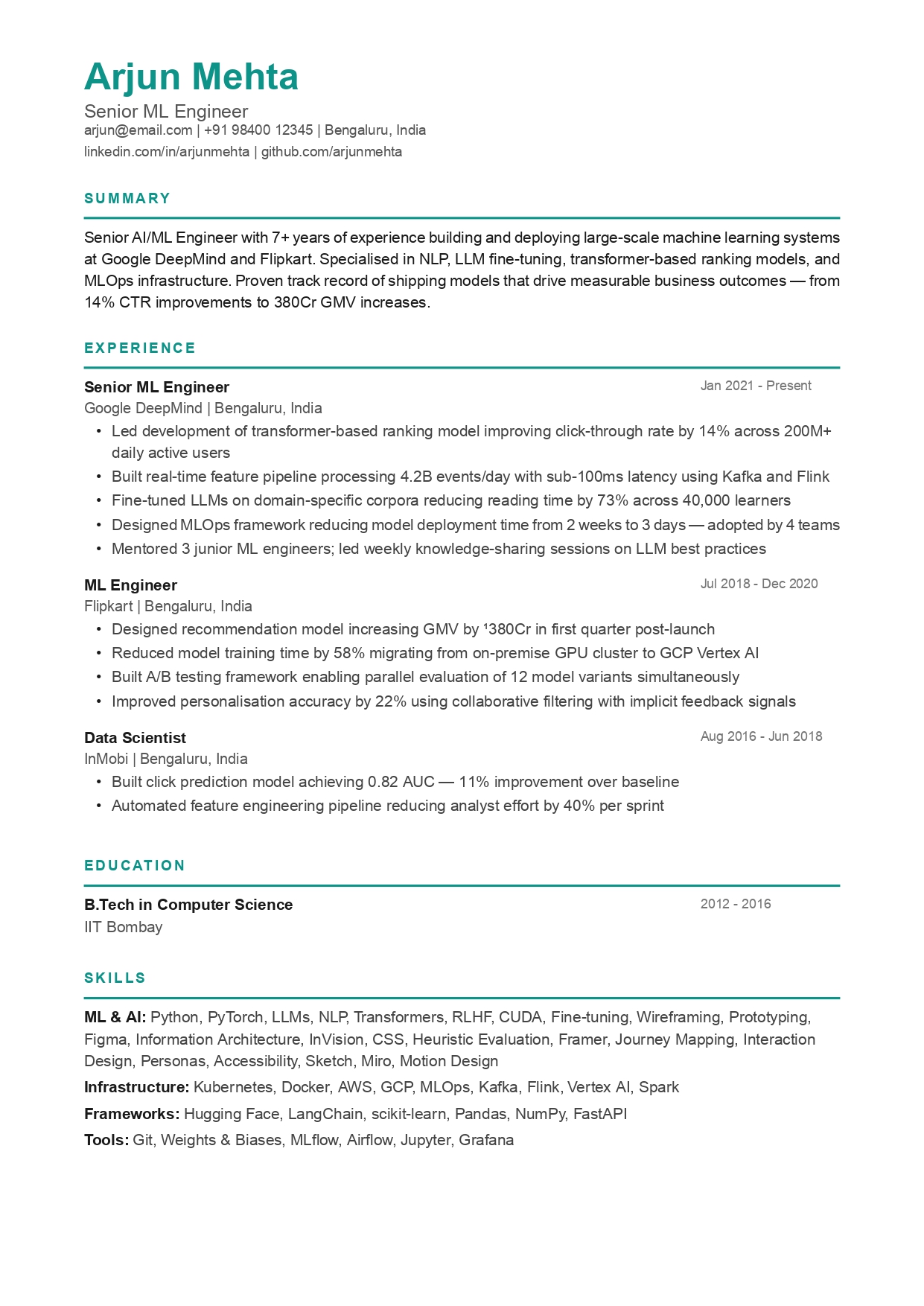
Classic template
The safe bet. Scores 95+ on ATS. Works for every company from startup to FAANG.
Use template
Executive template
Built for twenty years of career on two pages — premium spacing and a summary that leads, on a single ATS-safe column. Free to edit online, or download as Word or PDF.
Use template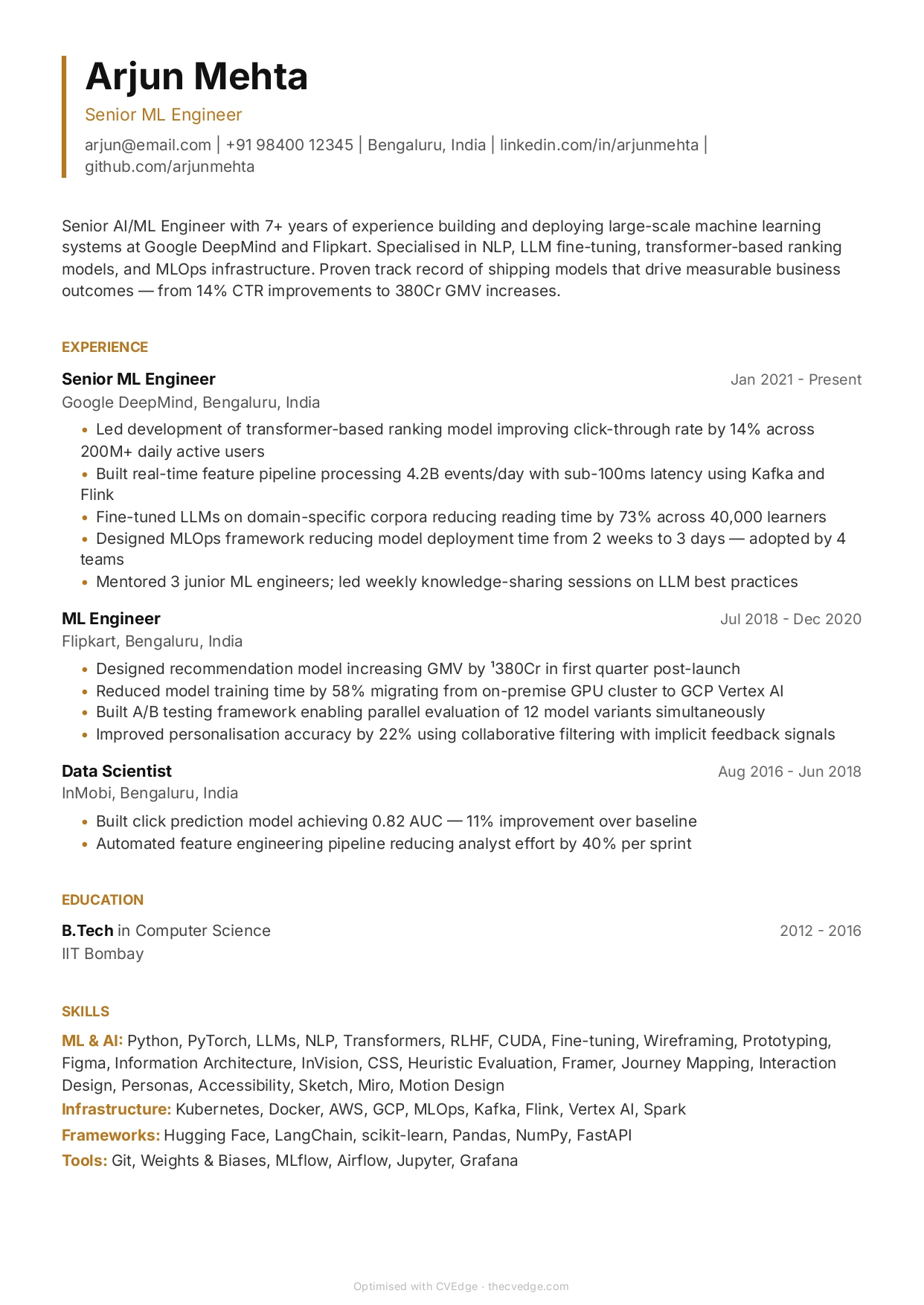
Sharp template
Bold section dividers, modern look. Passes ATS while standing out from generic formats.
Use templateLooking for game designer jobs?
Browse live game designer roles and match your resume against specific job descriptions before applying.
Game Designer professional summary example
Three or four sentences that state your specialisation, your level, and the single result you most want read first.
Game designer with 6 years across two shipped free-to-play titles (12M+ combined installs). Owned the mid-game economy and progression on a live title, lifting D30 retention from 8% to 12% through a reworked reward curve validated across four A/B cohorts. Prototypes in Unity; writes specs engineers can build from without follow-up.
Before and after: game designer resume bullets
Each pair below rewrites a bullet we see constantly on game designer CVs, with the reason the rewrite works for this role specifically.
Designed game mechanics and systems for mobile titles.
Owned the mid-game progression and economy on a live title with 4M MAU, reworking the reward curve to lift D30 retention from 8% to 12% across four A/B-tested iterations.
Why it works: "Designed mechanics" gives no scope or result. Naming the system owned, the player scale, the retention movement and the iteration count shows a designer who tunes with data rather than shipping a first draft.
Created design documents and worked with the development team.
Wrote the specs for 14 shipped systems including a crafting rework built by a 5-engineer team, cutting design-clarification requests to under 2 per feature through worked examples and edge-case tables.
Why it works: Documentation is only valuable if it is buildable. Quantifying clarification requests is an unusual, credible way to show your specs are actually precise — which is the practical skill studios hire designers for.
Conducted playtesting and gathered player feedback.
Ran 30+ moderated playtests and paired them with funnel telemetry, identifying that players quit at a difficulty spike they described as 'boring' rather than hard — reframing the fix from tuning to pacing and cutting tutorial drop-off 24%.
Why it works: The distinction between what players say and what the data shows is the core playtesting skill. This bullet demonstrates it concretely and ties it to a measurable outcome.
Metrics that belong on a game designer resume
Reviewers rank candidates on comparable numbers. These are the ones that carry weight in this role.
What changes by level
The same experience reads differently depending on the level you are targeting. Position your CV for the band you are applying to.
Junior (0–2 yrs)
Designs within an established system. Portfolio should show one shipped or finished project with tuning evidence.
Mid (2–5 yrs)
Owns a system end to end. Portfolio should show a design changed by playtest and telemetry.
Senior (5–8 yrs)
Owns major systems and mentors. Portfolio should show measurable player-behaviour outcomes.
Lead / Principal (8+ yrs)
Sets design direction for a title. Portfolio should show vision, team leadership and commercial results.
What gets game designer CVs screened out
Concept documents for unbuilt games presented as primary work.
No shipped or finished project of any size.
Team credits with no statement of what you personally owned.
No engagement with data — design intuition alone is not sufficient in live-service hiring.
Skills and tools reviewers scan for
Core skills
Tools & platforms
CV sorted — now the interview
Real game designer interview questions and what each round is scored on.
Game Designer resume questions
What does a game design portfolio need to contain?+
Two or three systems shown in depth, not a catalogue of concepts. For each: the design problem and its constraints, your specific contribution if it was a team project, the first version, what playtesting revealed, and what you changed as a result. Include the actual artefacts — a spec, a balance spreadsheet, a progression curve — because studios want to see whether you can specify precisely enough to be built. Shipped work beats unshipped, and a small shipped game beats an elaborate design document for a game that never existed.
Do I need to be able to code or use an engine?+
You do not need to be an engineer, but designers who can prototype in Unity or Unreal — even roughly, with blueprints or simple scripts — iterate faster and are consistently more employable. Being able to build a grey-box version of your own idea removes a dependency and lets you test a mechanic before asking anyone to build it properly. Scripting and data-driven tuning (spreadsheets, config files) are effectively baseline expectations rather than differentiators.
What metrics belong on a game designer's CV?+
Titles shipped and their scale first — platform, player numbers, review scores where flattering. Then design outcomes: retention or session-length change after a system you tuned, conversion or engagement effects of an economy change, difficulty completion rates you moved. "Rebalanced the mid-game economy, lifting D30 retention from 8% to 12%" is strong because retention is the number the whole studio is judged on. Be careful to claim only your contribution — studios verify.
How do I break into game design without shipped titles?+
Ship something small yourself. A finished, tuned game jam entry or a released mod demonstrates more than an unbuilt design document, because it proves you can carry an idea through constraints to completion. Mod communities, jams and small collaborative projects are the conventional routes. Also consider adjacent entry points — QA and live-ops roles inside studios convert to design fairly often, and they give you the playtest and telemetry exposure the discipline runs on.
Build your game designer resume — free
Upload your existing CV or start fresh. Get an ATS score in seconds and fix every issue before you apply.